Getting Started · Tool · 3 min ·
Can you keep training when life gets busy? Plan a minimum week and see what it keeps
Most people who quit training do not quit on purpose. They have one bad week, miss the sessions, feel behind, and the plan quietly dies. The fix is a plan that already knows bad weeks are coming.
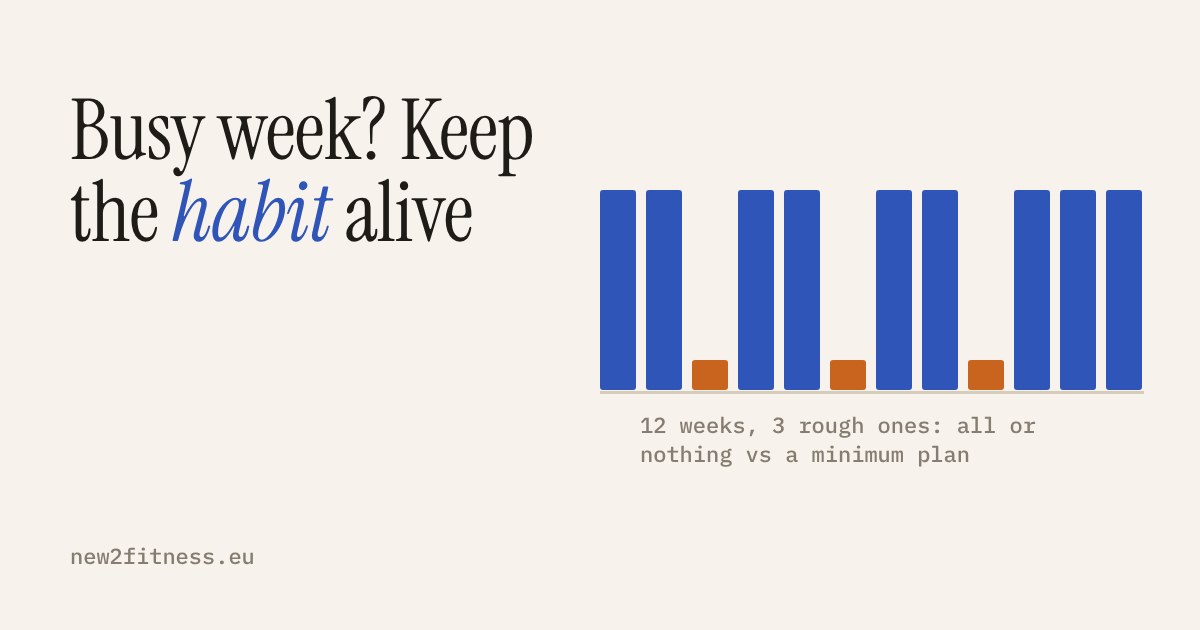
Set your normal week, define a minimum session, then tap the weeks that go wrong. Compare an all-or-nothing plan with a minimum plan, and see how many sessions and minutes each one keeps over twelve weeks.
One missed week is not the problem
Most people who quit training do not quit on purpose. They have a bad week: work runs over, a child gets ill, travel eats the days. They miss the sessions, feel behind, and the plan quietly dies. The fix is not more willpower. It is a plan that already knows bad weeks are coming.
It helps to know how habits actually form. In one widely cited study of people building everyday behaviours, the time until the behaviour felt automatic ranged from roughly 18 to 254 days, and averaged around two months. Skipping a single day did not derail the process. Treat those numbers as a rough guide, not a deadline: harder behaviours and busier lives take longer, and you do not need to feel automatic to keep going.
Plan the bad week before it happens
Decide now what a minimum session is: the smallest workout that still counts. Ten to fifteen minutes is plenty, for example two or three exercises from your normal plan, a few easy sets each. It will not build much on its own. Its job is to keep the routine alive, so that a rough week is a quieter week instead of an empty one.
Two rules keep this honest. First, the minimum is for busy weeks, not sore or ill ones; when you are properly unwell, rest. Second, a minimum session is not a failure. Showing up small is still showing up.
Play with the weeks. Mark two or three as rough and compare the rows. The all-or-nothing plan loses the whole week each time; the minimum plan loses most of the minutes but keeps the weekly rhythm unbroken.
Make the first step obvious
Vague plans ("I'll train more") are easy to drop. Specific ones are easier to follow: pick a day, a time and a trigger. "After I finish work on Monday, I go to the gym" is better than "Monday sometime". Research on these if-then plans suggests they help people follow through, though the boost is modest, so think of it as a small nudge rather than a trick.
It also helps to make the start easy. Pack your bag the night before, lay out your kit, and keep the first exercise simple. The hardest part of most sessions is the first five minutes.
When you do miss a session
Do the next one on schedule. Do not double up to make up for it, and do not skip a week as a penalty. One missed session barely changes your progress, and the plan that survives is the one you actually follow. If you have missed a longer stretch, our guide to missed training explains what you lose and how quickly it comes back.
What to look for in your own plan
- A named minimum. Write it down: which exercises, how many minutes.
- A fixed trigger. A day and a cue, not a mood.
- A rule for bad weeks. Minimum plan for busy, rest for ill.
- Patience. Give it a couple of months before judging whether it feels automatic.
This guide is general information, not medical advice. If you have pain, an injury, a heart or other health condition, or you are pregnant, check with a doctor or physio before changing how you train.