Cardio · Tool · 3 min ·
Is the 10% rule the right way to build up your running? Set your weekly step and see
Is the 10% rule the right way to build up your running? Not always. One study of 486 novice runners found a slow 10% plan and a faster standard plan gave about the same injury rate, while sudden jumps of more than 30% in a week were linked to more injuries.
Set where you are now and how big a step you take each week, and watch twelve weeks of running take shape, with spikes flagged and an easier week built in. Not medical advice.
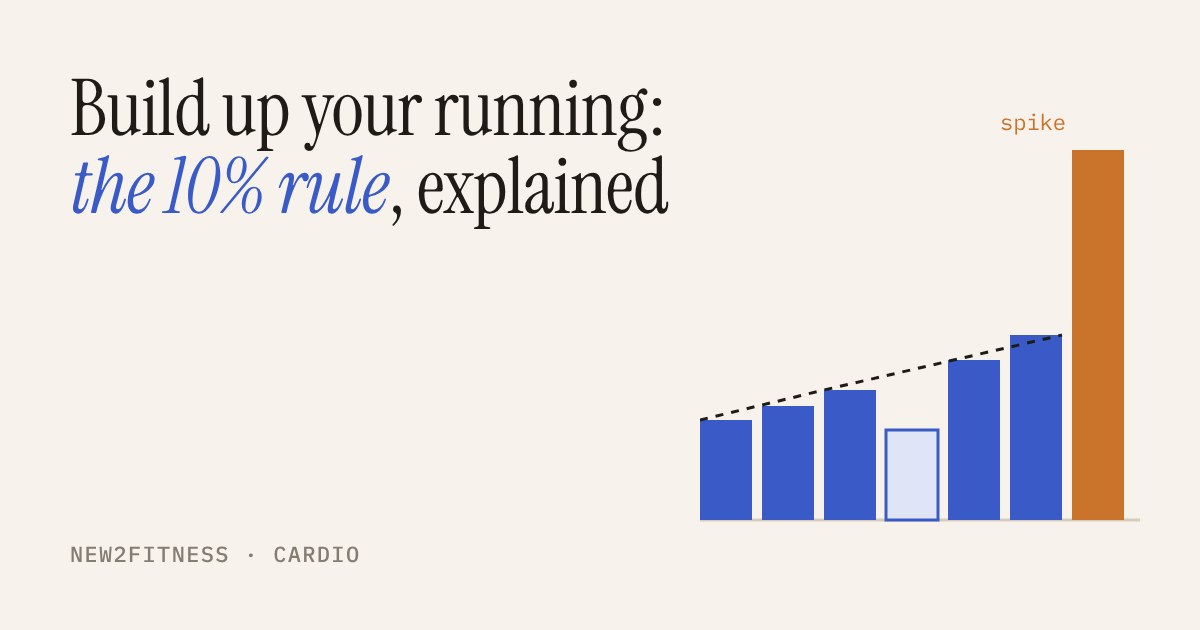
You can run your first few weeks without much thought. The harder question comes after: you can now jog for twenty minutes, so how fast should you add more? Ask around and you will hear the "10% rule": never raise your weekly running by more than a tenth. It sounds precise. It is also shakier than it sounds, and for a beginner it can be the wrong tool altogether.
Where the 10% rule comes from
It is a rule of thumb that passed from coach to coach, not a law found in a lab. When researchers tested it, the result was underwhelming. In a trial of 486 novice runners, one group followed a gentle 13-week plan with roughly 10% steps and another followed a standard 8-week plan to the same goal. Injuries were about the same in both, around one in five. Going slower did not clearly protect anyone.
That does not mean you can ramp up freely. A separate study of novice runners tracked with GPS found that people whose weekly distance jumped by more than about 30% in a single week were more likely to get hurt than people with smaller steps. So there is a sensible zone: steady, modest increases, with no sudden spikes.
Why percentages fail at the start
If you run 20 minutes a week, 10% is two minutes. That is not a plan, it is a rounding error. At low volumes, add a fixed few minutes instead. At higher volumes, a percentage makes more sense, because the same two minutes means almost nothing when you run two hours a week.
Try it below. Set where you are now and how big a step you take each week, and watch what the next twelve weeks look like.
What a good build-up looks like
For a beginner, a simple plan beats a clever one. Add a little to one run, not all of them. Keep most running easy enough to talk in short sentences. Treat any week where life, sleep or work goes badly as a week to hold steady rather than push.
- Add minutes, not miles. Time is easier to track than distance and does not punish you for running slowly.
- Step up for two or three weeks, then ease. A lighter week every third or fourth week gives your legs and tendons a chance to catch up, and many plans do exactly this.
- Hold when it hurts. If a niggle gets worse as you run, or lingers into the next day, do not add more. Check in with a doctor or physio for pain that persists, especially in a joint or a bone.
- Do not make up for a missed week. After a break, restart a little below where you left off rather than where the plan says you should be.
The bigger picture
The 10% rule is not harmful, and it is a decent reminder to avoid big spikes. It is just not a guarantee. Injuries come from many things: sleep, shoes that suit you, hills, speed, previous injuries and plain bad luck. A gentle ramp is one lever among several, and it is the one you can plan in your own diary.
If you are new to running, a run-walk approach with small additions each week is a sensible way in. If you have a medical condition, are pregnant, or have not exercised in years, speak to a doctor before you start building running volume.