Cardio · Explainer · 4 min ·
What is a side stitch? Pick your meal and see why a full stomach makes running hurt
Roughly two in three runners get a stitch at least once a year, and nobody has fully pinned down why. The best-supported pattern is about what is in your stomach when you start: recent meals and sugary drinks are linked with more of them.
Play with a meal, a drink, the gap before your run and your starting pace to see how full your stomach still is, then learn what to try mid-run and when pain is not a stitch.
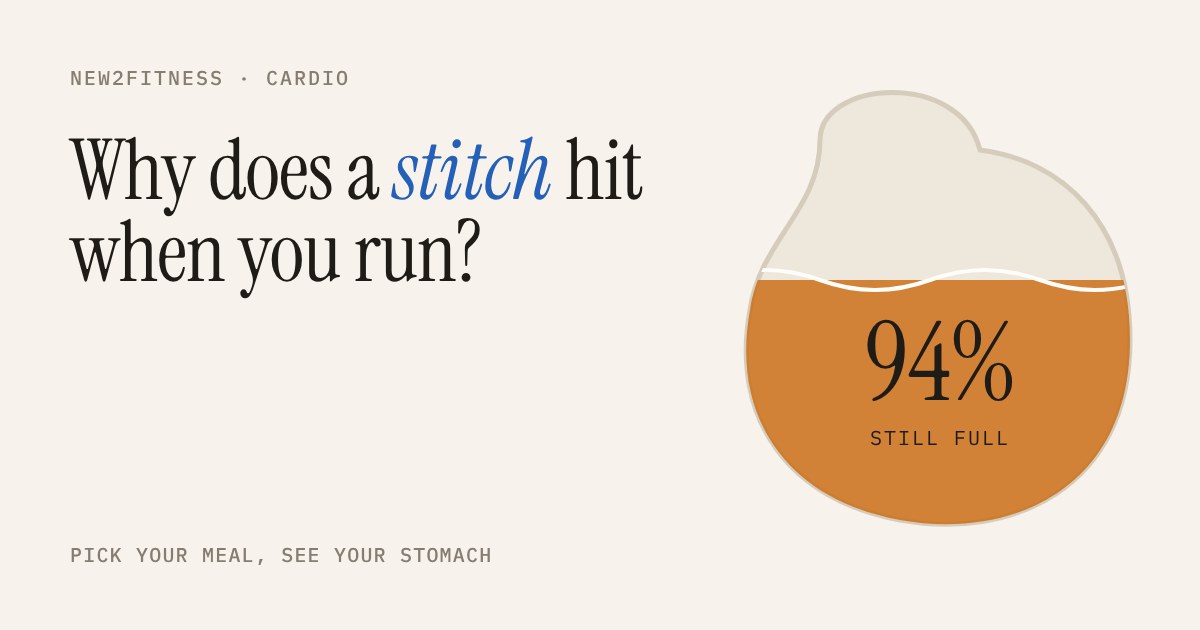
You are ten minutes into a run, feeling good, and then a sharp pain digs in under your ribs on one side. Almost every runner has met it. Its proper name is exercise-related transient abdominal pain, and everyone else calls it a stitch. It is harmless in an otherwise healthy person, it fades, and it is more predictable than it feels.
How common is it, and why do we still argue about it?
Surveys of runners suggest roughly two out of three get at least one stitch in a year. It turns up in running, swimming and horse riding, at every level from school children to elite athletes, and it is reported more often in younger people than in older ones. Anything that jolts the body while the torso twists or stays upright seems to make it more likely.
The honest answer on cause is that nobody has pinned it down. The explanation researchers favour most is irritation of the lining of the abdomen (the membrane that wraps the organs and the inside of the belly wall). When the stomach is stretched and the body bounces or twists, the two layers of that lining may rub, and the lining is full of nerves that report pain. Older ideas, such as the diaphragm not getting enough blood, are poorly supported. Because the cause is not settled, the advice below is a set of sensible things to try, not a cure with proof behind it.
The usual suspects: a full stomach and sugary drinks
The most consistent pattern is about what is in your stomach when you start. Stitches are reported more often after a recent meal, and after sweet, concentrated drinks such as fruit juice or sugary sports drinks. The proposed reasons are that a stretched stomach rubs more, and that very sugary drinks leave the stomach slowly. Those reasons are plausible, not proven, but the practical lesson is cheap to act on: give a meal time to leave your stomach before you run, and sip plain water if you need a drink.
Use the picture below to play with it. It is an illustration of how a stomach empties, not a measurement: real emptying varies from person to person and with what you ate. Pick a meal, a drink and a gap, and see how full the stomach still is when you start.
Breathing, posture and the way you start
Stitches also tend to show up when a run starts fast from cold, or when you breathe shallowly and quickly. Starting at a pace where you could still hold a conversation gives your breathing time to settle. A rounded, slumped upper back has also been linked with more stitches in some research, so running tall with relaxed shoulders is a reasonable habit anyway. Building up your fitness over weeks helps too, because the same pace feels easier and your breathing stays calmer.
If one hits mid-run
Because the cause is uncertain, nothing here is guaranteed, but these are the common things people try, roughly in order of effort:
- Slow down to an easy jog or a walk. Easing off often takes the edge off within a minute or two.
- Breathe in slowly through your nose and out slowly through pursed lips, letting your belly move. Deep, slow breathing is the most common advice.
- Press your fingers into the sore spot while you breathe out.
- Bend gently forward or stretch the arm on the sore side overhead for a few breaths.
- If it will not ease, stop and walk until it fades, then restart slowly.
You may have heard that you should breathe out when a particular foot lands. There is little firm evidence for that, so treat it as a thing you can try, not a rule.
When it is not a stitch
A stitch comes during exercise, eases soon after you stop, and does not bother you at rest. See a doctor if you get pain that continues after you stop, pain in the chest, pain that travels to your shoulder or jaw, pain with feeling faint, vomiting or blood, or a stitch that comes every time you exercise even when you have eaten nothing. This guide is general information, not medical advice.
What to take from this
Finish meals a couple of hours before you run (a small snack needs less), sip plain water instead of sweet drinks, start at a talking pace, and breathe slowly. If a stitch still arrives, it is a nuisance and not a warning sign in a healthy runner. Slow down, breathe out slowly, and carry on when it passes.