Cardio · Explainer · 4 min ·
Cardio before or after lifting? Build your session and see what each order costs
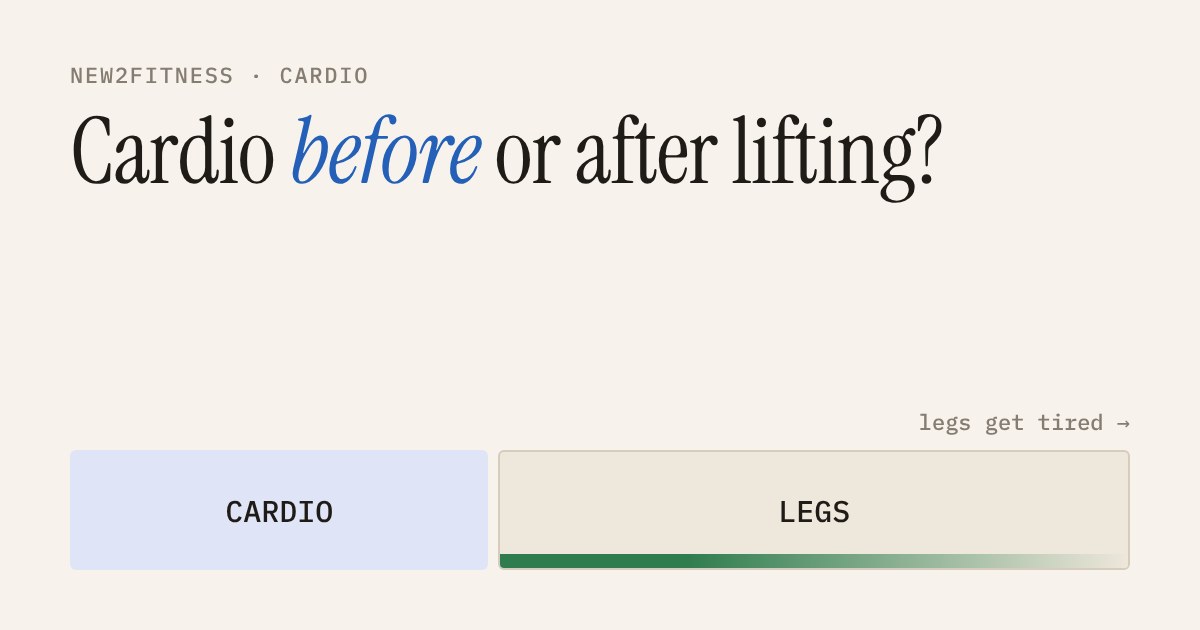
Cardio and lifting often end up in the same session, so which should go first? Build your own session below and see how a hard or long first block leaves your legs tired for the second.
The short answer: put the one you care about most first. A review of ten studies found lifting first gave better lower-body strength gains, with no clear difference in muscle size or fitness. Easy cardio costs your legs almost nothing, so order only matters when the cardio is hard or the lifting is heavy.
You want to lift and you want cardio, and your time is limited, so they end up in the same session. Which one goes first? Gym folklore has strong opinions. The research is calmer than the folklore, and the answer depends on what you care about most.
Short version: the one you care about goes first
Whatever comes second is done on tired muscles and a tired mind. That is the whole idea. Hard running before squats means your legs start the squats already used up, so you do fewer good reps. Heavy squats before a long ride means the ride feels harder than it should. Neither is dangerous. It just means the second half of the session is a bit worse than it could be.
When researchers pooled ten training studies that put both kinds of exercise in one session, mostly in healthy beginners and recreational exercisers, doing the lifting first gave bigger gains in lower-body strength than doing the cardio first. Muscle size, aerobic fitness and body fat showed no clear difference by order. So order is a small lever, not a secret. It matters most for the one thing you most want to get better at.
Why the second half suffers
Muscles don't stop working when a block ends. After a hard run, your legs have less fuel and the muscle fibres have done a lot of work. Your nervous system, the part that tells muscles to contract, is also a bit tired. Squat right after that and you may get fewer reps at the same weight, or the same reps feeling much harder. Over weeks, fewer good reps can mean slower progress for that lift.
The reverse happens too. After a heavy leg session, an easy walk or ride feels fine, but a hard interval session feels much worse than usual. That is why the sliders above separate how long and how hard the cardio is. A gentle 10 minutes on a bike barely touches your legs. Forty minutes of hard running does.
Easy cardio is almost free
If your cardio is easy, where you can still hold a conversation, it takes very little out of your legs. Five to ten minutes of easy cycling or walking before lifting is a perfectly good warm-up. Easy cardio after lifting is a good way to cool down and still count towards your weekly total. If you are curious what "easy" feels like, our guide to the talk test explains it.
The order only starts to matter when the cardio is hard, long, or the lifting is heavy for your legs. Upper-body lifting days are even more relaxed: arms don't care much about the run you did earlier.
The better answer: separate them if you can
Doing cardio and lifting on different days, or at different times of the same day, avoids the problem entirely. Each gets a fresh start. The study of ten trials above only included sessions where the two were done back to back, so it says little about gaps. But the logic is simple: more rest between the two means less tiredness carried over.
If your week only allows combined sessions, that's fine too. Plenty of people get fitter this way. Pick the order that protects your main goal, keep the cardio easy on days with heavy leg work, and keep hard efforts for days when your legs are fresh.
What to look for in your own week
- Your main goal first. If you want to lift more, lift first. If you want to run further, run first.
- Easy cardio is flexible. Warm-up, cool-down, either order. It barely matters.
- Hard cardio and heavy legs shouldn't share a session if you can avoid it, especially in your first months.
- Listen to your body. If your lifts keep stalling on days you did cardio first, swap the order or move the cardio.
This is general information for healthy adults, not medical advice. If you have heart or joint problems, are pregnant, or feel pain or dizziness when you exercise, check with a doctor or physio before changing your training.