Cardio · Explainer · 4 min ·
Is treadmill running easier than outside? Slide your speed and see what the 1% incline fixes
Is a treadmill run easier than the same run outside? The old advice says set the belt to 1% incline to make up for the missing air resistance. That rule comes from a study of trained runners moving faster than most beginners.
Slide your own speed and incline to see how much the air really adds at your pace, and which incline would match it. Then see what an incline can't fix: heat, pacing and the surface under your feet.
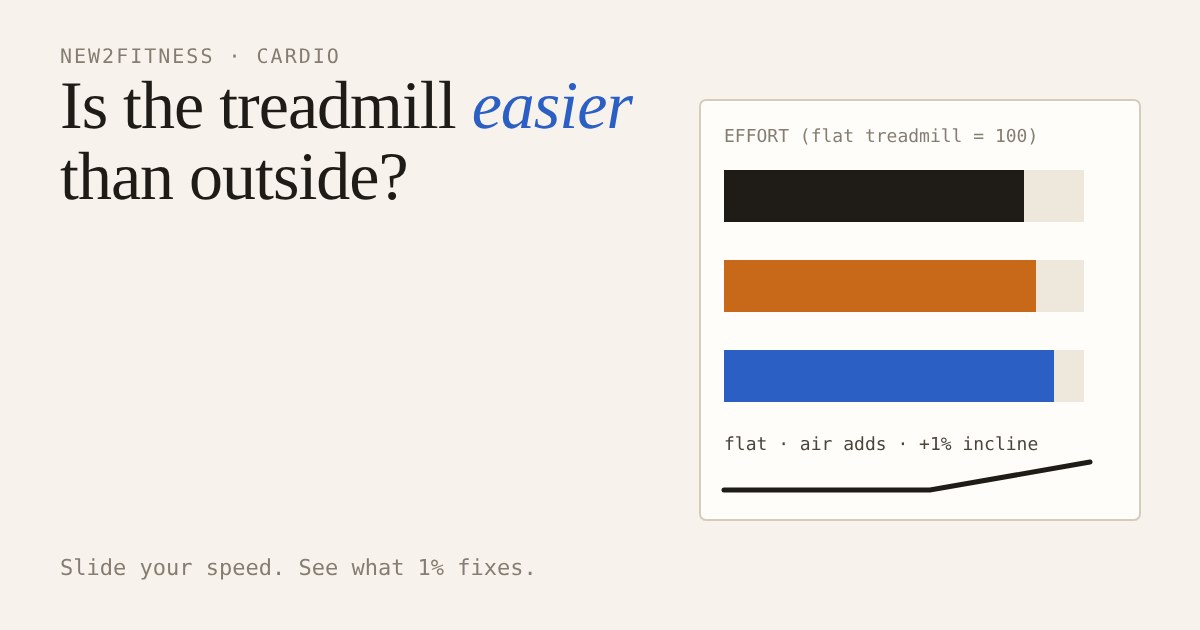
Most beginners meet the treadmill first: it is warm, it is flat, and nobody sees you walk-jog. Then someone says "set it to 1% incline, it's the same as outside" and you wonder whether the treadmill is cheating you out of effort, or just being kind. Here is what is actually going on, and how much of that old rule is left at the speeds you will probably run.
What is different indoors?
Outdoors, you push through air. That air pushes back, and the push grows quickly as you speed up: doubling your speed roughly quadruples the force. On a treadmill the air is still, so that extra cost disappears. In 1996 researchers Jones and Doust measured trained runners at speeds from roughly 10.5 to 18 km/h and found that a 1% incline made treadmill running cost about the same oxygen as running on a level road. That is where the famous "1% rule" comes from.
Two details are worth knowing. The study had nine trained men who were used to treadmills, and the slowest speed tested (about 10.5 km/h) is faster than many beginners run. So the rule is a sound starting point for brisk running, but it was never a law for everyone.
Try it: how much does the air add?
The tool below uses a simple model so you can see the idea. It estimates how much extra effort air resistance adds outdoors at your speed, and how much a treadmill incline adds. Slide the speed to your own easy pace, then try different inclines.
Notice two things. At an easy jog the air adds only a percent or two, so a flat treadmill is already close to outdoors, and a 1% incline makes it a little harder than the road. Only as you get towards a fast pace does 1% become the right match. Many treadmills also show a calorie number that is only a rough estimate, so treat it as a guide, not a measurement.
How the model works
For air, it uses the standard physics for drag: force = half × air density × drag area × speed squared. It assumes a drag area of 0.24 m², a commonly used value for a runner, and that about a quarter of the energy your muscles use turns into movement. For the incline it uses the running energy-cost curve measured by Minetti and colleagues in 2002 (about 3.6 joules per kilogram per metre on the flat). It then compares the two. It is a simplification: real runners differ in size, style and treadmill belt, and the model ignores wind and heat.
What the incline does not fix
- Heat. Moving air cools you outdoors. Indoors you can feel hotter and your heart rate can drift up sooner, so a fan or open window helps.
- Pacing. The belt sets the speed for you. That is handy for steady practice, but it can also hide how hard you are really working, so check your breathing with the talk test.
- The surface. Treadmill belts are usually softer than roads, and some studies find small differences in effort between treadmills of different stiffness.
- Terrain and turns. Real routes have hills, bends and wind that no setting copies exactly.
What to do with this
If you run easy on a treadmill, 0 to 1% is fine; there is no need to chase an exact number. If you are doing faster runs, 1% is a sensible default. If a higher incline feels like hill work, that is exactly what it is, so build it in slowly. Holding the handrails changes how you run, but if you need them to feel safe, use them. Safety comes before matching a number in a study.
This is general information, not medical advice. If you feel chest pain, dizziness or unusual breathlessness, stop and check with a doctor, and speak to one before starting if you have a heart or joint condition. The model is not for walkers on steep inclines, for very heavy or very light runners who want exact numbers, or for outdoor trail running.