Cardio · Explainer · 4 min ·
Why does your heart rate creep up at the same pace? Slide the heat and see cardiac drift
You hold the same pace for an hour, yet your watch shows a higher heart rate than it did at the start. That is cardiac drift, a normal rise caused by heat, sweat and time, not by losing fitness.
Slide the session length, temperature and fluid intake to see how the line climbs at a constant pace, and when it crosses your zone ceiling. Then learn when to trust the number and when to trust your breathing instead.
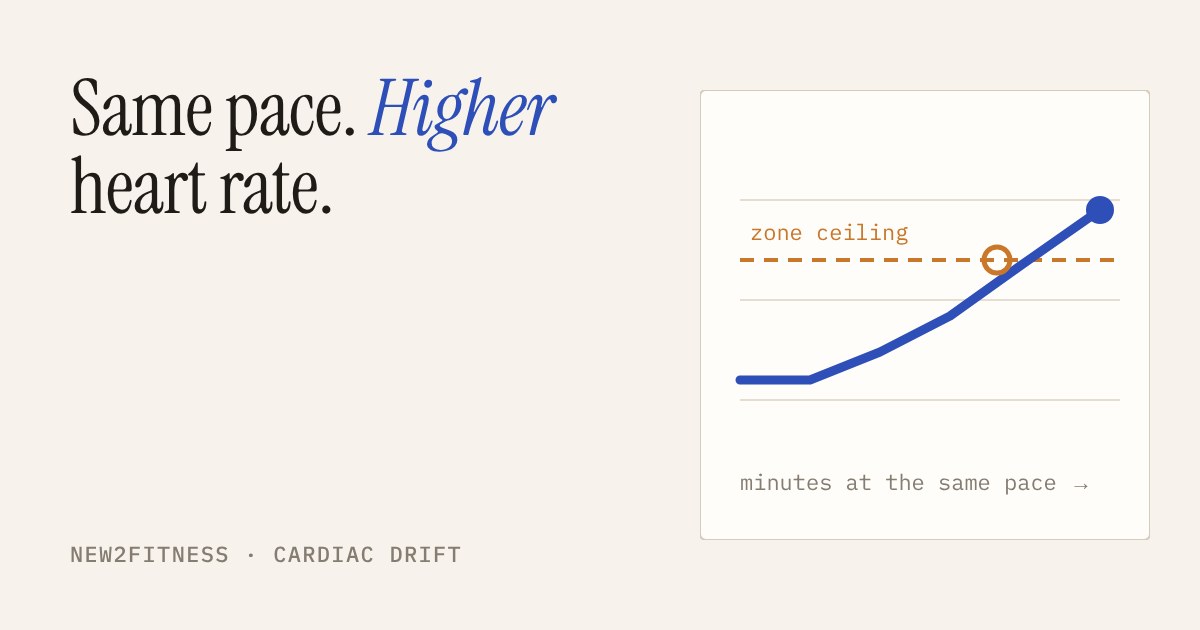
You held the same pace. Why is your heart rate higher?
You head out for a long, easy run or ride. For the first twenty minutes your watch says 140. An hour later it says 152, yet your legs are moving at exactly the same speed and the effort feels much the same. Did you get less fit in the middle of a workout?
No. This is called cardiac drift (also cardiovascular drift): a slow rise in heart rate during long, steady exercise even though the pace has not changed. It is a normal, well-documented response, and knowing about it saves you from two common mistakes: panicking at the number, and slowing down for no reason.
Why the number creeps up
Each heartbeat pushes out a certain amount of blood, called the stroke volume. Your heart rate times your stroke volume is how much blood your body gets per minute. Your muscles need roughly the same amount for the same pace, so if stroke volume slips, heart rate has to rise to make up for it.
Stroke volume slips for a few connected reasons:
- Heat. Exercise warms you up, and your body sends more blood to the skin so heat can escape. Less blood is left circulating for the heart to pump.
- Sweat. Sweating lowers the fluid volume of your blood. A smaller blood volume means a smaller stroke volume.
- Time. It builds slowly. The longer the steady effort, the larger the gap, which is why it shows up late in long sessions rather than in a 20-minute jog.
Heat and humidity make all of this bigger. In one cycling study that is often quoted, riders who drank nothing saw their heart rate climb about 10% over the session, against about 5% when they drank enough to match their sweat. Run-length examples are similar: a few percent in cool weather, and up to roughly 15% in a long, hot one.
What to do when it happens
Judge by effort, not only the number. If your breathing is still easy and you can still talk in full sentences, the higher reading is the drift, not a problem. If your breathing gets harder and the talk test starts to fail as well, that is real extra effort, so ease off.
Don't chase the zone. Slowing down to force the number back under your ceiling can turn an easy run into a shuffle. On long days, use heart rate for the first stretch and let perceived effort take over later.
Drink to thirst, and a bit more in the heat. Fluids that roughly match your sweat keep the drift smaller. Food first for fuel, and for sessions under an hour, plain water is enough for most people.
Use it as a yardstick. Run the same route at the same easy pace every few weeks and compare your heart rate in the first half with the second half. If the gap shrinks over a couple of months, your aerobic base is improving.
Don't blame fitness loss. A higher heart rate late in a session does not mean you are getting worse. It means your heart is beating faster while pumping a little less per beat.
Who this isn't for
Drift explains a gradual, modest rise at a steady pace. It does not explain a very high or erratic reading, a sudden jump, or a reading that doesn't match how you feel. A wrist sensor can also simply be wrong, which a chest strap helps rule out. If you ever feel dizzy, faint, chest pain, or unusually breathless, stop and check with a doctor. The same goes if you have a heart or blood-pressure condition or take medication that changes your heart rate.
The short version
- Heart rate rising at a steady pace is normal, and it grows with time, heat and unreplaced sweat.
- Trust breathing and the talk test as much as the watch on long efforts.
- Don't slow down just to hit a number; do ease off if effort itself feels harder.
- Same route, same pace, every few weeks: a smaller drift is a sign of progress.