Nutrition · Explainer · 4 min ·
Do you need to combine plant proteins at the same meal? Tap your day together and see the weak spots cancel
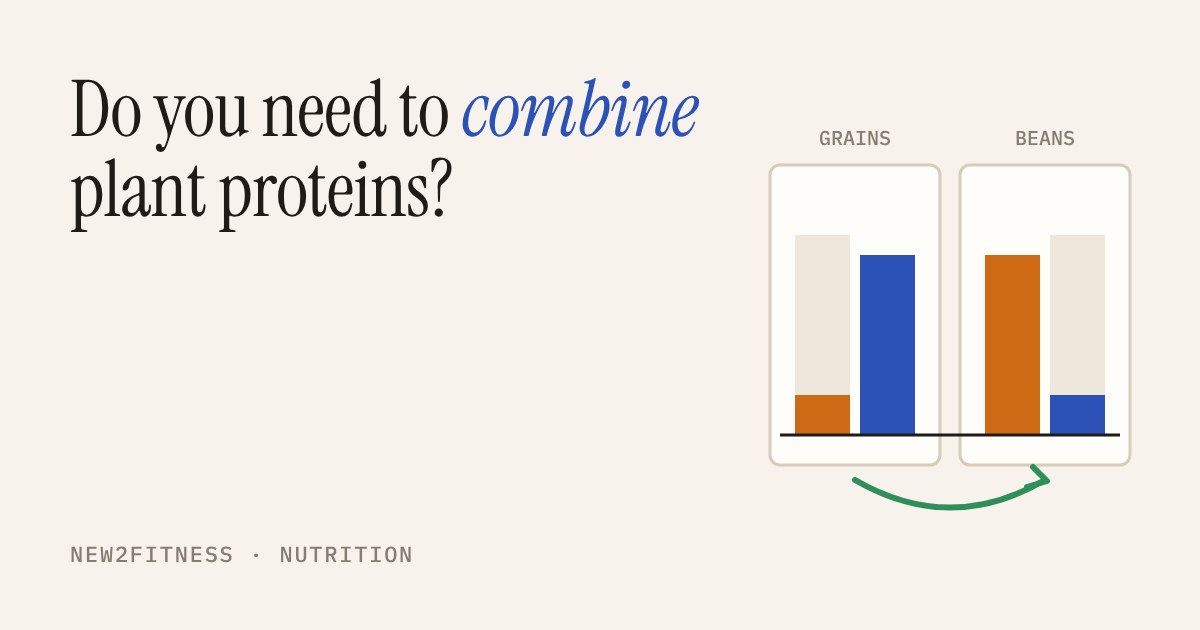
Is a plant protein really "incomplete"? Most plant foods have all nine essential amino acids, just a little low in one: lysine in grains and nuts, sulphur amino acids in beans and lentils.
Tap foods into your day and see where your protein comes from, how the weak spots cancel out, and why you don't need to pair them at the same meal. Total protein and variety matter far more.
You may have heard that plant proteins are "incomplete" and that you must pair rice with beans at the same meal or lose out. It is one of the most repeated food rules around, and it is mostly out of date. Here is what it gets right, what it gets wrong, and how to check your own day in a minute.
What "incomplete" really means
Protein is built from 20 amino acids. Your body can make 11 of them and has to get the other nine from food. Those nine are called essential. A food is called "complete" when it has all nine in useful amounts, which is true of eggs, dairy, meat and fish, and also of soy and quinoa.
Most other plant foods contain all nine too. They are just thin on one or two. Grains and nuts run low in lysine. Beans, lentils and peas run low in the sulphur amino acids (methionine and cysteine). "Incomplete" means "has a weak spot", not "is missing something".
The useful part is that the weak spots are different. Lysine is where grains are short and legumes are strong; sulphur amino acids are where legumes are short and grains are fine. Put them in the same day and each covers the other.
Where the "same meal" rule came from
The idea of pairing foods at every meal was popularised in the 1970s by the book Diet for a Small Planet. Its author later said it was much easier than she had first thought, and major dietetic bodies now say that complementary proteins do not need to be eaten at the same meal. Your body keeps a pool of amino acids, so what matters is the pattern across the day.
You can see that in the tool above: try the grain-only and bean-only days, then the mixed one. No meal is planned. The day is simply varied.
What it means for building muscle
Reviews of training studies generally find that people gain strength and muscle on well-planned plant-based eating in much the same way as on diets with animal protein, as long as the total protein is high enough. Total protein is the big lever. A common target for people lifting weights is about 1.6 g per kg of body weight a day, and up to around 2 g per kg is fine.
There is one fair caveat. Plant proteins are digested a little less completely than animal ones, and some are lower in leucine, the amino acid that most strongly signals muscle building. Many dietitians suggest aiming for the middle or upper part of the range if most of your protein is from plants. Soy, pea and a mix of sources all work well. Protein powder is optional; see Do you need protein powder? to check your gap first.
Easy ways to make a plant-leaning day work
- Eat at least one legume or soy food most days. Lentils, beans, chickpeas, tofu, tempeh, edamame or soy milk bring lots of lysine.
- Keep some grains, nuts or seeds in the mix. They bring the sulphur amino acids and add up quickly in oats, bread and rice.
- Count total protein first. Variety fixes the weak spots; quantity decides whether you are eating enough.
- Don't force it. If you eat eggs or dairy, they are balanced and fill any gap on their own.
Who should check with a professional
This guide is general information, not medical advice. If you eat no animal products at all, you need a reliable source of vitamin B12 (a fortified food or supplement), and iron, iodine and calcium deserve a look too. If you are pregnant, a teenager, an older adult, managing a health condition or have a history of disordered eating, talk to a doctor or a registered dietitian before changing how you eat.