Nutrition · Explainer · 3 min ·
Do you need to eat more to build muscle? Slide your surplus and see what it does to your weight
Muscle needs training and food, but more food is not always more muscle. Slide your surplus above maintenance and see what it means for your weekly weight gain, compared with the range researchers suggest.
You'll get a starting estimate of your maintenance calories and see when extra food stops helping and starts turning into fat.
"Eat big to get big" is old gym advice, and it's half right. Muscle is built from training plus food, and your body does need spare energy to build new tissue. But more food is not always more muscle. Past a point, the extra just becomes body fat. So the useful question is not "should I eat more?" but "how much more, if any?"
Maintenance is your starting line
Maintenance is the number of calories you eat on an average day while your weight stays flat. A surplus is eating a bit above it, a deficit a bit below. Nobody knows their maintenance exactly. Online calculators give an estimate, and the best check is your own scale: eat steadily for two or three weeks, weigh yourself at the same time each morning, and see whether the weekly average moves.
The estimate in the tool below uses the Mifflin-St Jeor equation, which is: 10 × weight (kg) + 6.25 × height (cm) − 5 × age + 5 for men, or − 161 for women. That gives your resting burn, which is then multiplied by an activity factor. Treat the result as a starting guess that can be a few hundred calories off in either direction.
What the research suggests
A 2019 review of nutrition for bodybuilders in the off-season suggested a surplus of roughly 10–20% above maintenance, which works out to gaining about 0.25–0.5% of your body weight per week. For someone weighing 75 kg, that is around 0.2–0.4 kg a week. The same review said more experienced lifters should aim for the lower end. That makes sense: the longer you've trained, the slower muscle grows, so the less spare energy it can use.
Notice what that review is about: people competing in bodybuilding. You don't need to copy them. Many beginners do fine at the low end of the range, and a first-timer can often gain some muscle while eating close to maintenance, because everything about training is new to the body.
Why more isn't better
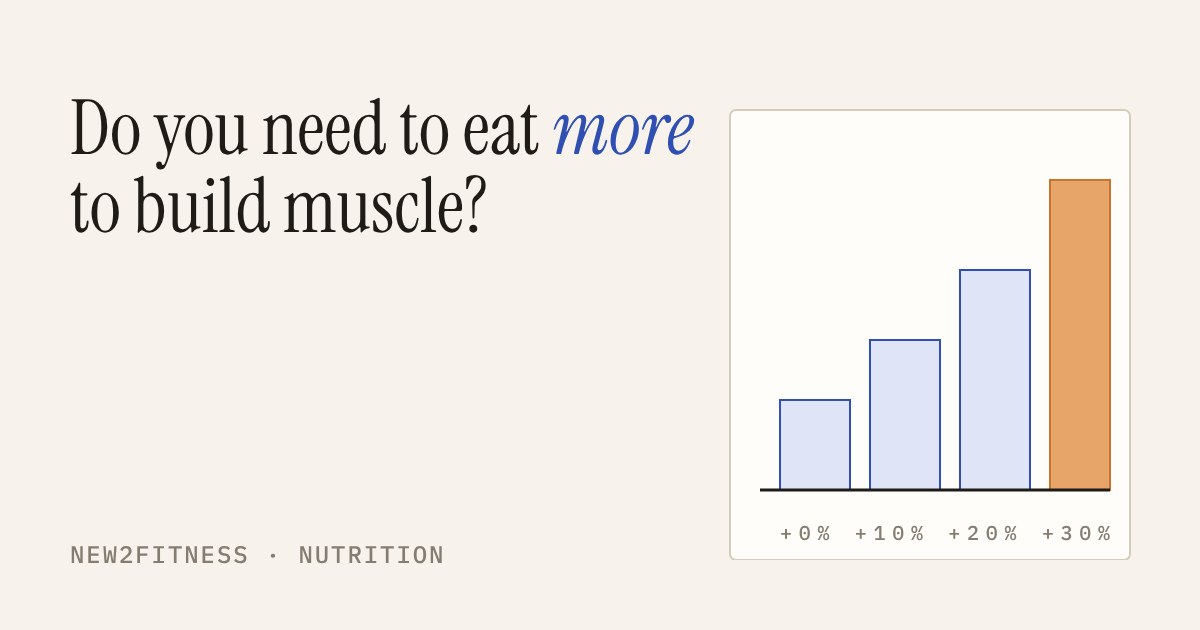
Drag the slider to +30% and the scale will climb quickly. But the body can only build muscle at a limited speed, and in your first year that speed is already the fastest you'll ever see. Energy beyond what it can use is stored as fat. Eating more won't make muscle grow faster; it just changes what the extra weight is made of.
Who this is not for
This is a general guide for healthy adults. If you are under 18, pregnant, have a medical condition, or have ever had a difficult relationship with food or weighing yourself, check with a doctor or a registered dietitian before changing how much you eat. If tracking numbers makes you anxious, skip it and just eat regular, filling meals.
A simple way to use this
Start with your estimated maintenance, add a small surplus, and keep it steady for three or four weeks. Check the average of your weekly weigh-ins. If your weight isn't moving, add a little more food. If it's climbing faster than the range, take a little off. Pair it with progressive training and a reasonable amount of protein, and keep food first: meals made from whole foods do most of the work.