Nutrition · Explainer · 4 min ·
How do you read a nutrition label? Slide your portion and see what the numbers really mean
Every pack has two columns of numbers: per 100 g and per serving. They answer different questions, and mixing them up is how labels get misread.
Pick an example product, drag the portion and watch both columns change. See why the serving is the maker's choice, where the calorie number comes from, and what a "high protein" claim really measures.
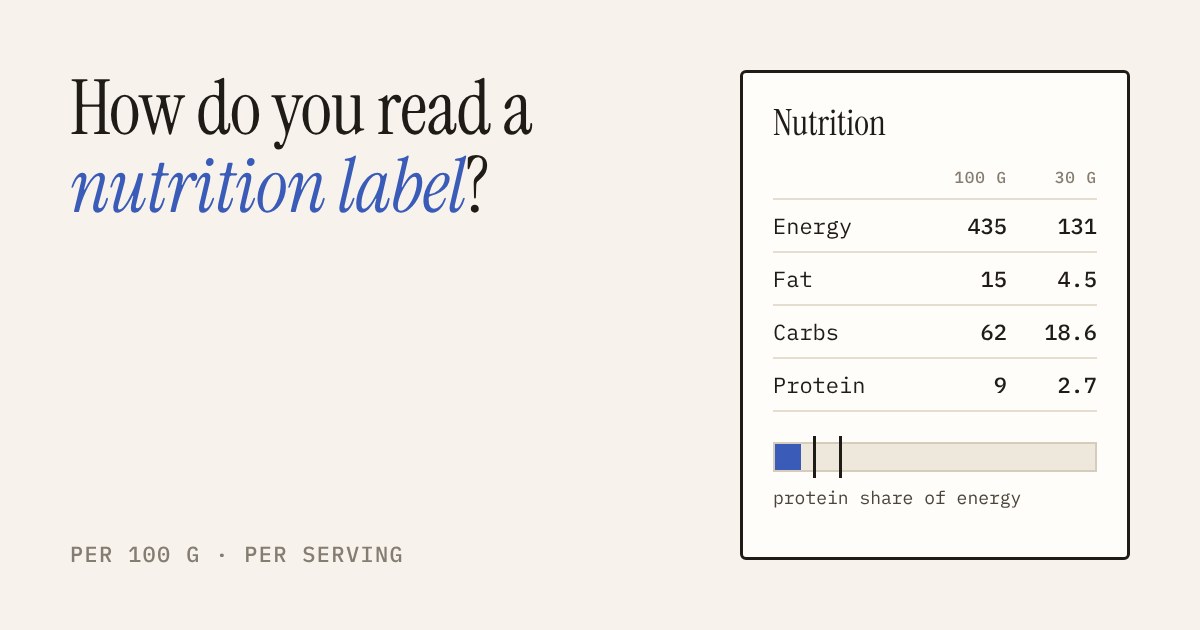
Turn a pack over and you find a table with two columns of numbers: one "per 100 g" and one "per serving". They look like they say the same thing. They don't, and mixing them up is the most common way people end up misreading a label. This guide shows what each column is for and lets you drag the portion to watch the numbers change.
One column for comparing, one for eating
In the EU the numbers that have to be on the label are given per 100 g (or per 100 ml for drinks). Per-portion numbers are an extra the maker may add. The "per 100 g" column exists so you can compare two products fairly: a 60 g bar and a 400 g bag of granola are not the same size, but 100 g of each is.
The "per serving" column answers a different question: what is in the amount I actually eat? That is only useful if the serving matches your real portion. And the serving size is chosen by the maker. A small serving makes the numbers look smaller, which is why a bag of granola can quote the calories for a spoonful or two.
The serving is the maker's choice
Pick granola and press "Whole pack". Nothing about the food changed, but the calories in the right-hand column jump from a small number to more than a thousand. The label was never wrong; the serving was just small. Before trusting any per-serving number, ask yourself whether it is the amount you will really eat. If not, scale the per-100 g numbers instead: multiply by your grams and divide by 100.
Where the calories number comes from
The energy figure is not measured by burning food. It is calculated from the grams of each nutrient using fixed factors set in EU rules: protein 4 kcal per gram, carbohydrate 4, fat 9, and fibre 2. Alcohol, where there is any, is 7. That is why fat packs the most energy for its weight, and why two products with the same weight can differ a lot. The factors are averages, so treat the result as a good estimate, not a lab reading.
What "high protein" actually means
A protein claim on the front of a pack is about the share of energy, not the grams. In the EU, "source of protein" needs at least 12% of the energy to come from protein, and "high protein" needs at least 20%. Watch the bar in the figure above: it is nearly the same for any portion of the same food. That is the point. A granola with a few grams of protein per serving does not become high protein by eating more of it.
The same idea applies to sugar claims. "Low sugars" means no more than 5 g of sugars per 100 g for solid foods, and "sugars-free" means no more than 0.5 g per 100 g. Again, per 100 g, which makes these claims comparable between products. "No added sugars" is different: it can still contain sugars that occur naturally, such as in fruit or milk.
What to check on any label
- Compare with per 100 g. Use this column to compare two products, and the per-serving column only to see what the maker had in mind.
- Check the serving against your plate. If you eat three times the stated serving, multiply everything by three.
- Look at protein as a share, not just grams. Grams per serving depend on the portion; the share of energy tells you what the food is made of.
- Read the ingredients list for what the table can't show, such as the main ingredient and anything you need to avoid.
Labels are a tool for understanding food, not a score you have to win. Most people don't need to read every number on every pack. If you have a medical condition, an allergy, or a diet set by a doctor or dietitian, follow their advice over a general guide like this one.