Getting Started · Tool · 4 min ·
Gym or home: where should a beginner start? Slide your trip and see which way you lean
Gym or home: where should a beginner start? Both build strength and muscle in the first months, so the better question is which one you will actually walk into three times a week.
Slide your trip time, pick how often you train and tap what is true for you. The tool shows what the trip really costs in hours and which way your answers lean, as a nudge rather than a verdict.
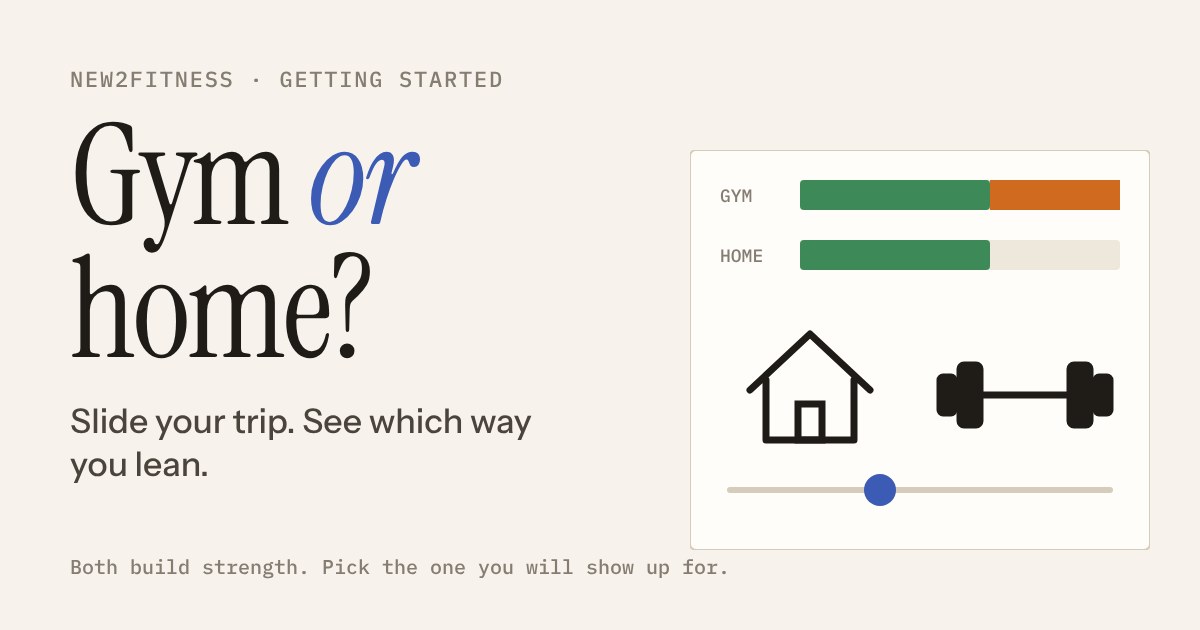
Start at the gym or at home?
Both work. A beginner can get stronger and build muscle in either place, so the better question is which one you will actually walk into three times a week. The best place to start is the one with the least in your way.
That sounds like a cop-out, so here is the reasoning, and then a small tool that shows what each choice asks of you.
What the weights have to do with it
Muscles respond to effort, not to the building. A 2017 meta-analysis of low-load and high-load training (Schoenfeld and colleagues) found that muscle growth was similar whether people lifted lighter or heavier weights, as long as the sets were taken close to failure. Heavier loads did give bigger gains in maximal strength, which is why a barbell matters later. In your first months, though, you are mostly learning the movements, and that is possible with bodyweight, bands and a pair of dumbbells.
So the choice is not "real training" against "fake training". It is a choice between two sets of trade-offs.
What a gym gives you
- Range of weights. You can add a small amount every week for years without buying anything.
- Machines and barbells. Machines guide the movement, which many beginners find easier to learn. Barbells let strength keep climbing.
- People around. Staff, other lifters and a routine of "going somewhere" help some people a lot.
What home gives you
- No trip. Nothing to pack, no weather, no queue for the one bench.
- Privacy. You can be clumsy for a month without anyone watching.
- Low cost to try. A mat, a band and one pair of dumbbells is a real start, and you can swap them later.
The cost nobody counts: the trip
A gym 20 minutes away, visited three times a week, costs about two hours of travel every week. That is not a reason to skip the gym, but it is a real price, and it is paid on the days you are already tired. The evidence on distance and attendance is thin: one study of 796 adults in a supervised programme found no clear link between how far they lived and how often they came, though it came from a single site with a self-selected group. So treat distance as a thing to check about yourself, not as a rule.
A simple test: picture a dark, wet Tuesday evening. Which option do you see yourself actually doing?
You can start in one and move to the other
This is not a one-time decision. A common path is to start at home for the first four to eight weeks, learn squats, hinges, pushes and rows with light weights, then add a gym once you want heavier loads. Another is to join a gym, use the machines first and add a home routine for busy weeks. Both are fine.
Whichever you pick, keep the plan small and the first week easy. If you have pain, an injury, a heart or blood pressure condition, or you are pregnant, check with a doctor or physio before you start, whatever the venue.
What to look for
- At a gym: a trip you can keep up, free weights and machines you can use without waiting, and a trial week or an easy way to leave.
- At home: a clear patch of floor, a way to go heavier over time (adjustable dumbbells or bands), and a plan so the first session does not depend on motivation.
- Either way: a start time you can repeat, and sessions short enough that you will not dread them.