Getting Started · Tool · 4 min ·
What weight should you start with? Do one trial set and find your first working weight
Picking your first weight is guesswork until you test it. Do one trial set with a weight you guess, say how many reps you did and how many more you could have done, and this tool turns that into a start weight for the exercise.
You will see why beginners should aim for about 8 to 12 clean reps with a few left in the tank, how the estimate works, and why your own "reps left" guess is probably too low.
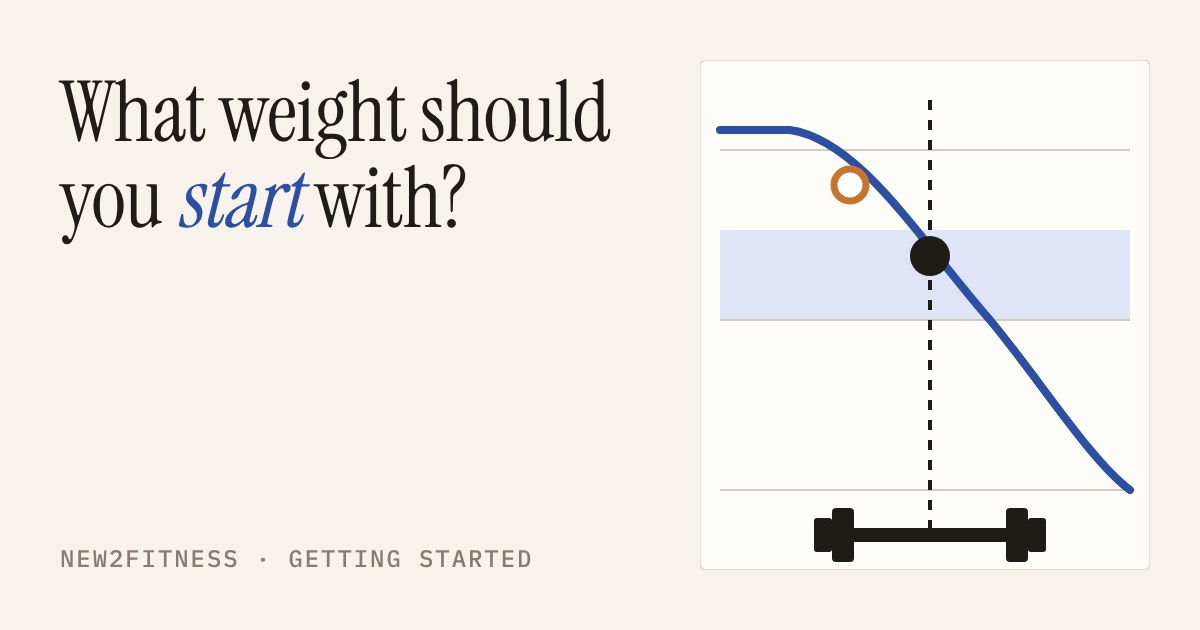
The hardest weight to choose is the first one. Too light and you wonder if you are wasting your time. Too heavy and your form falls apart by rep four. There is a simple way out: do one trial set with a weight you guess, then let the numbers tell you where to start.
Why the first weight should feel easy
For beginners, the standard advice is a load you can lift about 8 to 12 times per set. That is the range the American College of Sports Medicine's position statement on resistance training gives for novices. The weight that lets you reach that range is not a number you can look up. It depends on the exercise, your body and how you move today.
The first few weeks are mostly about learning the movement. Your nervous system gets better at the pattern long before your muscles change much, so a weight that leaves a few reps in the tank teaches you just as well as a hard one. Starting light costs you almost nothing. Starting too heavy costs you good reps, and it makes the next session something to dread.
How the estimate works
Strength and reps trade off in a steady way: the lighter the weight, the more reps you can do. A common rule of thumb, the Epley formula, turns one set into an estimated one-rep max: max ≈ weight × (1 + reps ÷ 30). The "reps" in that formula are the reps you did plus the ones you could still have done.
The tool then picks a weight where you would reach about 14 reps at the limit. That means 10 reps with roughly 4 left, a gentle start inside the 8 to 12 range. It rounds down to a weight you can actually load. The formula is a rough guide, and it is most reliable for sets under about 15 reps. It gets you close, not exact.
How to do the trial set
- Warm up first. Do a few easy reps of the same movement with a lighter weight.
- Guess low. Pick a weight you are fairly sure is light. A set of 10 to 12 is ideal.
- Stop before it gets ugly. Do not push to failure. Stop when the reps start to slow down or your form wobbles, then ask yourself how many clean reps you had left.
- Use safe equipment. Machines and dumbbells are the easiest places to try this. For a barbell squat or bench press, use safety bars or a spotter.
- Test each exercise on its own. Your legs and your arms start at very different weights.
Be honest about the "reps left" guess
This is the weak spot. In one study of 141 gym members, people predicted how many reps they could do on machine exercises before reaching failure. Almost everyone guessed too few. The least experienced lifters were off by around 4 to 5 reps, and even experienced ones were off by 1 to 2. In plain words: when you feel you have nothing left, you often have more.
That is why the tool aims for a start that feels easy rather than one that squeezes out the most. If you are unsure, nudge the "reps left" slider up by a couple, or pick the lower step. You will find your real level within two or three sessions anyway.
What to do next
Use your start weight for the first session of that exercise. If the last set felt easy and your form stayed clean, go up one step next time. If the reps got shaky, drop one step. After that, a simple rule for going up takes over, like adding weight once you hit the top of your rep range on every set.
The number is not a verdict on you. Everyone starts somewhere, and the weight you begin with matters far less than showing up for the next four weeks.
Who this isn't for
This is a starting guess for healthy adults trying a new gym exercise. If you have pain, an injury, a heart or blood-pressure condition, or you are pregnant, check with your doctor or a physio before you pick up weights, and let them set the starting point. Stop any set that causes sharp pain, and never lift alone with a load you cannot put down safely.