Getting Started · Tool · 4 min ·
What does 3 × 8–10 @ RPE 8 mean? Build a workout line and see it in plain English
Workout plans are written in shorthand: 3 × 8–10 @ RPE 8, tempo 3-1-1-0, rest 90s. It looks like code, but it is only six pieces: sets and reps, a rep range, an effort score, a tempo, a rest time and a superset label.
Build a line with the tool, or tap an example, and see the shorthand turn into plain English next to a rough time for that line. Also covers AMRAP, EMOM and "per side". A translator, not a programme.
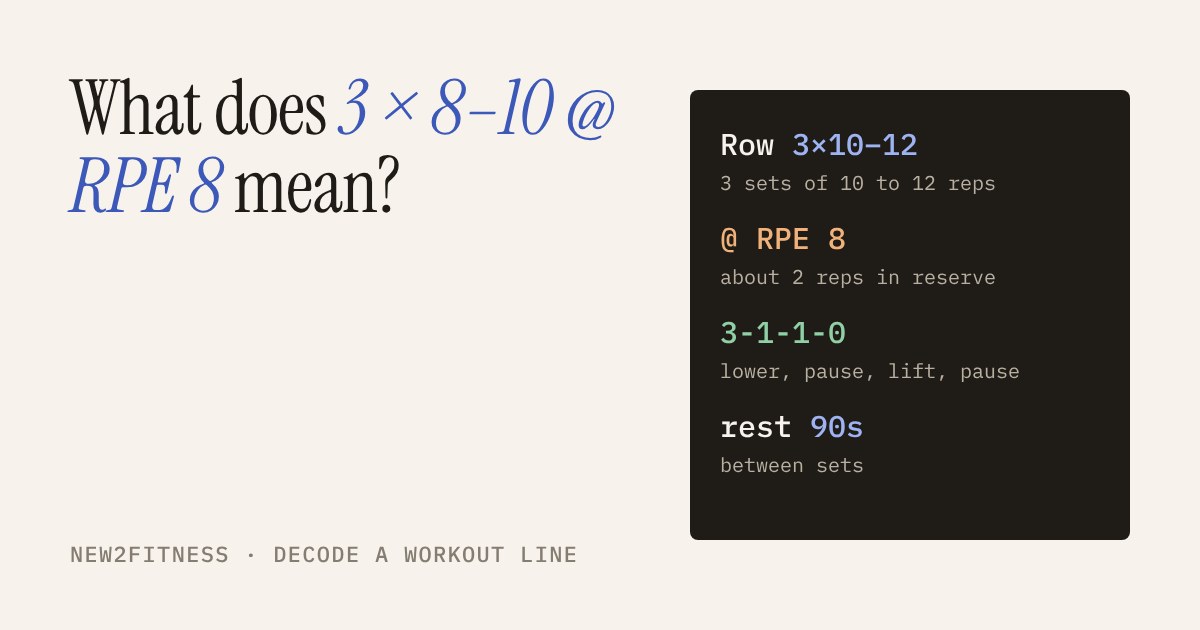
What does 3 × 8–10 @ RPE 8 actually mean?
Most beginner plans, whether from a coach, a gym app or a magazine, are written in shorthand. A line like Row 3 × 10–12 @ RPE 8, tempo 3-1-1-0, rest 90s is easy for the person who wrote it and a puzzle for everyone else. The good news is that there are only about six pieces, and they always mean the same thing.
Build a line below, or tap one of the examples. The shorthand and the plain-English version update together, and you also see roughly how long that line takes.
The six pieces, in plain words
| Written | It means |
|---|---|
3 × 8 | Three sets of eight reps. Sets first, reps second. |
3 × 8–12 | A rep range. Use a weight where you reach at least the bottom number on every set. |
@ RPE 8 | How hard: roughly two clean reps left when you stop. |
3-1-1-0 | Tempo in seconds: lower, pause at the bottom, lift, pause at the top. |
rest 90s | How long to wait between sets. |
A1 / A2 | Two exercises done back to back, then a rest. |
The two that trip people up
Reps in reserve and RPE are the same idea from opposite ends. Reps in reserve counts how many clean reps you had left; RPE counts how hard the set was out of 10. In the usual version of the scale, 10 minus your RPE is the reps you had left, so RPE 8 is about two in reserve. It is a judgement, not a measurement, and beginners tend to guess too easy. That is fine. Your guesses get closer after a few weeks of practice.
A rep range is a rule for when to add weight. If a plan says 8–12, start with a weight that lets you do 8 on every set. Each session, try to add a rep or two. When you hit 12 on every set, add a small amount of weight and drop back toward 8. It is slower than adding weight every session, and much easier to keep going.
Other bits of shorthand you may meet
AMRAP means as many reps as possible, with good form, usually in one set or a time limit. EMOM means every minute on the minute: start a set at the top of each minute and rest for whatever is left. Per side means do the reps on each arm or leg separately, so the line takes twice as long as it looks. A percentage such as 70% means 70% of your one-rep max, the heaviest weight you could lift once, which is why beginners are usually better off with a reps-in-reserve target. A deload is a planned easier week.
What this is for, and what it isn't
This is a translator, not a programme. It cannot tell you which exercises or how many sets suit you, and the time estimate is a rough guide. If a line asks for more than you can do today, do fewer reps or less weight; a plan is a suggestion you adjust, not a test you pass. If you have pain, an injury, a heart or blood pressure condition, or you are pregnant, check with a doctor or physio before following a plan, and stop any set that hurts in a way that feels wrong.
The practical habit: when a plan hands you a line you cannot read, decode it with these six pieces before you start, and write what it means in your own words next to it in your notes. Next time it will take a second.