Wearables · Explainer · 4 min ·
What does the HRV on your watch mean? Slide the noise and see why one night tells you so little
Your watch gives you an HRV number and a readiness score every morning. It looks precise, but one night is mostly noise.
Slide the night-to-night noise and the real change in your last week to see why the seven-night average against your own normal range is the only reading worth acting on, and what the score is and isn't telling you.
Many watches now give you a morning number built on heart rate variability, often called HRV, and a colour or score such as "readiness" or "recovery" that says how hard to train. It looks precise. Here is what it actually measures, why one night means very little, and the one way of reading it that is worth your time.
What HRV actually is
Your heart does not beat like a metronome. The gap between one beat and the next changes a little every time, by tens of milliseconds. HRV is a summary of how much those gaps change. Most watches report a measure called RMSSD, and they usually take it while you sleep, when you are still and the signal is cleanest.
A higher number is not simply "better". HRV differs a lot from person to person, and it tends to fall with age. Someone whose normal is 35 is not less fit than someone whose normal is 80. That is why comparing your number with a friend's, or with an "average" on a chart, tells you almost nothing.
What moves it
Things that stress the body can push your number down for a night or two: a short or broken night's sleep, alcohol, a hard session, a fever or a cold, a heavy week at work. Rest, regular sleep and easier days tend to let it settle back. The effect of any single cause is small compared with the random noise from night to night, which is the whole problem with reading one morning in isolation.
Why one reading is a poor guide
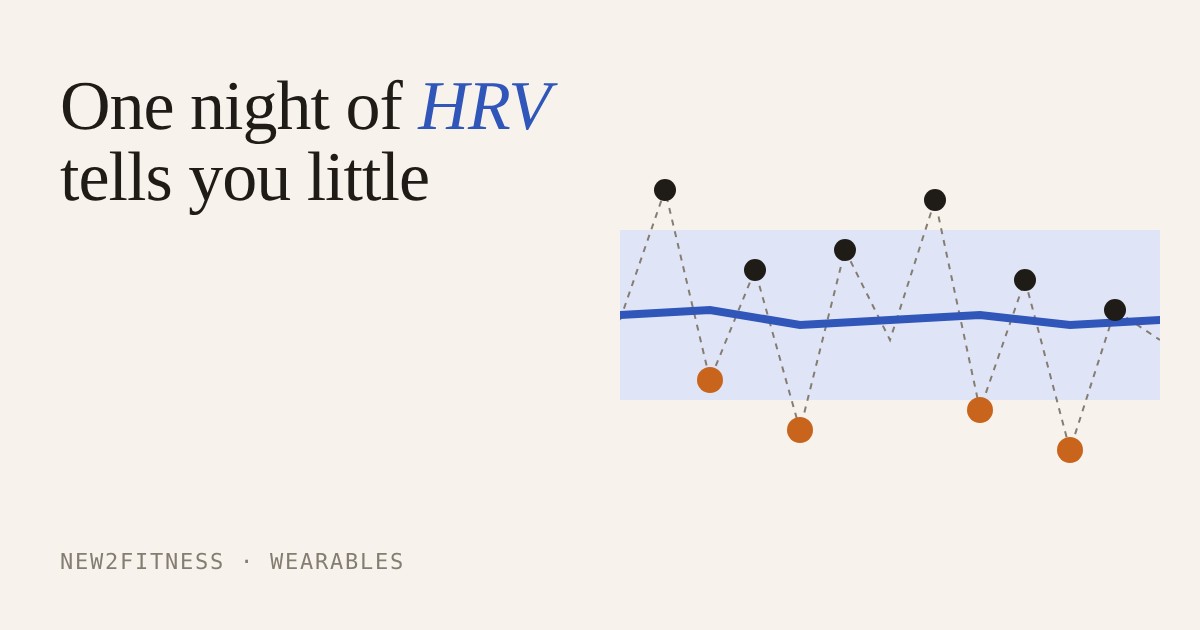
Try the chart above. With a moderate amount of noise, even a body that has not changed at all produces a "low" night every so often. A score that tells you to rest because last night dipped is mostly reacting to that noise. The line that matters is the seven-night average: it moves when something real changes and ignores the one-off wobble.
Wrist sensors measure the pulse with light. At rest, and especially overnight, studies comparing them with chest straps or ECG tend to find them reasonably close. During movement they get worse. That is why overnight numbers are more useful than a reading taken after a walk or a run. It also means a bad fit, a loose strap or a restless night can add errors of its own.
What the readiness score adds
A readiness or recovery score is usually a blend: your HRV, your resting heart rate, how long you slept, and sometimes your recent training. Each company uses its own formula and does not publish it, so a "72" on one watch means something different from a "72" on another. Treat it as a nudge that summarises a few signals, not a measurement of how recovered your muscles are. If it says "low" and you feel fine, you do not have to skip the session. If it says "high" and you feel awful, listen to yourself.
How to use it, if you want to
- Wear the watch most nights. You need a few weeks of readings before your own normal range means anything.
- Compare you with you. Ignore other people's numbers and any population average.
- Look at the weekly trend, not the morning number. A week or more below your range is worth a look at sleep, stress and training load.
- Pair it with how you feel. Mood, energy, soreness and how the warm-up goes are information too, and they are free.
- Keep the plan steady. As a beginner, regular training and enough sleep matter far more than any number a watch produces.
HRV is not a health test. If you notice a racing or irregular heartbeat, dizziness, chest pain or fainting, or a number that looks very different from your normal for no reason, speak to a doctor rather than a watch app. The same goes for any health condition or medication that affects the heart.
What to look for
If a watch's HRV and readiness features are a reason to buy, a few things matter more than the score itself. Look for overnight tracking that you will actually wear to bed, comfortable straps, and an app that shows a trend over weeks rather than only a single colour. A chest strap is worth considering only if you want very accurate readings at rest and are happy to wear it. Do not pay extra for a feature you will not check, and remember that a cheap band with a steady heart rate sensor will still tell you your resting trend.