Wearables · Explainer · 3 min ·
How accurate is the calorie count on your watch? Set your workout and see the range it could really be
The calorie count on your watch looks like a measurement, but it is a formula's best guess, and studies find it can be off by a wide margin, in either direction. Heart rate and steps hold up much better.
Set your watch number, a possible error and your workouts per week, and see the range your real burn could sit in, plus what eating back every watch calorie could add up to. Includes simple ways to use the number and when to leave it alone. Not medical advice.
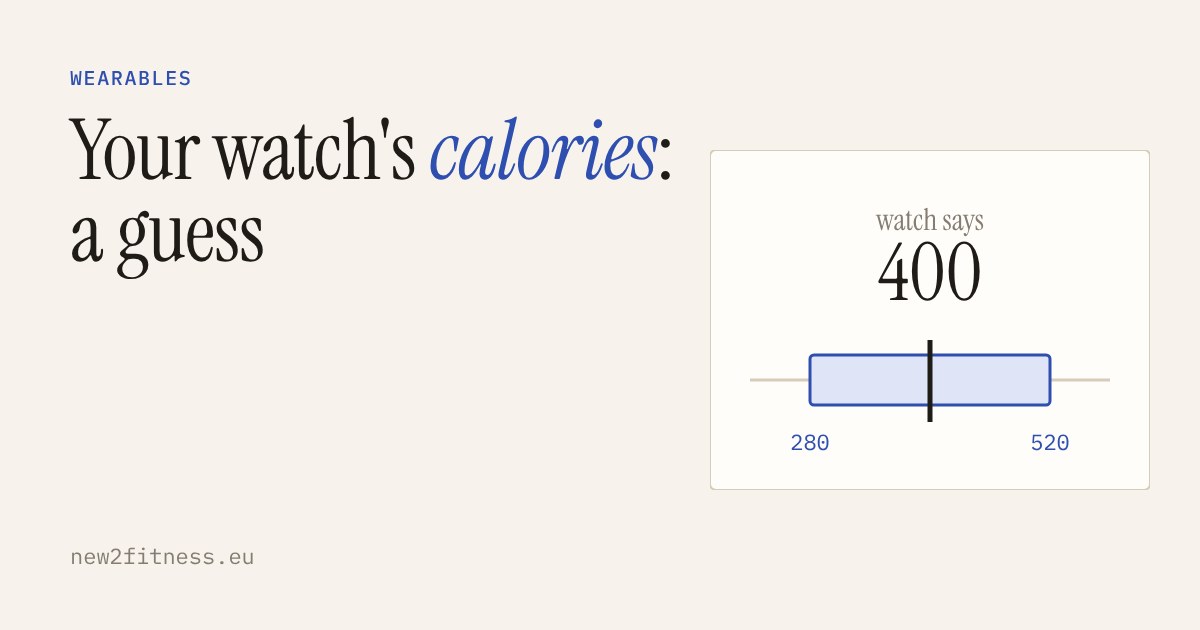
At the end of a workout your watch shows a neat number: 412 calories. It looks like a measurement. It is closer to an educated guess, and the guess can be a long way off. That matters most if you use the number to decide how much to eat.
Where the number comes from
Your watch can't see how much energy your body burns. It measures things it can sense: your heart rate from light shining into your wrist, your movement from a motion sensor, and sometimes your pace from GPS. Then it feeds those, plus the age, height, weight and sex you typed in, into a formula. The calorie count is the formula's output, not a reading.
The inputs are not equally good. Heart rate and step counts are measured fairly well. The leap from "heart rate and arm movement" to "calories" is where the error creeps in, because two people with the same heart rate can burn different amounts of energy.
How far off can it be?
In a well-known Stanford study (Shcherbina and colleagues, 2017), 60 volunteers wore seven different wrist devices while sitting, walking, running and cycling. Heart rate was close: the typical error was about 2% to 7%, depending on the device. Calories were not. The typical error ranged from about 27% for the best device to about 93% for the worst.
A 2022 review of 57 studies covering 72 devices from 29 brands reached the same broad conclusion: energy expenditure was the weakest measurement, the errors were large, and they went in both directions. Some devices overshot, others undershot, and it changed with the activity. Heart rate and step counts held up better.
Newer watches may do better than the ones in these studies, but the calorie number is still an estimate. A figure of around 30% is a cautious rule of thumb for how far off it might be, not a guarantee. Try it below.
What to do with the number
You don't have to ignore it. Use it for what it is good at:
- Comparing like with like. The same watch, the same kind of workout, week after week. A consistent error still lets you see whether a session was harder or easier than last time.
- A rough sense of effort. Heart rate and time are more trustworthy than the calories derived from them.
- Not as a food budget. Avoid "earning" food by eating back every calorie the watch shows. If you are trying to change your weight, watch your average weight and appetite over a few weeks and adjust from that.
Your daily total on the watch includes the energy you burn just staying alive, which is also an estimate built from the details you entered. Keep your age, height and weight up to date, but expect a ballpark, not a bill.
Who this isn't for
This guide is general information about fitness trackers. If you need to manage a medical condition, an eating disorder or a prescribed diet, talk to your doctor or a registered dietitian rather than relying on a watch. Not medical advice.
What to look for
If you are choosing a watch or band partly for its calorie number, don't pay extra for it. A device that measures heart rate well and lets you check it against a chest strap will tell you more about your effort than any calorie figure. Look for the heart rate and motion sensors you will actually use, accurate step counts, and a way to enter your up-to-date details.