Mobility · Explainer · 4 min ·
Does touching your toes mean you're flexible? Change your proportions and see why it isn't a fair test
Can you touch your toes? It feels like a flexibility score, but it is mostly a distance, and distance depends on how long your arms, torso and legs are.
Slide the hinge angle and body proportions in a simple side view and see two people hinge the same amount yet land differently. Learn what the test says about your hamstrings, what it can't say about your back or health, and how to use your own number sensibly.
A toe-touch is a rough test of one thing
Sit on the floor, legs straight, and reach for your toes. Fingertips past your feet and you are "flexible"; a hand stuck at your shins and you are "tight". It is the most familiar flexibility test there is, and it is easy to read too much into it.
What the test mostly measures is how far you can hinge forward at the hips before the muscles along the back of your thigh (the hamstrings) say stop. Your lower back, calves and hips join in a little. A review that pooled many studies of sit-and-reach tests found a moderate link with hamstring range, and only a low link with how much your lower back can bend (Mayorga-Vega and colleagues, Journal of Sports Science and Medicine, 2014). So it is a fair rough guide to hamstrings, and a poor guide to your back.
Your proportions change the score
The test is a distance, not an angle. How far your fingers travel depends on how long your arms and torso are compared with your legs. Two people can hinge forward by exactly the same amount and one touches the floor beyond their toes while the other falls short.
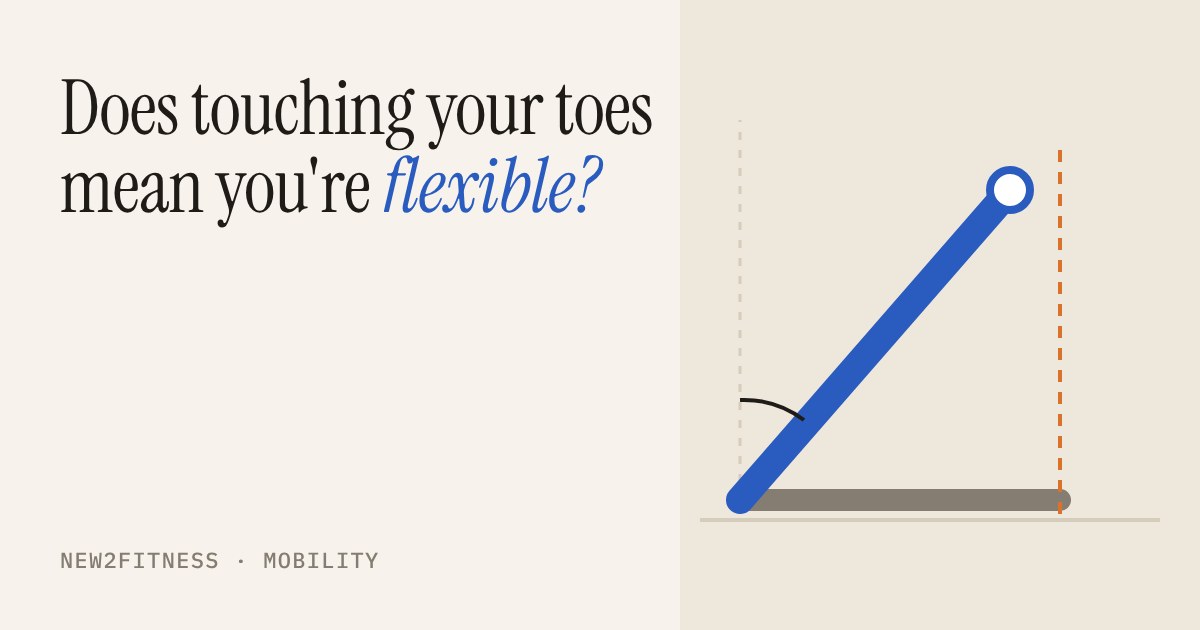
The picture below is a simplified side view: legs flat on the floor, and one line standing for torso plus reaching arms. It ignores rounding of the spine, so real people will land a little differently, but the geometry is the point. Move the sliders, or try the two presets.
Leave the hinge angle where it is and press each preset. With long arms and short legs you pass your toes comfortably; with short arms and long legs the same hinge leaves you well short. Neither person has better hamstrings. That is why comparing your reach with a friend's, or with a chart, tells you less than it seems to.
What a toe-touch can't tell you
It does not tell you whether you are healthy, how well your back works, or whether you need to stretch. Being unable to touch your toes is common and is not a fault. Being able to is not a prize either. Plenty of people lift well, run well and move well with a reach that stops at the shin.
It is a very rough read on one thing: how much hip hinge your hamstrings allow at the moment. If that is not something you want to change, you can simply skip the test.
Making the number useful
If you do want a measure, compare yourself with yourself. Use the same surface, the same position and the same time of day. Do one slow reach, mark where your fingertips land with a ruler or a strip of tape, and note it down. Repeat every few weeks. A change in your own number tells you something; a gap to someone else's mostly tells you about arm length.
If you want more hinge range, the gentle options are the ones you can keep doing: a slow hamstring stretch held for a comfortable pull, a hip hinge with a light weight through its full range, or the squats and deadlift variations in your program done with control. A stretch should feel like a firm pull, never sharp pain.
If bending forward hurts, if you feel pain, numbness or tingling down a leg, or if you are recovering from an injury or are pregnant, check with a doctor or physio before testing or stretching.