Mobility · Explainer · 5 min ·
Why can you stretch further than you can move? Slide your range and see passive and active flexibility
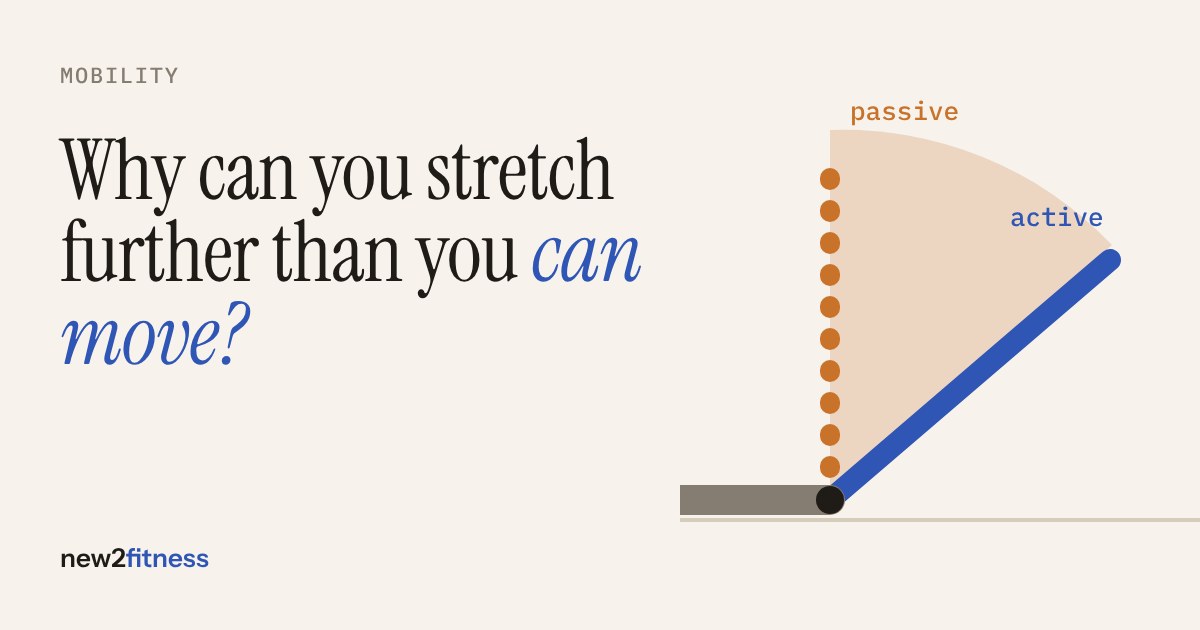
Lift your own leg as high as you can, then have a strap or a friend ease it further. The two numbers are usually different, and that gap has a name: active range versus passive range.
Slide both numbers in the figure and see what a wide gap means, what the research says stretching and strength training each change, and a simple way to check your own gap and close it safely.
Lie on your back and let a friend lift your straight leg until the stretch feels firm. Now lower it and lift the same leg yourself as high as it will go. For most people the second number is smaller. That difference is real, it has a name, and it explains why you can feel flexible on the floor and stiff in a squat.
Two numbers, not one
Passive range is how far a joint can be moved by something else: a helper, a strap, gravity, your own hands. Active range is how far you can move it using only your own muscles. People say "flexibility" for both, but they are measured differently and they can improve at different speeds.
Passive range is limited by the stretch you are willing to tolerate and by how stiff the tissues feel. Active range has an extra condition: the muscles on the other side of the joint have to pull the limb there, and the muscle being stretched has to let it go. If the pulling muscles are weak in that position, or you simply have never practised it, active range stops short of passive range.
See the gap
Try pulling the active slider all the way up to the passive one. The gap closes and the verdict changes: your muscles can now use all the range the joint offers. Then pull the passive slider down below the active one and notice that it drags the active range with it. You can never actively move further than the joint can be moved at all.
What stretching changes
Stretching is the obvious tool for passive range, and it works, but probably not in the way the word "lengthening" suggests. A large 2025 review pooling 65 trials found that regular stretching over several weeks mainly raised stretch tolerance, meaning how much stretch people were willing to accept, while muscle fibre length did not measurably change. Tissue stiffness dropped a little too. The authors rated much of the evidence as low certainty, so treat this as a best current picture, not a settled one.
That fits everyday experience. After a few weeks of stretching your hamstrings the position feels less alarming, so you go further. It does not automatically follow that your muscles are strong or well coordinated out there.
What strength training adds
If active range is the part you want, it makes sense to train the muscles that produce it. A 2021 systematic review and meta-analysis in Healthcare pooled 11 studies with 452 participants, lasting 5 to 16 weeks, and found that strength training and stretching improved range of motion to a similar degree. Most of the tests were of the hamstrings and knee range, so the result is clearest there.
Two things are worth taking from that. First, lifting through a full, comfortable range is not the enemy of flexibility, and it can help it. Second, strength work trains something stretching alone does not: producing force in the positions at the edge of your range.
A simple way to use this
- Check both numbers. Lie on your back and lift one straight leg as high as you can while the other stays flat and the knee stays straight. Take a photo from the side and note the rough angle. Then, using a strap or towel around the foot, gently ease it a little further to the first firm stretch. Never force it or bounce. The difference is your gap.
- Small gap, low active range: stretching for a few minutes most days is a reasonable place to start, because the joint has more to give.
- Big gap: add slow, controlled strength work that loads the muscle in its stretched position, with light weights you can control: Romanian deadlifts with a gentle hinge, deep split squats, slow lowering phases. Pull up toward the end of your range on purpose.
- Retest every few weeks using the same position and the same photo angle. The active number is the one that tells you whether the range is yours to use.
Who this isn't for
This is a general idea, not a prescription. If you have pain, numbness or tingling, a recent injury, or joints that feel unstable or unusually loose, check with a doctor or physiotherapist before pushing your range. Stretching should feel like a firm pull, never sharp pain, and you should never force a position.
The short version
Passive range tells you how far your joint can go. Active range tells you how far you can take it. If the two are far apart, the missing piece is usually not more stretching but strength and control at the edge of your range. Train both, and measure the one that counts.