Recovery · Explainer · 4 min ·
Does foam rolling help? Slide the minutes and see how long a looser calf lasts
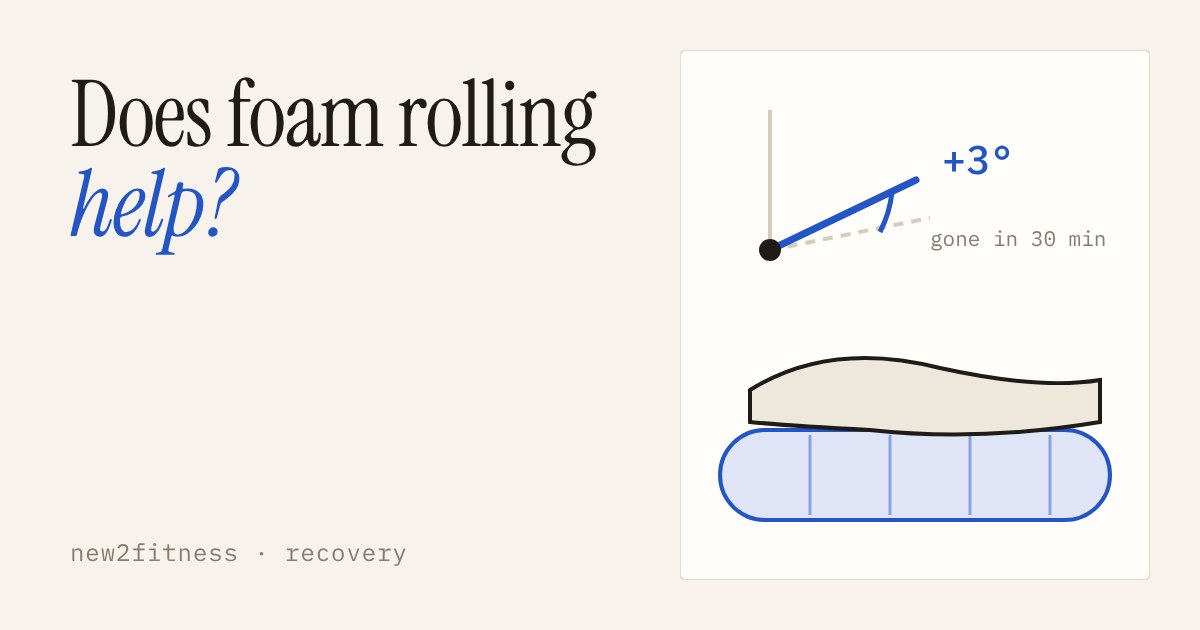
Foam rolling feels like it fixes something, but the research is modest. A 2019 meta-analysis of 21 studies found it gave a small boost to flexibility and a small drop in how sore people felt, with no real change in strength. In one randomised study, rolling a calf for 90 seconds or more let the ankle bend a few degrees further, and the gain was gone 30 minutes later.
Pick how long you roll and see what happens to the calf, then get a simple, safe way to use a roller (or skip it).
Foam rolling looks like a recovery tool: you lean on a firm cylinder, roll slowly over a sore muscle, and it feels like something is being fixed. The research is more modest than the feeling. Rolling can make a muscle bend a little further for a short while, and it can take the edge off how sore you feel. It does not seem to change your strength, and it is not a way to "break up knots" or fix an injury.
What the studies actually measured
A 2019 meta-analysis (Wiewelhove and colleagues) pooled 21 studies with 454 people. It split them by when the rolling happened. Rolling before exercise gave a small improvement in flexibility (about 4%) and a tiny one in sprint speed (about 0.7%). Jump height and strength barely moved. Rolling after exercise reduced how much muscle pain people reported, by about 6%, a small-to-moderate effect, but the gains in recovering sprint or strength were not statistically significant. The authors summed it up as effects that are "rather minor" and partly negligible, and said the evidence fits foam rolling as a warm-up activity better than as a recovery tool.
So the honest summary is: a little more movement, a little less soreness, no extra strength. That is still a fair deal for a few minutes, as long as you don't expect it to replace sleep, food or a sensible week of training.
Slide the minutes and see what the calf does
One randomised study (Nakamura and colleagues, 2021) gave 45 young, healthy, mostly inactive adults three different amounts of calf rolling: 30 seconds in total, 90 seconds, or 300 seconds. It measured how far the ankle could bend (the knee-over-toes movement you need in a squat) before, 2 minutes after and 30 minutes after. Pick an amount below to see the group averages.
What the chart tells you
Rolling for 30 seconds did nothing measurable. Rolling for 90 seconds gave a gain of under 2 degrees, and 300 seconds (five minutes on one calf) gave about 3 degrees. Thirty minutes later the gain had gone in every group. The muscle itself did not get any less stiff when the researchers measured it directly, and strength did not change. The authors think the extra movement is mostly a change in stretch tolerance: you feel less need to stop, so you go a little further.
That makes foam rolling a useful thing to do just before a session where you want a bit more range, such as a squat day where your ankles feel tight. It makes it a poor way to build lasting flexibility from one session. Longer programmes lasting several weeks have shown lasting gains in range of motion in healthy young adults, but they involved regular sessions, not the occasional roll.
Do you need to stretch as well?
Not for range of motion. A 2021 review of 12 studies (Konrad and colleagues) found that foam rolling plus stretching gave no extra range over either one alone. If you have two minutes, pick whichever you find easier to stick with.
A simple way to use it
- Before training: roll the muscles you are about to use for about 1 to 2 minutes each, slowly, then do your normal warm-up sets. The research shows this does not cost you strength.
- After training or on a sore day: a few minutes of gentle rolling may help sore muscles feel better. Treat it as comfort, not repair.
- Keep the pressure tolerable. It should feel like a firm, slightly uncomfortable massage, never sharp. If it is sharp, ease off.
- Skip it over: bruises, swelling, wounds or an area that is injured or hurts in a way that is new to you.
This is general information, not medical advice. If you have pain that does not settle, a possible injury, a circulation or clotting condition, or you are pregnant, check with a doctor or physiotherapist before rolling.
Do you need to buy one?
None of the findings above depend on a particular brand or price of roller, and the effects are small, so there is no reason to spend much. If you try it and enjoy it, a basic roller is enough. If you don't, nothing here says you are missing out on strength or muscle.