Recovery · Explainer · 4 min ·
Does a night of drinking undo your training? Pour your week and see what it does to recovery
Does a few drinks undo your training? The research gives a graded answer. Small amounts of alcohol showed little effect on strength after hard exercise, while large amounts lowered how fast muscle builds new protein and made overnight recovery measurably worse.
Set your weight and your drinks, see your dose in grams per kilo, and see where it sits against three well-known studies. It also covers what those studies can't tell you.
Short answer: a drink or two barely shows, a big night does
You trained hard on Saturday and there is a party that evening. Does a few drinks undo the session? The research gives a graded answer, not a yes or no. Small amounts of alcohol show little in the muscle studies. Large amounts after a hard session show clear costs for muscle repair and for how well your body recovers overnight.
This guide is not telling you what to drink. It shows what a few well-known studies found, so you can judge your own week with real numbers.
What the studies actually measured
Researchers describe alcohol in grams of pure alcohol per kilo of body weight (g/kg), because the same drinks hit a 55 kg person harder than a 100 kg one. Three results are worth knowing.
- Muscle building. Eight active men did a hard session of weights and cycling, then drank about 1.5 g/kg of alcohol (roughly 12 standard drinks). The rate at which their muscles built new protein was 24% lower than with protein alone when they also had a protein drink, and 37% lower when they had carbohydrate instead.
- Strength after a damaging session. Ten men did 300 hard lowering-phase thigh contractions on one leg. Those who then drank 1 g/kg lost more strength at 36 hours (about 41% of peak isometric strength) than those who drank a non-alcoholic drink (about 29%). A repeat design with half the dose, 0.5 g/kg, found no difference at all.
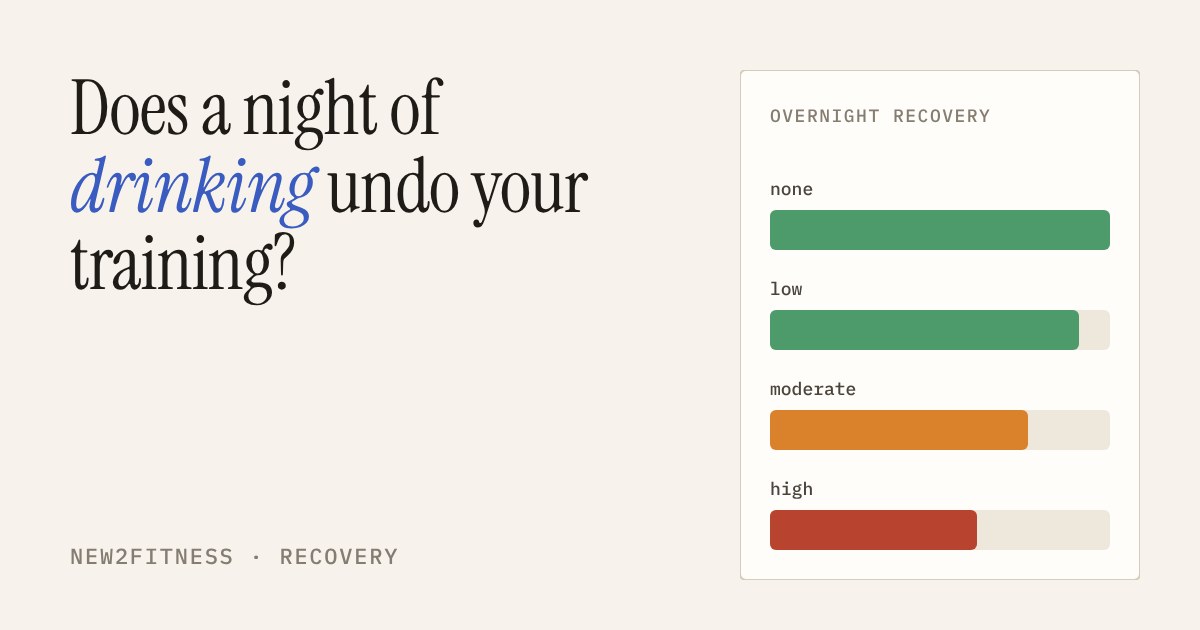
- Overnight recovery. In a Finnish study of 4,098 working adults wearing heart-rate sensors, nights after alcohol showed a lower heart-rate-variability recovery score, and the drop grew with the dose: about 9, 24 and 39 percentage points for low (up to 0.25 g/kg), moderate (0.25 to 0.75 g/kg) and high (above 0.75 g/kg) amounts. Active people were not protected.
A word on that overnight score. Heart-rate variability is the small beat-to-beat change in your pulse. When your body is properly at rest, it tends to be higher and your heart rate lower. Alcohol pushes the other way, which is why a watch that tracks it often shows a rougher night after drinking. It is a rough signal of recovery, not a measure of muscle repair, so read it as a hint, not a verdict.
Pour your own week
Set your weight and the drinks you might have. The tool converts them to grams of alcohol, works out your g/kg and shows where that sits against the studies.
What the studies can’t tell you
The muscle studies are small: eight and ten men, a single dose each, tested within a couple of days. They do not show what happens to your muscle size or strength over months. The Finnish study is observational, which means it compares nights, it cannot prove alcohol was the only cause, and it measured the first three hours of sleep, not the whole night. Most of the people in these studies were men, so be careful about applying exact numbers to yourself.
What the studies do agree on is the direction. Less alcohol means less cost, and the costs show up when the amounts are large and close to a hard session.
If you do drink
- Eat the protein anyway. In the muscle study, having protein with the alcohol softened the drop compared with carbohydrate alone (24% against 37%). A normal protein-rich meal is still worth having.
- Treat the next night as a lighter one. If your watch shows a lower recovery score, that is expected, not a sign you failed. One rough night does not matter much for progress. A pattern of them is what adds up.
- Keep the session you planned for the day after gentle if you feel flat. A shorter, easier session still keeps the habit going.
This guide is general information, not medical advice. It isn’t for anyone who is pregnant, takes medication that interacts with alcohol, or finds it hard to cut down on drinking. If that is you, talk to a doctor before changing how you train or drink.