Recovery · Tool · 4 min ·
Is a walk better than the couch after a hard workout? Set your soreness and see what to do
Is a walk better than the couch the day after a hard workout? Easy movement on a sore day is called active recovery, and a 2018 review found it may lower soreness a little, though the evidence is small and the benefit looks brief. It didn't reduce overall tiredness and wasn't clearly better than other methods.
Set your soreness, your plan and any warning signs in the day-after planner to see whether to train, walk or rest. It is a rule of thumb, not medical advice.
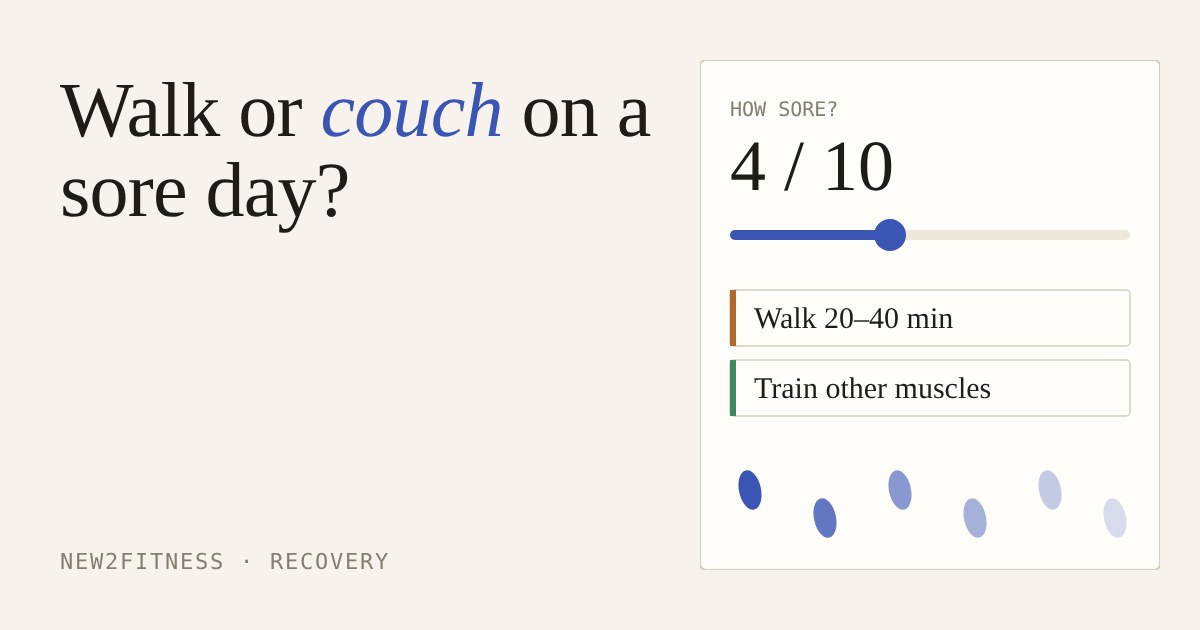
You lifted hard yesterday, your legs feel like wet sand, and the plan says "recovery day". Do you lie on the couch, or does a walk do something the couch can't? Fitness people call easy movement on a day like this active recovery. It sounds like a free upgrade. Here is what the research actually says, and a short tool to decide what to do on your own sore day.
What "active recovery" means
It simply means easy movement instead of complete rest: a walk, a gentle bike ride, a loose swim, some light mobility work. The key word is easy. If you can't speak in full sentences, it has stopped being recovery and become another workout, which adds to tiredness instead of draining it.
It is different from a rest day in the sense of planning your week (our guide on rest days covers how many you need). This is about what you do on a day when you are sore or tired.
What the evidence shows
A 2018 systematic review with meta-analysis in Frontiers in Physiology pooled studies of many recovery methods, including massage, compression clothing, cold water and active recovery. For active recovery and muscle soreness it found a reduction, and on paper the effect looked large. But look at what it rests on: only 8 groups of people, 90 participants in total, and a confidence range wide enough that the true effect could be much smaller than the headline.
Three more details matter for a beginner:
- Active recovery did not reduce how tired people felt overall, even though soreness scored a little lower.
- The authors could not show it was better than the other methods they looked at.
- The studies could not hide from people what they were doing, so some of the effect may be expectation, and the authors flagged signs of publication bias (small positive studies are more likely to be published). The benefit also appears to be short-lived.
The fair reading: easy movement probably helps sore, stiff muscles feel a bit better for a while. There is no good evidence that it repairs muscle faster, and it is not a substitute for sleep, food and enough easy days in the week.
So walk or couch?
For most beginners with ordinary soreness, either is fine, and a short easy walk costs you nothing. The real decisions are about the other things on your plan: should you train the sore muscles again, and is this soreness the ordinary kind at all? The planner below walks through both. It is a rule of thumb built from common coaching practice, not a research result, so treat it as a starting point.
Why the plan changes with soreness
The thing that matters most is not the walk but what you do to the sore muscles. At low soreness they are fine to train again, and warming up often makes them feel better. At moderate soreness, a coach would normally keep you off hard sets for those muscles, but would not stop you training other ones. At heavy soreness, most people simply do less for a day or two. The tool uses those same steps.
If you do walk, keep it easy: you should be able to talk in full sentences, which is roughly effort 3 out of 10. Twenty to forty minutes is plenty. A harder session on a recovery day isn't active recovery; it's training with less rest.
Who this isn't for
This isn't medical advice. If you have pain in a joint, sharp or one-sided pain, swelling, dark urine, or you feel unwell, check with a doctor or physio before you train again. The same goes if you are pregnant, have a heart condition, or are recovering from an injury or illness. Soreness that doesn't ease within about a week is also worth asking about.
The short version
An easy walk on a sore day is a good habit and costs nothing. The research suggests it may make soreness feel a little better for a while, but the evidence is small and shouldn't be oversold, and it doesn't replace sleep, food and sensible planning. What matters more is not hammering the same sore muscles again, and noticing when soreness is a sign to get something checked.