Recovery · Explainer · 3 min ·
Does training late at night ruin your sleep? Pick your session and see when it ends too close to bed
Does a workout at night keep you awake? A review of 23 studies found that exercise in the four hours before bed did not hurt sleep on average, with one exception: very hard sessions in the last hour.
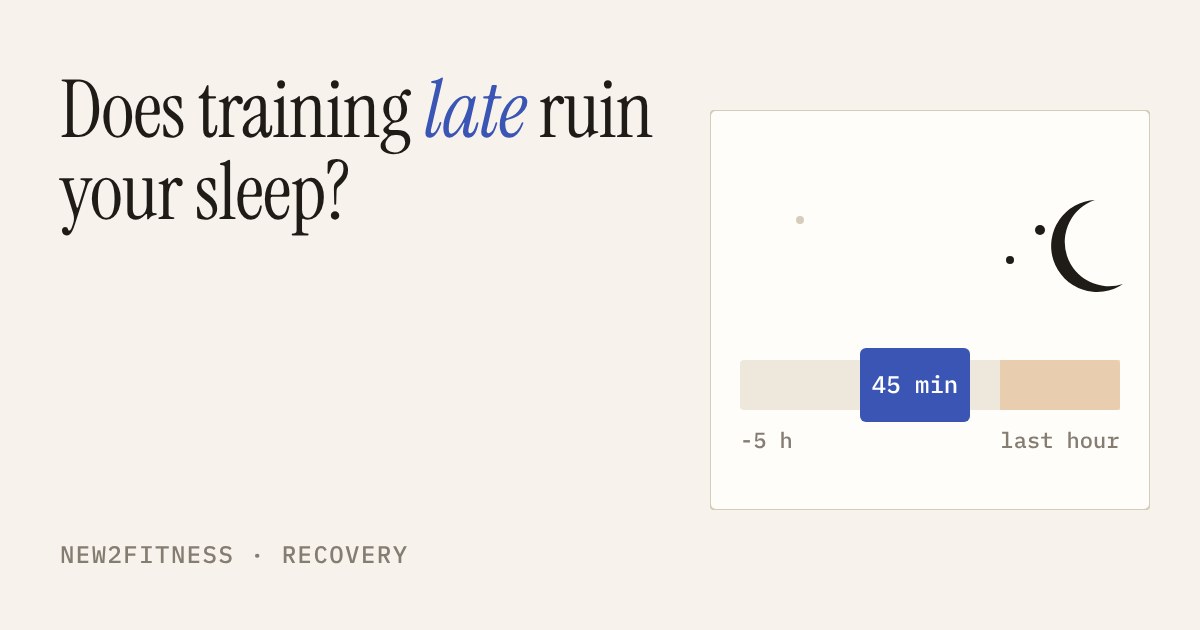
Pick how hard you train and slide when you finish to see where you land. Easy and moderate evening sessions look fine; vigorous ones close to bedtime are the one thing to watch. Plain words, no old rules.
"Never train in the evening, it wrecks your sleep" is one of those rules everyone has heard. If your only free hour is after work, it is also a rule that can stop you training at all. So what does the research actually say?
What the studies found
A 2018 review pulled together 23 studies on healthy adults who exercised in the evening and then slept. The headline result is reassuring: exercise in the four hours before bed did not, on average, make sleep worse. Moderate sessions that ended about 30 minutes before bed were fine too. Some people even spent a little more of the night in deep sleep, roughly 21% of sleep time against 20% on days with no evening session. That is a small difference, so don't expect a miracle.
There was one exception. In the single study that tested vigorous exercise finishing within an hour of bedtime, people took longer to fall asleep, and their hearts were still beating more than 20 beats per minute above resting. One study is thin evidence, so treat it as a hint, not a law. It does fit what you would expect: a body that is still revved up is not ready to switch off.
Try it: when does your session end?
Why a hard session can keep you up
Hard training lifts your heart rate, your body temperature and your levels of alertness hormones such as adrenaline. These take a while to settle. Sleep tends to come more easily when your body is cooling down and your heart is slowing. A session that is still winding down when you get into bed is working against that.
Two other things can add to it. Bright gym lights and a lively playlist keep you alert. And a caffeinated pre-workout drink stays in your system for hours, so a late scoop can be the real culprit rather than the training itself.
A simple way to schedule it
If you train in the evening, you don't have to give it up. A few small tweaks go a long way:
- Keep the hardest work, such as intervals or heavy sets close to failure, earlier in the day when you can.
- If the evening is all you have, finish the hard part at least an hour before bed and add five to ten minutes of easy walking or stretching.
- Skip caffeine in the afternoon and evening if you are sensitive to it.
- Have a shower and dim the lights afterwards, so the evening winds down instead of carrying on.
- Keep a note for a week or two: how long did it take to fall asleep after each type of session?
Who this isn't for
The studies were on healthy adults, mostly in short trials. If you have trouble sleeping that goes on for weeks, or any heart or health condition, talk to your doctor before changing how hard you train, and don't rely on a timing tweak to fix it. A missed night now and then is normal; training in the evening is not the likely cause of every one.
The takeaway
For most people, evening training is fine. Easy and moderate sessions are low risk, even fairly late. The one thing worth being careful about is very hard exercise in the last hour before bed. And the best time to train is the one you will actually keep doing, so use how you sleep, not an old rule, to decide.