Recovery · Tool · 4 min ·
Do you need a deload week? Check your own signs and see an easier week
A deload is a planned easier week: the same plan, turned down so fatigue can fade. Coaches use them often, but for a first-year lifter the better question is when you actually need one. A 2024 study found a full week off made little difference to muscle gain in trained lifters.
Answer five quick questions about your last two weeks, enter your usual session, and get a verdict plus an easy-week version of your workout. General information for healthy adults, not medical advice.
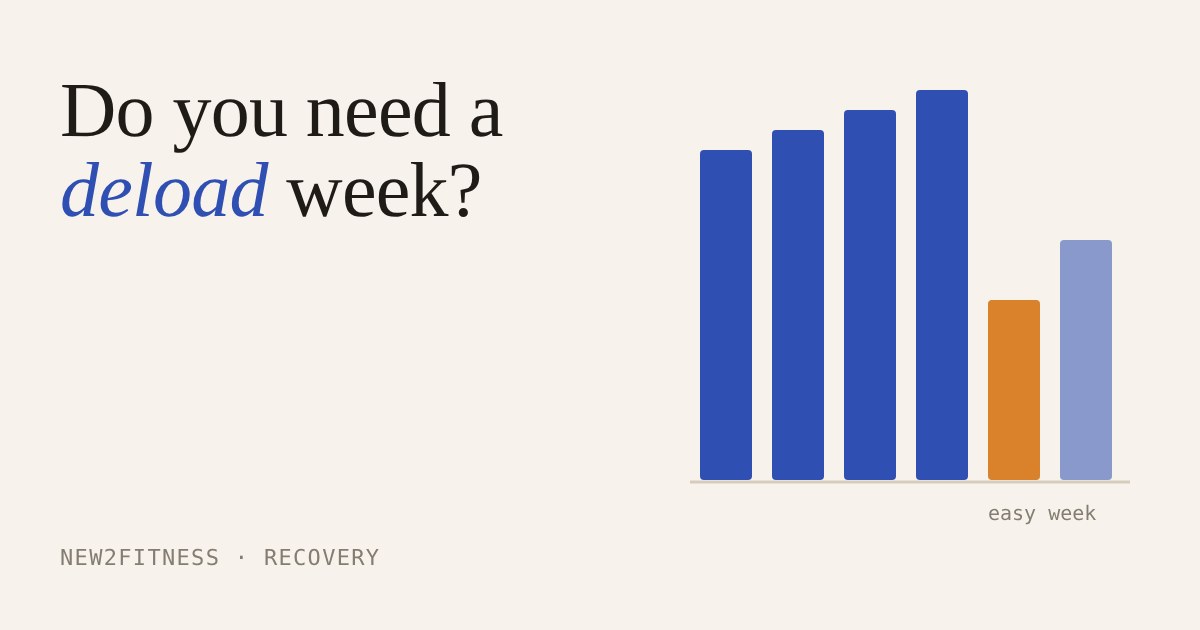
"Do I need a deload week?" A deload is a planned easier week: you still turn up, but you do less work than usual so tiredness can drain away. People who lift for years use it a lot. For someone in their first year, the honest answer is usually "not on a schedule, but sometimes yes", and the trick is spotting when.
What a deload is, and what it isn't
A panel of strength coaches in a published consensus exercise (a Delphi study, 2023) described deloading as a period of reduced training stress, used to ease physical and mental fatigue, help recovery and get you ready for the training that follows. Note what that leaves out: it is not a week off, and it is not a punishment for missing sessions. It is the same plan, turned down.
There is no agreed schedule. Some coaches plan one every few weeks, others only when a lifter looks run down. That is why a beginner is better off learning the signs than copying a calendar.
Does a week off hurt your progress?
A 2024 study in PeerJ followed 39 trained men and women through nine weeks of high-volume lifting. One group stopped lifting completely in week 5 (they could still do cardio); the other trained straight through. Both groups gained muscle, and the difference in muscle size between them was close to zero. Strength leaned slightly in favour of the group that never stopped (about 13 kg versus 16 kg more on the squat), but the uncertainty was big enough that the study could not call it a real difference.
The sensible reading: a short, planned break is unlikely to cost you much, but it is not a magic ingredient either. It is a tool for when you feel worn down. These were trained lifters on a hard programme, so treat it as a hint, not a rule for beginners.
Check your own signs
Answer the five questions about the last two weeks, say how long it has been since an easier week, and enter what your usual session looks like. You will get a verdict and a deload version of your session.
How to run an easy week
A common way is to keep your usual days and exercises, do roughly half the sets, and use weights a little lighter than normal, then stop each set with plenty left in the tank. The planner above uses half the sets and about 10% less weight as an example. These numbers are a convention among coaches, not a measured prescription, so adjust them to what feels easy.
You can also keep it simple: swap one hard session for a walk, or skip the last set of every exercise. What matters is that you finish the week feeling fresher, not wrecked.
Other things to try first
Often what feels like a need for a deload is plain under-recovery. Before changing the plan, check the basics: are you sleeping enough, eating enough protein and energy, and leaving a day between sessions for the same muscles? Fixing one of those can be worth more than a whole easy week. If you have felt unusually tired, low or achy for weeks, that is a reason to see a doctor, not a reason to train through it.
Who this isn't for
If you are pregnant, recovering from an injury or surgery, living with a heart or other medical condition, or taking medication that affects exercise, ask your doctor or physio how much to train. The planner is general information for healthy adults, not medical advice.
Watch trends, not single days
One poor night's sleep is not a signal. Several weeks of lifts feeling heavier, along with worse sleep and dwindling motivation, is. Write a one-line note after each session and the pattern shows up on its own.