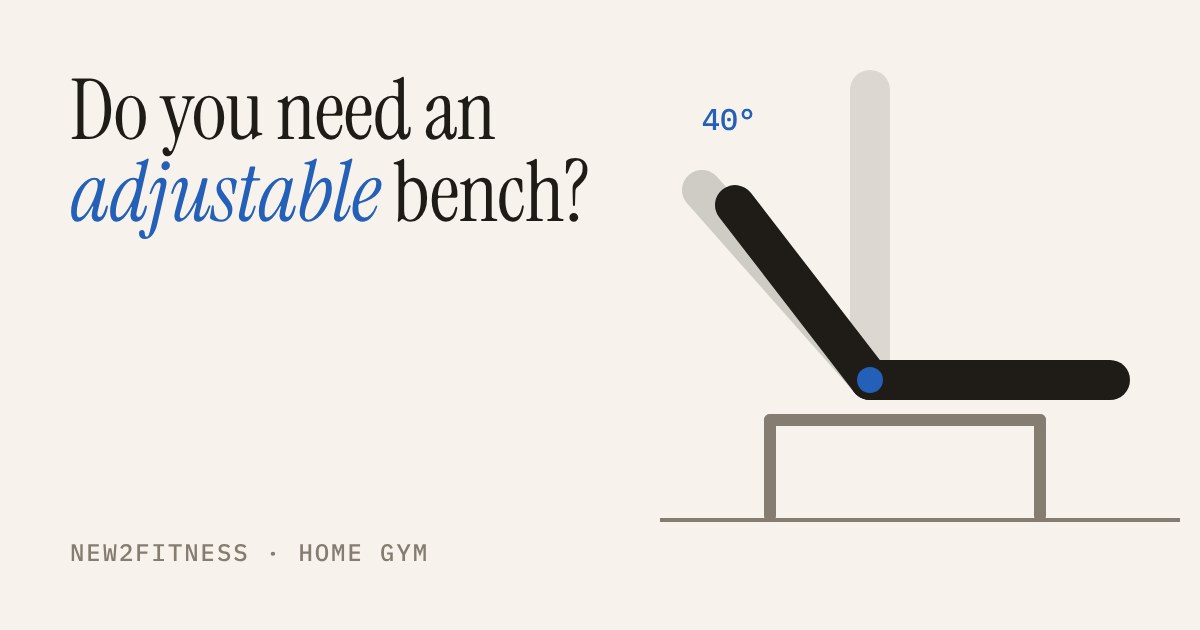
A bench does three jobs
A weight bench is a padded, stable platform. It holds your back while you press, it lifts you off the floor so dumbbells can travel further down, and it gives you something solid to row from, step onto or push your hips against. You can start without one: floor presses and push-ups work fine in the first weeks. But once you have a pair of dumbbells, a bench is the piece of kit that opens up the most new exercises.
The decision that sorts almost every bench into one of two groups is simple: does the backrest move? A flat bench is cheaper, lighter and steadier for its price. An adjustable bench costs more but changes the angle of your back, which changes the exercise. The tool below shows which of your planned lifts need that.
What the angles change
On a flat bench your chest does most of the pressing. Tilt the back up and the work shifts towards the front of your shoulders. In one lab study that compared five angles from flat to 60 degrees, the upper chest was most active around 30 degrees, the middle and lower chest worked hardest when flat, and shoulder activity kept rising as the bench got steeper. Those are muscle-signal readings, not a promise about how much you will grow.
The practical reading: a gentle incline is a useful variation on a flat press, and a steep one turns into more of a shoulder exercise. A near-upright back is what a seated overhead press needs, because you want your spine supported while the weights go over your head. A flat bench can't do that, whatever its price.
Read the weight rating properly
A bench's rating is the most it is designed to carry. For a dumbbell press that is you plus the dumbbells, since your body sits on the pad too. Some listings say the rating includes the user; others are vague, so when it isn't stated, assume it does and add your body weight to your heaviest weights, as the tool above does. A bench with plenty of headroom is safer and will last longer. The rating is a ceiling, not a target.
Steady beats fancy
A wobbling bench is the real hazard, not a missing angle. Wide feet that sit flat on the floor, a firm pad that doesn't bottom out under you and a backrest that locks with a clear click matter more than extra positions. A heavier frame is steadier; a lighter one is easier to slide under a bed. Check the pad length too: a short pad is fine for most dumbbell work, but if your head hangs off the end when you lie back, it is too short for presses.
If you press heavy weights alone, dumbbells you can lower to your sides are easier to bail out of than a barbell above your chest. A barbell needs a rack with safety arms. And if a movement hurts your shoulder or you are working around an existing injury, check with a doctor or physio before loading it.
What to look for
What matters changes with your budget, so here is what to check at each level:
- Under about €75, flat bench: a rating with real headroom over your body weight plus weights, rubber feet and a firm pad. Don't expect an incline; you buy this one for presses, rows, step-ups and hip thrusts.
- About €100–150, adjustable backrest: several back positions including one near upright, a seat that adjusts too, and a rating high enough that you won't outgrow it. This is where most people who plan a shoulder press end up.
- About €200–300, heavy-duty bench: a much heavier frame, more back positions and a higher rating. Worth it if you plan to press a lot of weight or add a barbell and rack later; check it fits your room first, as these are long and heavy.