Cardio · Tool · 4 min ·
How many steps do you need? Enter your daily average and see a gentle build-up
The 10,000-step rule is a round number, not a finding. Large studies of adults followed for several years suggest the benefit starts at around 4,000 steps a day and flattens out near 6,000–8,000 if you are 60 or over, or 8,000–10,000 if you are younger.
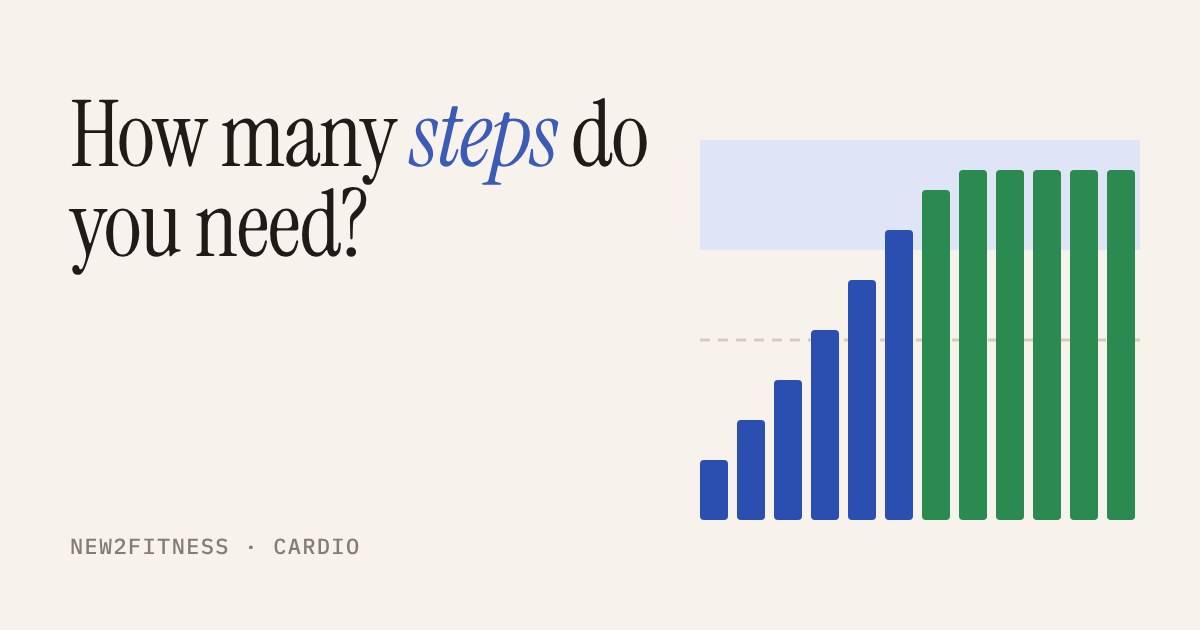
Enter your own daily average, pick your age group and choose a gentle weekly build-up, then see twelve weeks of the plan against the zone where extra steps matter less.
You have probably heard that you need 10,000 steps a day. That number did not come from a health study. It traces back to a pedometer sold in Japan in the 1960s whose name meant roughly "10,000 steps meter", a round number that was easy to remember. Since then, researchers have actually measured how step counts relate to health, and the answer is kinder than 10,000: most of the benefit arrives much earlier.
What the studies found
Two large reviews pooled many studies that followed people for several years. In a 2022 analysis of 15 studies and 47,471 adults, the risk of dying during follow-up fell as daily steps rose, then flattened out at around 6,000 to 8,000 steps for people aged 60 and over and around 8,000 to 10,000 steps for younger adults. The group stepping the most had about half the risk of the group stepping the least.
A 2023 analysis of 17 studies and 226,889 people found that the benefit for all-cause mortality starts at roughly 4,000 steps a day, with about 15% lower risk for every extra 1,000 steps. For deaths from heart and blood-vessel disease, the benefit started even lower, near 2,300 steps.
The curve is steepest at the bottom. Going from 2,000 to 4,000 steps matters more than going from 8,000 to 10,000.
Try it with your own number
Look at the average on your phone or watch over the last week or two, not your best day. Enter it below, pick your age group, and choose how many steps a day you would add each week. The chart shows twelve weeks of a gentle build-up towards the start of the flat part of the curve.
How to read the result
The plan adds a small, fixed amount each week and stops once you reach the lower edge of the flat zone. Small weekly additions are easier to keep, and a walking habit you keep beats an ambitious one you drop. If your number already sits in the zone, you do not need to push higher for the sake of the health numbers, though you are free to if you enjoy it.
The formula is plain arithmetic: weeks needed = (zone start − your average) ÷ weekly addition, rounded up. It is a pacing aid, not a prediction of your health.
Easy ways to add steps
Steps do not have to come from one long walk. A ten-minute walk after a meal is roughly 1,000 steps. Getting off the bus a stop early, taking phone calls on your feet and choosing the far end of the car park all count. On days you lift weights, the walk is a gentle way to stay moving without adding much tiredness.
Some studies also hint that a brisker pace may add benefit on top of the total, but the evidence is mixed, so treat the total as the main goal and pace as a bonus.
What this does not tell you
These studies are observational. People who walk more also tend to be healthier in other ways, so the numbers show an association, not proof that steps alone cause the difference. Step counters also vary: a wrist watch and a phone in a pocket can disagree noticeably, so compare your own numbers over time rather than against a friend's.
This is not for anyone with pain, an injury, heart or lung conditions, a pregnancy, or a doctor's activity limits. If any of that applies, check with a doctor or physio before raising your activity, and let them set the target. Steps also do not replace strength training; they work alongside it.