Mobility · Explainer · 4 min ·
Does slouching hurt your back? Drag your head forward and see the lever it creates
Does slouching hurt your back? Drag your head forward and watch the lever it creates at your neck, then see what the research really says: long, unbroken sitting seems to matter more than any one shape.
You will learn why a slouch feels tiring, why the scary numbers online are model estimates, and what to do instead of sitting rigidly: vary your position and keep moving.
Does slouching hurt your back?
You have probably been told to sit up straight. By a parent, a teacher, a physio poster, maybe the little voice in your own head right now. The idea is simple: a straight line is safe, a curve is damage. It is a tidy story, but the research is messier and, for a beginner, more reassuring.
This guide covers what posture actually changes in your body, what the evidence says about pain, and what to do instead of holding yourself rigid.
What a slouch changes
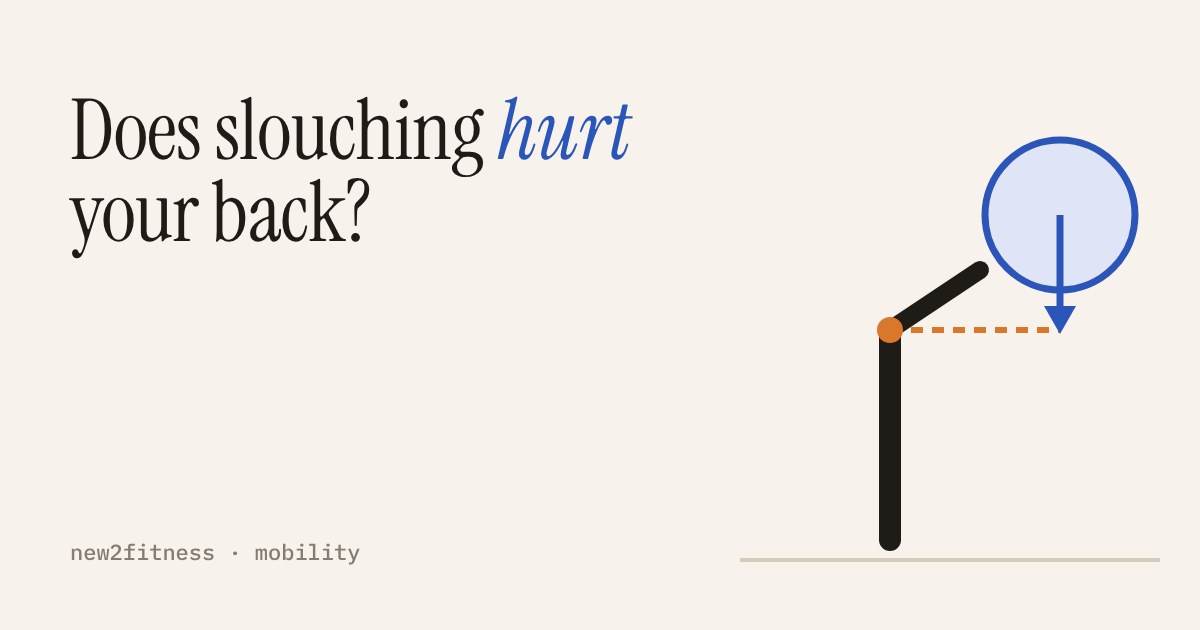
Your head weighs roughly 4 to 5 kg, about the same as a bowling ball. When it sits right above your shoulders, bones and ligaments carry most of that weight. When it drifts forward, the weight acts on a longer lever, and the muscles at the back of your neck have to work harder to hold it up.
That is basic physics: the turning force at the base of your neck is the head's weight multiplied by how far forward it sits. Try it below. Drag the slider and watch the lever.
What the research says about pain
If the lever were the whole story, people who sit more forward would have more pain, and the evidence would be clear. It is not that tidy. A 2020 systematic review of studies that measured sitting time objectively found that prolonged sitting increases how often adults report low back pain in the moment. The same authors point out that this does not show sitting leads to long-lasting back problems, and they call for better long-term studies.
A 2025 scoping review of office workers found that longer sitting time, fewer breaks and long stretches of staying static were all linked to low back pain, and that sitting behaviour (how long you stay put) had the strongest link. Posture mattered too, but it was one piece among several.
Some popular numbers you may have seen, claiming a forward head multiplies the load on your neck several times over, come from a computer model, not from measuring people's necks. Treat them as an illustration of the lever, not a prediction of damage.
The honest summary is that slouching is not a harmless nothing, and it is not a spine-wrecking habit either. What seems to matter more is how long you stay in any one position.
What to do instead of sitting rigidly
- Vary it. Lean back, sit forward, cross your legs, stand for a call. The best posture is mostly the next one.
- Break up long stretches. A minute of walking or a few shoulder rolls beats an hour of perfect stillness.
- Set up for comfort. Put the screen near eye height so the head is not constantly reaching, and keep what you use often within easy reach.
- Build the muscles that hold you. Rows, carries and light neck and upper-back work make the posture you have easier to keep. If you are just starting out, two short sessions a week is plenty.
When to ask a professional
This guide is general information, not medical advice. If you have pain that is severe, getting worse, keeps you up at night, or comes with numbness, tingling, weakness or fever, or if it follows an injury, check with a doctor or physiotherapist before changing anything. The same goes if you are pregnant or have a heart or spine condition.
The short version
Slouching shifts the load onto your neck and back muscles, and that is why it feels tiring after a while. The evidence points to long unbroken sitting as the bigger issue than any single shape. So skip the perfect-posture chase: change position often, move a little every so often, and keep getting stronger.