Mobility · Explainer · 3 min ·
Why do your wrists complain in a push-up? Slide your shoulders and see the angle your hands need
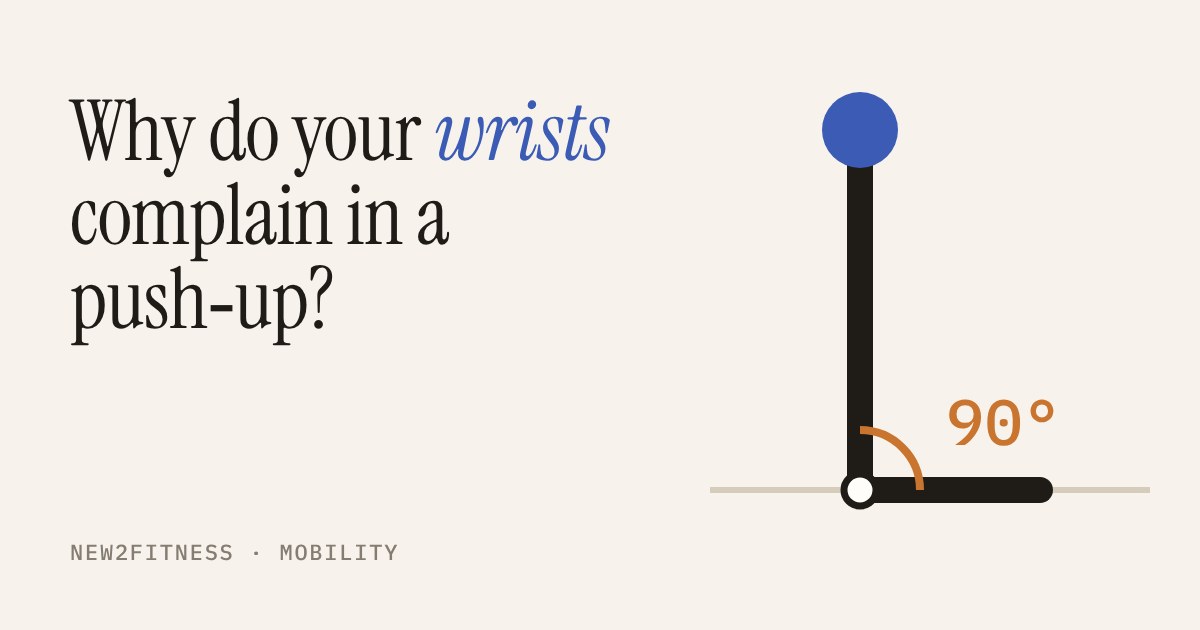
Why do your wrists complain in a plank or push-up? Because a flat palm under a straight arm asks your wrist to bend back about 90 degrees, more than the roughly 70 degrees usually quoted for an average adult.
Slide your shoulders forward and back, switch between flat palms, a wedge and fists or handles, and enter how far your own wrist bends comfortably. You'll see the angle each setup asks for, and which small change takes the pressure off.
Why do your wrists complain in a push-up? Slide your shoulders and see the angle
You get into a plank, press your palms into the floor, and the base of your hands tells you about it. Strong arms and a strong core do not help here, because this is a different problem: your wrists are being asked to bend further back than they usually do. The good news is that the angle is simple geometry, so you can see it and change it.
The floor sets the angle
With a flat palm on the floor and your arm pointing straight down, your hand sits at a right angle to your forearm. Measured from a straight, neutral wrist, that is about 90 degrees of wrist extension (bending the hand back toward the forearm). Common range-of-motion charts list the average healthy adult at roughly 70 degrees of extension, so a flat-palm plank asks for more than the typical chart number. Charts show averages and people vary a lot, which is why the same push-up feels fine to one person and cramped to another.
Your wrist angle in the plank is decided by three things: where your shoulders are compared with your hands, how your hand meets the floor, and how much extension you have to spare. The tool below lets you change all three.
What changes the angle
Shoulder position. Shoulders stacked over the hands give the 90-degree case. Push them forward, the way many people drift when they start to fatigue, and the angle grows. Let them sit a little behind the hands and it shrinks, but only so far before the exercise changes character. Try the slider: in this simple model, every few centimetres makes a visible difference.
What your hand sits on. A wedge or rolled towel under the heel of the hand tilts the palm, so the wrist bends back less. Fists or handles go further: the wrist stays close to straight, because the forearm lines up with your hand. Some people prefer parallettes or dumbbells for the same reason.
What does not change it. Kneeling or putting your hands on a bench lowers how much of your body weight rests on the hands, which can make the position easier to tolerate. It does not change the wrist angle itself, because the palm is still flat and the arm is still straight over it.
What to try
Build up gradually rather than doing a lot of push-ups on day one. Before you load the wrists, spend a minute on all fours gently rocking forward and back with your hands flat, within comfort, so the joint warms up. If your wrists are the limit, work on a bench or a wall first, or switch to fists or handles while your tolerance grows, and let the sets stay short enough that you finish with the same technique you started with.
This model draws a straight arm over a flat floor. Real arms bend at the elbow, real hands turn out a little, and bodies differ, so treat the number as a way to see the idea, not as a measurement of you.
Sharp pain, swelling, numbness or tingling, or pain that lingers after you stop are reasons to stop and check in with a doctor or physio rather than push through. This guide is general information, not medical advice.