Mobility · Explainer · 4 min ·
Why does your squat feel better with your toes out? Change your stance and see how different hips find their depth
Two people can squat in the same stance and get different depths, because the ball-and-socket of the hip is shaped and angled a little differently in each of us. This guide shows why turning your toes out or changing your stance width can make a squat feel smoother, with an interactive that lets you try three illustrative hip shapes and watch where each one finds its depth.
You will also get a simple way to test stances yourself, what to watch for, and when a pinch at the hip is a reason to see a doctor or physio rather than push through.
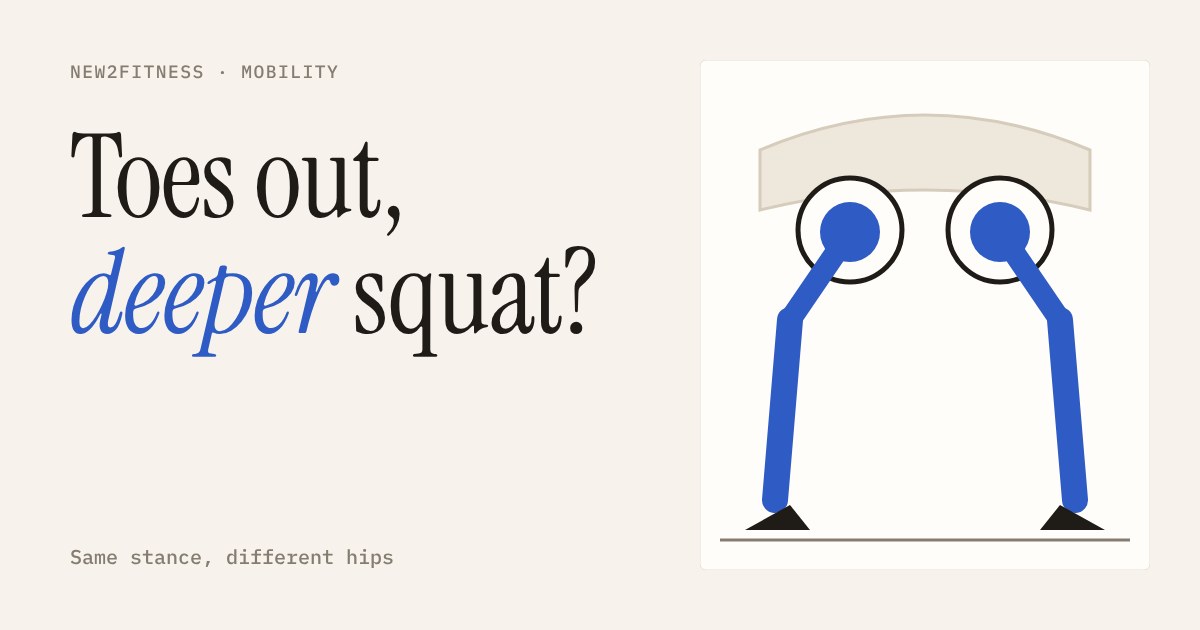
Why does your squat feel better with your toes out?
Watch ten people squat and you will see ten slightly different stances. Some stand narrow with their toes forward. Some stand wide with their feet turned out. Most of them are not doing it wrong. They are finding the stance their own hips like.
The hip is a ball in a cup, and every cup is different
Your thigh bone ends in a rounded ball. It sits in a cup on the side of your pelvis, called the socket. As you squat, the ball rolls and spins in that cup until something stops it. Sometimes that is muscle. Sometimes it is the bone of the thigh meeting the rim of the socket.
Here is the part that surprises people: the cup and the ball are shaped and angled a little differently from person to person. Some sockets face more forward, some more to the side. The neck of the thigh bone that joins the ball to the shaft can be angled differently too. Coaching literature on the squat treats this as one reason there is no single correct stance, and suggests starting with a comfortable one rather than copying someone else's.
That means two people with equally flexible muscles can reach different depths in the same stance, simply because their joints meet in different places. Turning your toes out or widening your feet changes where the ball sits in the cup, so it can move the point where the bone gets in the way.
Try it: find where each hip type gets deep
The picture below is an illustration, not a measurement. It uses three made-up hip shapes to show the idea. Pick one, then change stance width and toe angle. The figure shows roughly how low that hip would go before it feels blocked or pinchy. Notice that each type has a different sweet spot, and that the same stance can feel great for one and cramped for another.
What this means for your squat
You cannot see your own socket shape without imaging, and you do not need to. You can learn what you need by experiment. Warm up, then try the same bodyweight squat in a few stances. Start about shoulder width with your toes turned out a little. Then try a bit wider and a bit more turned out, and a bit narrower with the toes straighter. Keep your knees pointing the same way as your toes the whole way down.
Choose the stance where you can go down smoothly, stay balanced and feel your thighs and glutes working, with no sharp pinch at the front of the hip. Depth is a nice thing to have, but comfort and control come first.
What not to do
If a stance gives you a sharp pinch at the front or side of the hip, do not push through it to prove a point. Stop, move your feet, and try again. If the pinch keeps coming back, or you have pain that lingers after you train, talk to a doctor or physiotherapist. They can check the joint properly. This guide is general education, not a diagnosis.
Also be careful not to blame everything on your bones. Tight ankles, a stiff upper back, and plain unfamiliarity with the movement all limit depth too, and those can improve with practice.
What to look for
- A stance you can repeat. Mark your foot positions the first few sessions so you can compare like with like.
- Knees following toes. If your knees fall inward, narrow the toe angle or widen the stance a little rather than forcing it.
- Smooth, not forced. The bottom should feel like the end of a movement, not a wall you are shoving through.
- Patience. Your stance may drift as you get more practised; that is normal.