Mobility · Explainer · 4 min ·
Why do your heels lift when you squat? Test your ankle and see what it limits
If your heels lift or your chest folds forward in a deep squat, the ankle is often the quiet cause. Squatting with your heels down needs your shin to tilt forward over your foot, and how far it can go depends on your ankle's range.
Do the simple knee-to-wall test at home, then slide your result into a side-on squat drawing to see how the torso lean changes at the same depth, and what a small heel lift does. Includes what stretching can realistically add, and when to see a physio instead.
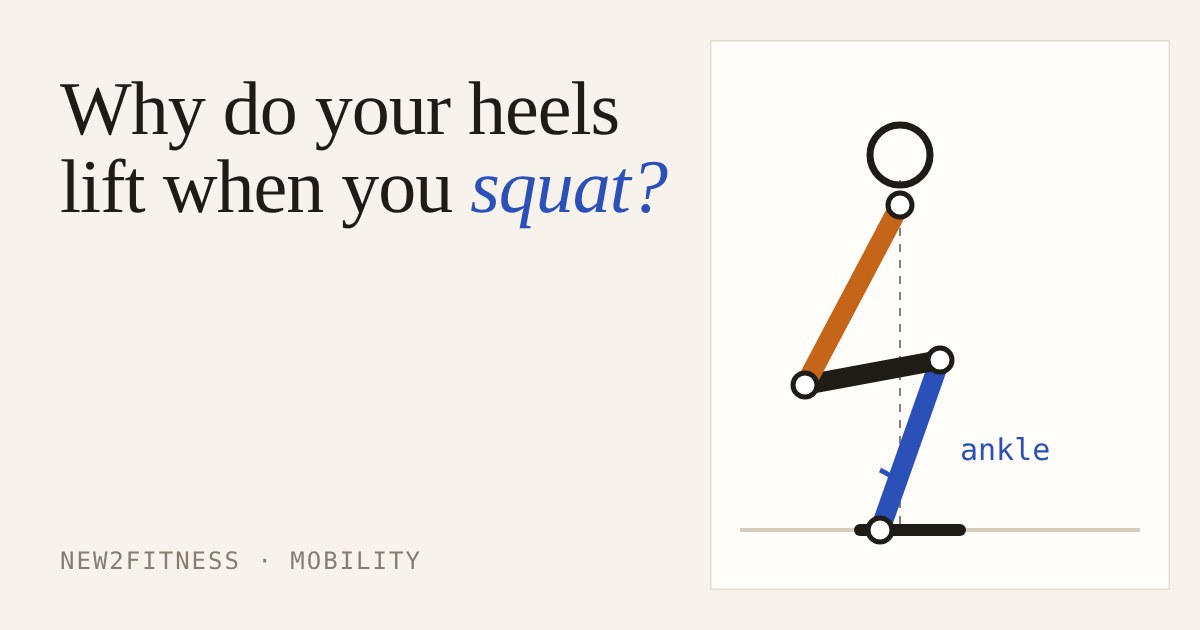
You squat down and your heels lift, or your chest folds forward, or you tip backwards. The usual suspects are tight hips or a weak back, but the ankle is often the quiet cause. To squat deep with your heels on the floor, your shin has to tilt forward over your foot, and how far it can tilt depends on your ankle.
What the ankle has to do in a squat
The movement is called dorsiflexion: your toes move towards your shin, or, with your foot planted, your shin moves forward over your toes. In a squat your knees travel forward as you go down. If the ankle runs out of range, something else has to give. Your heels come up, your torso leans further forward to keep your balance, or you stop at a shallower depth.
None of that is automatically wrong. Many people squat well with limited ankle range by leaning a little more or by using a slightly different stance. But it explains why two people with the same strength can have very different squats.
Try the knee-to-wall test
This simple test is used by physiotherapists and is easy to do at home. Stand facing a wall with one foot flat on the floor, toes a few centimetres from the wall. Bend your front knee forward and try to touch the wall without letting your heel lift. If you can, move your foot back a little and try again. The furthest distance from big toe to wall where your knee still touches, with the heel down, is your result. Do both sides and measure in centimetres.
A rule of thumb from the research is that each centimetre is worth roughly 3.6° of ankle movement. The test is reasonably repeatable when done carefully, though different sources give different "normal" distances, so treat any single cut-off as a rough guide rather than a verdict. Differences of around 2 cm between tries are within normal measurement error, so only a clearly bigger gap between your left and right sides is worth noticing.
Slide the distance down and watch the torso lean grow at the same depth. Then try the raised heels. A small heel lift gives the shin a little extra room without any change to your ankle, which is why weightlifting shoes have one.
What the model is doing
The drawing uses a shin of 42 cm, a thigh of 43 cm and a trunk of 50 cm. Your ankle range sets how far the shin can tilt forward. The figure uses as little tilt as it needs to keep the torso at a comfortable lean, and if that is not enough it uses all the range you have and leans the torso further. The weight is kept over the middle of the foot throughout. A raised heel adds about 4.6° of effective tilt, which is a 2 cm lift over a 25 cm foot. Real bodies vary in limb proportions, so use it to see the trade-off rather than to predict your own numbers.
Can you improve it?
Probably a little. A review of studies in healthy people found some evidence that stretching the calf increases ankle range, with gains of a few degrees. The effect is modest, and the studies did not follow people for long enough to say how well it lasts. The same review notes that nobody has settled how much of a gain actually matters in practice. A calf stretch, or slow knee-to-wall rocks done a few times a week, is cheap and low-risk to try. Keep going while it feels like a stretch and stop if it hurts.
Several other things help your squat at the same time: a slightly wider stance, toes turned out a little, or a small heel lift. Squatting deeper with practice also shows you what your body actually needs.
Who this is not for
If you have ankle pain, swelling, a recent sprain or an old injury that still bothers you, or the two sides are very different, get it looked at by a doctor or physiotherapist rather than stretching through it. A stiff ankle is common and usually harmless, but pain is not something to push past.
The takeaway
If your heels lift or your torso leans a lot in a deep squat, check your ankles before blaming your hips or back. Do the knee-to-wall test on both sides, note the gap, and try a wider stance, turned-out toes or a small heel lift. Some gentle calf work can add a few degrees over time, and you don't need a perfect score to squat well.