Getting Started · Tool · 3 min ·
How should you warm up before lifting? Enter your weight and see your ramp-up sets
A warm-up is a few minutes of easy movement plus a couple of light sets of your first exercise, so the first hard set feels smooth instead of stiff.
Enter the weight you plan to lift and see a ramp-up you can use today: how many sets, how much weight, how many reps, and how long it takes. Also: what to do about stretching, and who should check with a doctor first.
What is a warm-up actually for?
A warm-up is the few minutes before your first hard set. It does two plain jobs. It gets your body ready: your heart rate rises, your muscles and joints loosen up a little, and the first rep stops feeling stiff. And it lets you rehearse the movement: you practise the exact lift with light weight, so your hard sets start from a groove, not from cold.
It is worth being honest about the evidence. Reviews of warm-ups before lifting find no clear agreement on the perfect routine, and the research that exists is mostly in people who already train. The pattern that comes up most is that a warm-up using the lift itself, working up towards your real weight, helps most. The evidence that warming up prevents injuries is also thinner than the gym folklore suggests. So think of a warm-up as a way to feel and lift better, not as a shield.
Two parts: general, then specific
General means 3 to 5 minutes of easy movement that raises your heart rate: a brisk walk, an easy bike, or a light row. You should feel slightly warmer and a bit out of breath, not tired. Add a few easy movements for the joints you are about to use, like arm circles or bodyweight squats.
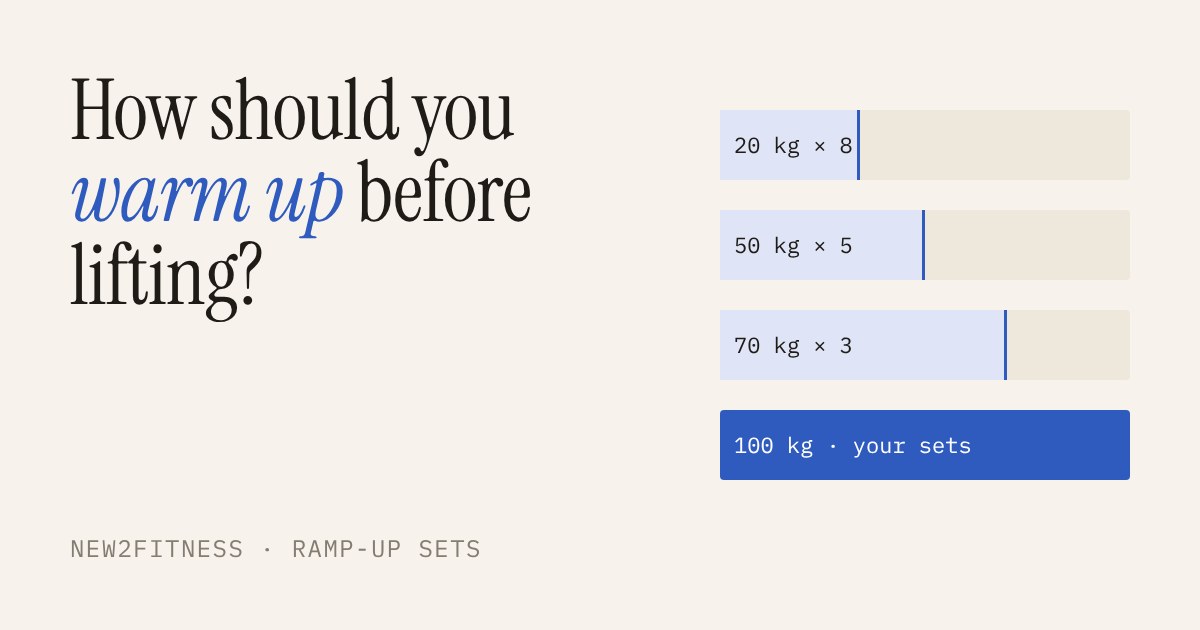
Specific means ramp-up sets of the first exercise of your session. You start light, add weight each set, and do fewer reps as it gets heavier, so you rehearse the lift without tiring yourself out. You only need this for your first exercise. By the second or third, you are already warm.
Build your ramp-up
Put in the weight you plan to use for your first exercise. The tool suggests ramp-up sets. The percentages are a common rule of thumb, not a law of nature, so treat the result as a starting point and adjust it to how you feel.
What about stretching first?
Holding a stretch for a long time right before a heavy set can make a muscle produce a little less force for a short while afterwards. Shorter stretches have little effect either way. So if you like to stretch, keep holds short before lifting and save the long ones for the end of the session or another day. Moving through the lift with light weight does the job of a stretch anyway.
Who this is not for
This is a general routine for healthy beginners. If you have pain, an injury, are pregnant, or have a heart or other health condition, check with a doctor or physio before you start, and ask them how to warm up for you. A sharp or worsening pain during a warm-up is a reason to stop, not to push through.
What to do this week
Keep it simple. Before your first exercise, spend 3 to 5 minutes on easy cardio. Then do two or three ramp-up sets of that first exercise. Start every session the same way, so it becomes a habit that takes about five minutes. If you are short of time, cut the ramp-up sets down to one or two, but do not skip the easy movement. And if a warm-up leaves you tired, it was too much: lighter, fewer reps, shorter rests.