Mobility · Explainer · 3 min ·
Can't touch your toes? Move the sliders and see what is really limiting you
How far you can reach toward your toes depends on four things at once: how far your hips hinge, how much your back rounds, how long your arms are compared with your legs, and how much stretch you can tolerate.
Move the sliders on a simple side-view model to see how different mixes of hinge and rounding end in the same place, and why arm length changes the result. Then learn what really improves with practice, why a toe touch is not a health requirement, and a gentle way to work on it.
A toe touch is four things at once
Bend forward with straight knees and reach for your toes, and you are testing more than your hamstrings. Four different things decide how far your fingertips get: how far your hips hinge (the pelvis tipping forward over the thighs), how much your back rounds, how long your arms are compared with your legs and torso, and how much stretch your body will tolerate before it tells you to stop.
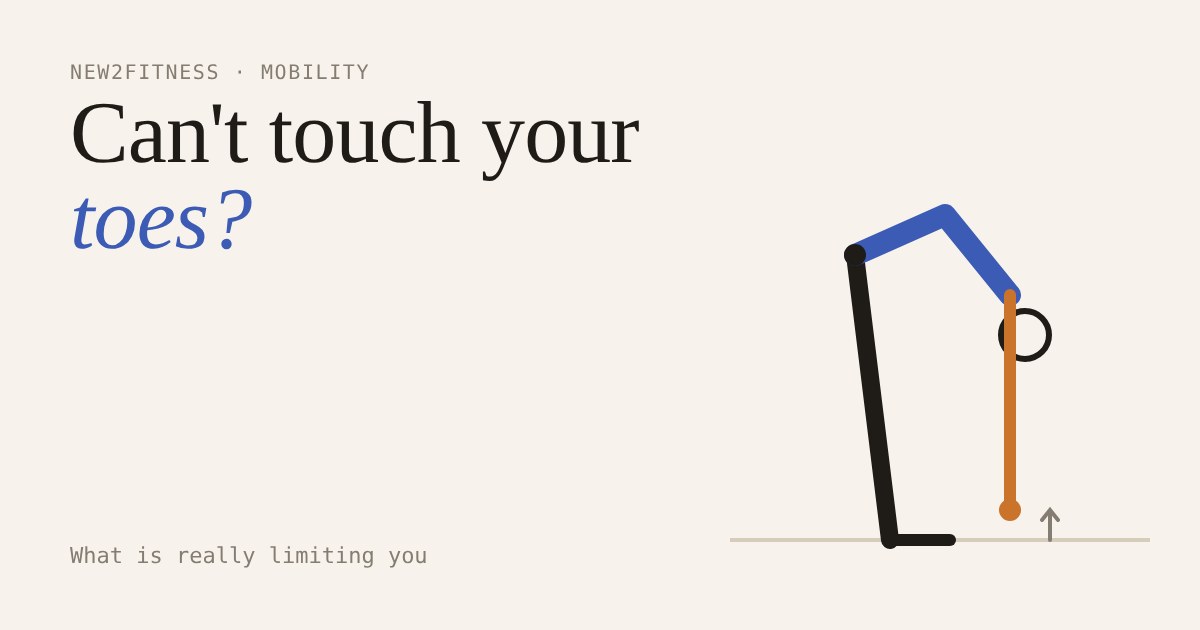
That is why two people with the same flexibility can finish with very different results, and why "I can't touch my toes, so my hamstrings are tight" is often too simple. The picture below is a simplified side view, a cartoon model rather than a measurement. Move the sliders and watch where the fingertips end up.
Why the same stretch gives different results
Try the "Mostly hips" and "Mostly back" examples. They reach nearly the same spot by different routes: one hinges deeply at the hips, the other bends less at the hips and rounds the back more. Then drag the arm length slider, or read the table under the picture. With the same bend, longer arms finish noticeably closer to the floor. Torso and leg lengths matter in the same way. This is one reason toe-touch and sit-and-reach scores are a rough guide at best, and why comparing yourself with a friend of different proportions tells you very little.
What changes when you practise
When people stretch regularly for a few weeks, their reach usually improves. Research suggests that a good part of that gain comes from the body tolerating a stronger stretch rather than from muscles becoming measurably longer, though scientists still debate the details. In everyday terms: the movement gets less alarming, so you can go a little further before it feels like too much. That is good news for a beginner, because tolerance can change in weeks with gentle, regular practice.
Is touching your toes a goal?
Not by itself. There is no health rule that says you must reach the floor, and with long legs and short arms you may never get there while moving perfectly well. A more useful question is whether your hips can hinge well enough for the things you want to do, such as picking something up, doing a Romanian deadlift, or tying your shoes. If you can bend from the hips and keep a comfortable position, you have what you need.
If you want to improve
Pick one gentle hip-hinge stretch and do it most days. Go to a stretch you can feel clearly but still breathe through, hold it for around 30 seconds, and repeat a few times. Bend your knees a little if that lets you keep the hinge at the hips. Slow, regular practice beats a big session once a week.
- Stay out of pain. A strong pulling feeling is fine; sharp pain is a signal to stop.
- See a professional if needed. If you have back pain, tingling or numbness down a leg, or you are recovering from an injury, check with a doctor or physiotherapist before stretching into it.
- This model is not a diagnosis. It cannot tell you what is limiting you, and it is not meant for anyone with a medical condition affecting the back or hips.