Mobility · Tool · 4 min ·
Can you balance on one leg for 10 seconds? Time yourself and see where you stand for your age
Standing on one leg is one of the simplest balance checks there is, and it needs nothing but a floor, a wall and a clock. Time yourself with the built-in stopwatch, enter your age and see how your best of three compares with the average for your age group.
Ten seconds is a handy first target. This guide shows what the test measures, how to read your result without over-reading it, and how to improve with a few minutes of practice. Not medical advice: if you feel unsteady or have fallen, see a doctor or physio.
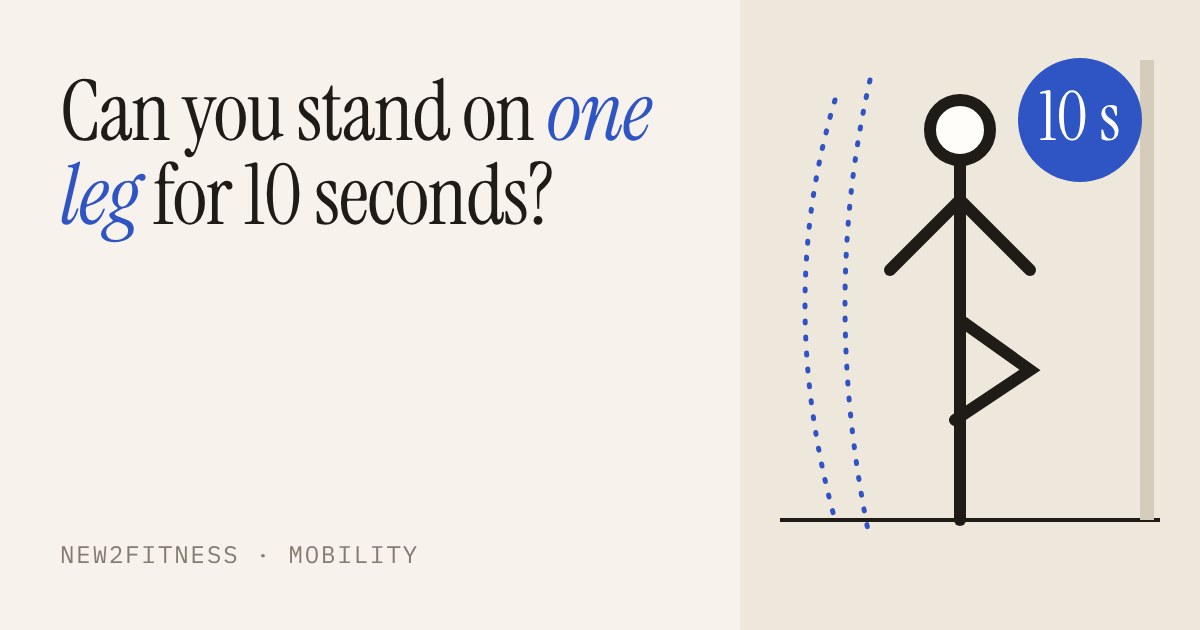
Standing on one leg looks like a party trick. It is also one of the simplest ways to check your balance, and it needs no equipment: a floor, a wall within reach and a clock. In this guide you will time yourself, enter your age and see where your result sits against a published sample of adults.
What the one-leg stand actually tests
Balance is a team effort. Your inner ear, your eyes, the sensors in your feet and ankles, and the muscles of your hips and calves all report to your brain, which makes constant tiny corrections. Standing on one leg takes away half your base of support, so any weak link shows up fast.
That is why physios use it. It is quick, repeatable and tells you something you can improve. A 2022 study of 1,702 adults aged 51 to 75 found that about one in five could not manage 10 seconds, and that failing was linked with a higher risk of dying over the next decade. Treat that carefully: it was an observational study, so it shows a link, not a cause. Balancing for 10 seconds is a useful marker, not a magic switch, and practising will not rewrite anyone's health history. It does make a good, simple target.
Try it yourself
Stand next to a wall or a sturdy counter so you can catch yourself. Put your hands on your hips, lift one foot a few centimetres and press Start when it leaves the floor. Press Stop when the foot touches down, touches your other leg, or a hand leaves your hip. The clock stops by itself at 45 seconds, the limit used in the research. Do three tries and use your best, the way the study did.
How to read your number
The chart uses one of the few published sets of norms for this test: 549 adults tested with their eyes open, hands on hips, taking the best of three tries. The averages fall slowly through your 20s to 50s, then drop faster. In that sample the average was about 45 seconds for ages 18 to 39, 42 for 40 to 49, 41 for 50 to 59, 32 for 60 to 69, 22 for 70 to 79 and 9 for 80 and over.
Two cautions. First, the spread is large, especially in older groups, so a perfectly healthy person can sit well below or above the average. Second, how you test matters: shoes off, flat floor, no wobbling arms, same leg each time. Compare yourself with your own result from last month before you compare yourself with anyone else.
If you close your eyes, expect the times to collapse. In the same sample the eyes-closed average was only about 15 seconds for the youngest group. That is normal: your eyes are doing a lot of the work.
How to improve it
Balance is a skill, so it responds to practice. A few minutes at a time works better than one long session, and you can do it while the kettle boils.
- Practise near a wall. Stand beside it, fingers ready, and let go as long as you can.
- Make it slightly harder, not scary. Look at a fixed point, then try a folded towel, then slow head turns.
- Train the supports. Squats, step-ups and calf raises strengthen the hips, thighs and ankles that do the catching.
- Do both legs. Most people have a better side, and the weak one deserves the extra time.
Times often improve with regular practice. If yours does not, or you feel dizzy, numb or unsteady in daily life, that is worth a conversation with a doctor or physio. This guide is not medical advice and cannot tell you why your balance is what it is.
The short version
Ten seconds on one leg is a common first target for adults in middle age and beyond, and a time that beats the average for your age group is a nice bonus. Test yourself once a month, practise a little in between, and watch your own number rather than anyone else's. It costs nothing and takes under five minutes.