Recovery · Explainer · 4 min ·
Why are your muscles sore two days later? Slide the soreness curve and see when it fades
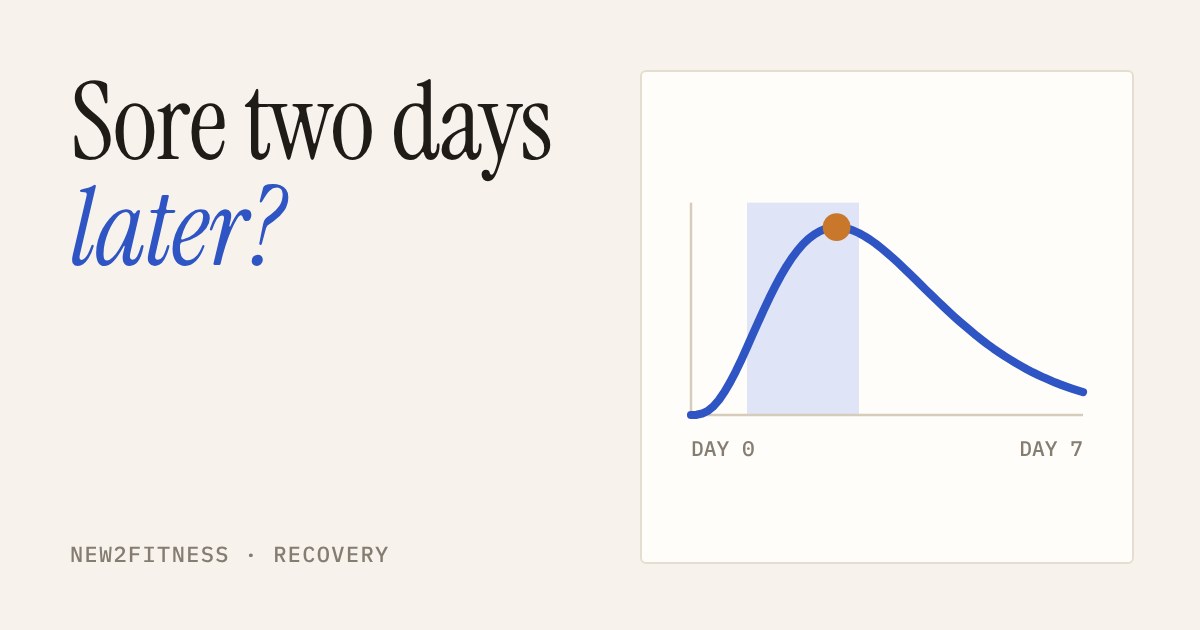
Why do your legs hurt two days after a workout, and not right away? Delayed onset muscle soreness usually builds in the first day, peaks between 24 and 72 hours, and fades within about a week. It comes mostly from new, muscle-lengthening work.
Play with an interactive soreness curve to see how a new, tough session compares with a familiar one, why the second time hurts less, and what is worth doing while you are sore.
You lift on Monday and feel fine. On Wednesday you take the stairs one careful step at a time. That delayed ache is called delayed onset muscle soreness, or DOMS, and almost every beginner meets it in the first weeks. It is normal, it is temporary, and it is far less meaningful than it feels.
Why it shows up two days later
Soreness usually starts to build within the first day, is strongest somewhere between 24 and 72 hours after the session, and then fades. It can take up to about a week to disappear fully after a very hard first session.
The main trigger is eccentric work: the part of a movement where the muscle lengthens under load, like lowering into a squat, lowering a dumbbell, walking downhill or running downstairs. Lifting a weight up (concentric work) causes very little soreness by comparison. The leading explanation is tiny, harmless-in-the-long-run strain inside the muscle fibres plus the repair work that follows, though scientists admit the exact mechanism is not fully settled.
The key word is unaccustomed. A new exercise, a bigger jump in sets, or a long break all produce more soreness than a routine you already know.
Play with the soreness curve
This is a schematic, not a measurement: real soreness varies from person to person. Set how new and tough the session was, then say when you last did something similar.
Why the second time is easier
Muscles adapt quickly to the exact thing that made them sore. This is called the repeated bout effect: do a similar session again and soreness is smaller, and strength and movement come back faster. The protection lasts several weeks, slowly fades as the gap grows, and is gone after around a year. Even a fairly gentle first session gives some of it, which is why easing into something new works.
It also explains a common beginner pattern: the first week hurts, the third week barely does, and a month off brings some of it back.
Soreness is not a score
It is tempting to treat soreness as proof that the workout worked. It is not a reliable measure of how much muscle damage happened or how much muscle you will build. Plenty of effective sessions leave you feeling fine, and a sloppy first session in a new exercise can leave you wrecked. A better scoreboard is simple: did you do the planned sets, and did the numbers creep up over the weeks?
What helps while you are sore
- Move lightly. A walk or an easy session often feels better than sitting still, even if the first minutes ache. Gentle movement does not slow recovery.
- Sleep and eat normally. Enough sleep and enough food, protein included, do more than any quick fix. Food first.
- Be patient. Soreness fades by itself. Stretching after training has only a small effect on it.
- Next time, ease in. Add a set or a new exercise gradually instead of everything at once, so the muscles adapt before the ache gets large.
When it is not just soreness
Normal soreness is a dull, tender ache across the whole muscle, on both sides, that eases from about day three. Check with a doctor or physio if you have sharp or sudden pain during a lift, pain in one spot or one side only, a joint that hurts rather than a muscle, soreness that gets worse after day four or is not clearly better after a week, or swelling you can see. Very severe pain with weakness and dark, tea-coloured urine needs urgent medical attention. If you are pregnant, have a heart or other medical condition, or take medication, ask a doctor before starting a new programme.