Mobility · Tool · 4 min ·
Can you sit on the floor and stand up without hands? Score your own test
Sit down on the floor and stand back up, no hands. That simple move checks leg strength, balance and hip and ankle movement all at once, and researchers have scored it out of 10.
Tick which supports you need on the way down and up, see your score and band, and get a note on where your points went. Then follow a four-week plan to improve it. Not medical advice: check with a doctor or physio first if you have knee, hip, back or balance problems.
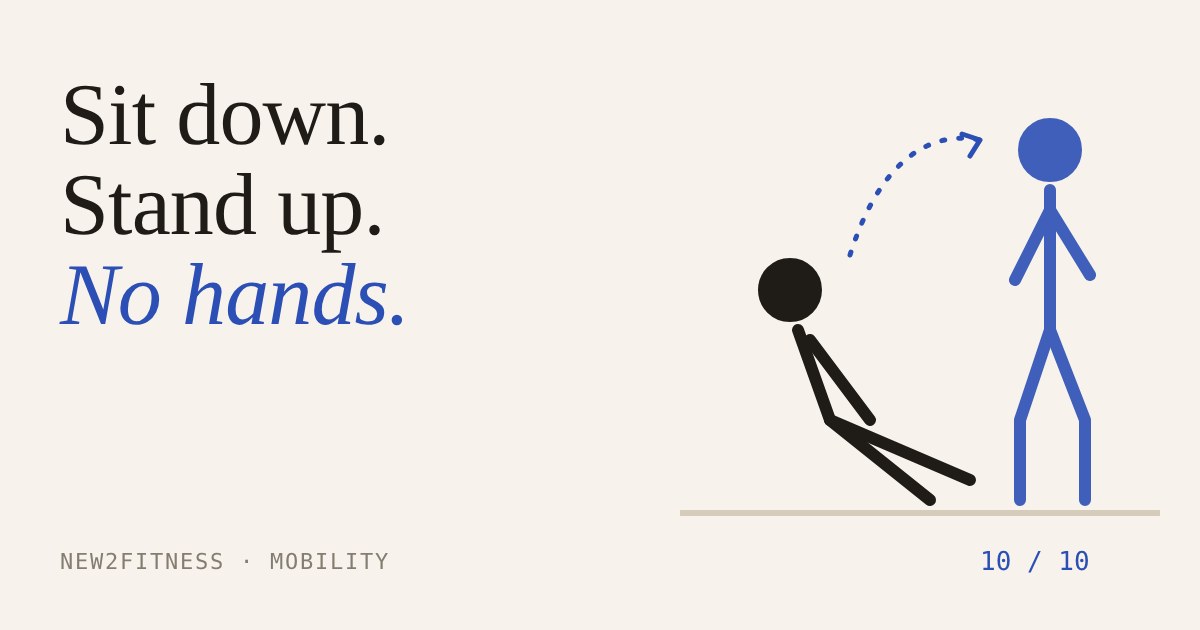
Sit down on the floor, then stand back up. That is the whole test. It sounds too easy, but doing it without your hands takes a mix of leg strength, balance and hip and ankle movement all at once, which is why researchers have used it as a quick check of how well a body moves.
How the test is scored
The version used in research gives you 5 points for sitting down and 5 points for standing up, so 10 in total. You lose a point each time you use a support: a hand on the floor, a knee on the floor, a forearm, a hand on your knee or thigh, or the side of your leg. In the original method a wobble costs about half a point. Nobody gets a prize for a perfect score; it is a snapshot, and one you can change.
The idea comes from a Brazilian study of more than 2,000 adults aged 51 to 80, followed for a median of about six years. Lower scores went with a higher chance of dying in that period, even after accounting for age, sex and body mass index. That is an association: it does not mean failing a floor test dooms anyone, and it does not prove that practising the test adds years. What it does suggest is that being able to get down and up from the floor is worth keeping, and the good news is that strength, balance and mobility all respond to training.
Try your own score
Tick what you honestly needed the last time you did it (or what you expect, if you haven't tried yet). Then use the notes below the score to see where your points went.
What the points actually measure
Each support stands in for something your body is missing in that moment, so losing points tells you where to look.
- Hands and knees on the way up usually mean the legs are doing most of the work and need more strength, or the lower position is hard to push out of.
- Help on the way down is often about control: lowering yourself is harder than it looks, because the muscles work while they lengthen.
- Wobbling is balance, which trains quickly with a few minutes of single-leg practice.
- Stiff hips or ankles can force you to take a detour (sitting to one side, using the side of the leg) because the direct route is blocked.
How to test yourself safely
Use a mat or carpet, wear nothing slippery and clear the space. Go at your own pace; the test is not timed. Stop if anything hurts. If you have knee, hip, back or balance problems, are pregnant, or have a heart or other medical condition, check with a doctor or physio before trying it. If getting up from the floor is something you cannot do at all, that is useful information too, not a failure; a physio can help you build up to it.
A four-week plan to improve your score
You do not need extra equipment. Three short sessions a week of ten minutes is plenty, and it fits around the rest of your training.
- Weeks 1–2, slow lowering. Squat down to a chair and sit for a full three seconds, then stand. Three sets of five.
- Weeks 1–2, one-leg balance. Stand on each leg for 20 to 30 seconds near a wall. Three rounds each side.
- Weeks 3–4, floor practice. Do the full sit and rise, using as few supports as you can. Take one support away at a time. Three to five slow reps.
- Weeks 3–4, add load. Goblet squats with a light weight twice a week build the leg strength to push out of the bottom.
Retest after four weeks under the same conditions. A single point is a real change.