Wearables · Explainer · 4 min ·
Can you trust the calories on your watch? See how far off it can be
Your watch says you burned 412 calories, and it feels exact. It isn't. Wrist devices measure heart rate well, but calories burned is a formula guess built around an average body.
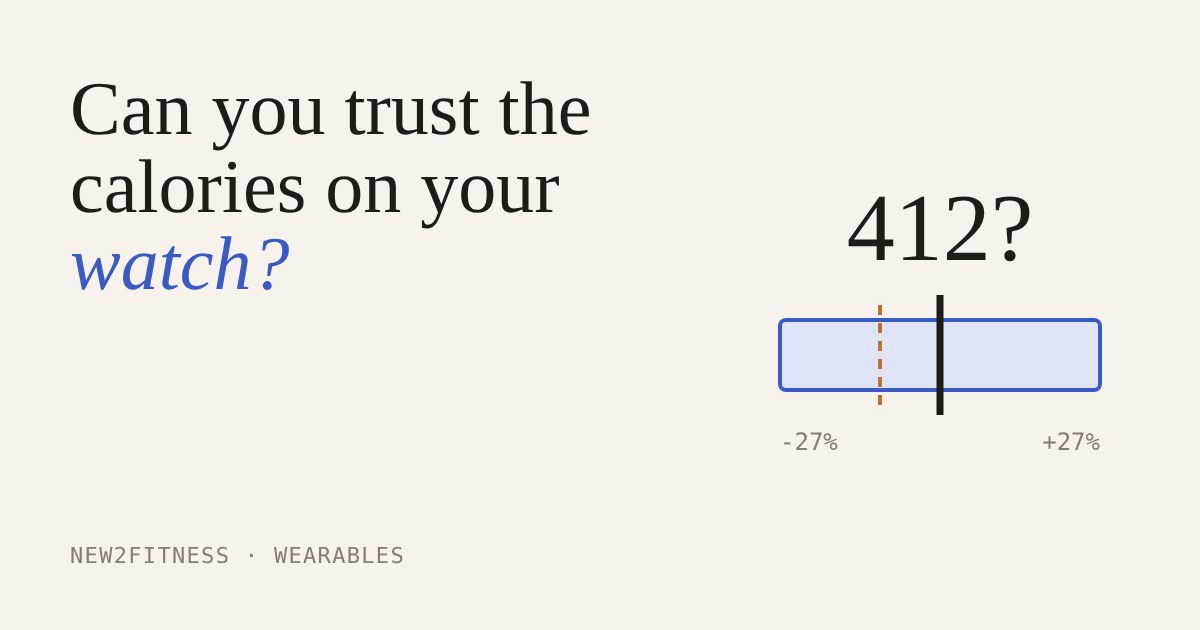
In one Stanford study of seven popular devices, the best was off by 27 percent and the worst by 93. Slide the error band on a real workout to see how wide the range gets, and learn why eating back the watch's number is a trap.
Your watch finishes a workout and flashes a big number: 412 calories burned. It feels precise. It isn't. Of everything a wrist device reports, calories burned is the weakest number, and knowing why will stop you from planning meals around it.
What the watch measures, and what it guesses
A wrist device measures a few things directly: how fast your wrist moves, and your pulse from light shining into the skin. Calories burned is not on that list. The watch estimates it by feeding your heart rate, movement, age, height and weight into a formula, and the formula assumes you are an average person.
You aren't average. Two people with the same pulse and the same weight can burn quite different amounts, because fitness, muscle mass and efficiency differ. The device cannot see any of that.
How far off can it be?
Stanford researchers tested seven popular wrist devices on 60 volunteers who walked, ran and cycled. Six of the seven measured heart rate with an average error under 5 percent, which is good. But none of the seven got energy expenditure right: the best was off by an average of 27 percent, and the worst by 93 percent. Newer watches have improved since that 2017 study, but the underlying problem, a guess built on an average body, has not gone away.
The error also runs both ways. A watch can overstate one session and understate the next, so you cannot simply subtract a fixed amount.
Try the sliders. At 27 percent error, a 420 kcal reading could mean anything from about 310 to 530. Push it toward the worst case and the range covers most of what a whole meal contains. That is the point: treat the number as a ballpark, not a measurement.
A rough check you can do yourself
Exercise scientists describe effort in METs: multiples of resting energy use. A rough estimate is MET value × body weight in kg × hours. A 75 kg person running easily at about 8 km/h is around 8.3 METs, so 40 minutes comes to roughly 415 kcal. Published MET tables are averages too, and this figure counts the calories you would have burned sitting down anyway, so the extra from the workout is smaller. Still, if your watch says something wildly different from this ballpark, trust neither number blindly.
Why this matters for eating
The common trap is "eating back" the watch's number: finishing a workout, reading 400 kcal, and adding a 400 kcal snack. If the reading is generous, you quietly cancel the effort. If you are trying to eat more to build muscle, a stingy reading can leave you under-fuelled.
- Use it for trends, not totals. The same watch on the same kind of session is consistent enough to show that this week was busier than last.
- Don't add exercise calories on top of your food target. Set a daily target from your weight and goals, then adjust it every two to three weeks based on what the scale and your energy actually do.
- Trust the pulse more. Heart rate is the part wrist devices do well, and it is far more useful for judging effort.
- Don't chase the number. A session is worth doing because of what it does for strength, fitness and mood, not because of a calorie count.
Who this isn't for
If you have a heart condition, take medication that affects your pulse, or are pregnant, a watch is not a safe guide to how hard to push. Ask your doctor or physio how to set your effort. And if tracking numbers ever makes eating or exercise feel stressful, switching the calorie display off is a perfectly good setting.
What to look for
If you are shopping, don't pay extra for a better calorie figure; no consumer device has solved it. Look for accurate heart rate (a chest strap is better for hard intervals), a comfortable fit you will actually wear, and battery life that survives a week. Features you will use matter more than the number you will over-read.