Wearables · Explainer · 4 min ·
Can you trust your watch's sleep tracking? Slide a night and see what it misses
Your watch gives you a sleep total and a chart of deep, light and REM, but it only senses movement and heart rate, not brain waves. Studies against sleep-lab measurements show wearables catch real sleep well but often miss the time you lie awake, and their stage guesses are shaky.
Slide your time in bed and time awake to see how much lying awake can inflate the total, then learn to use the numbers as trends, not verdicts.
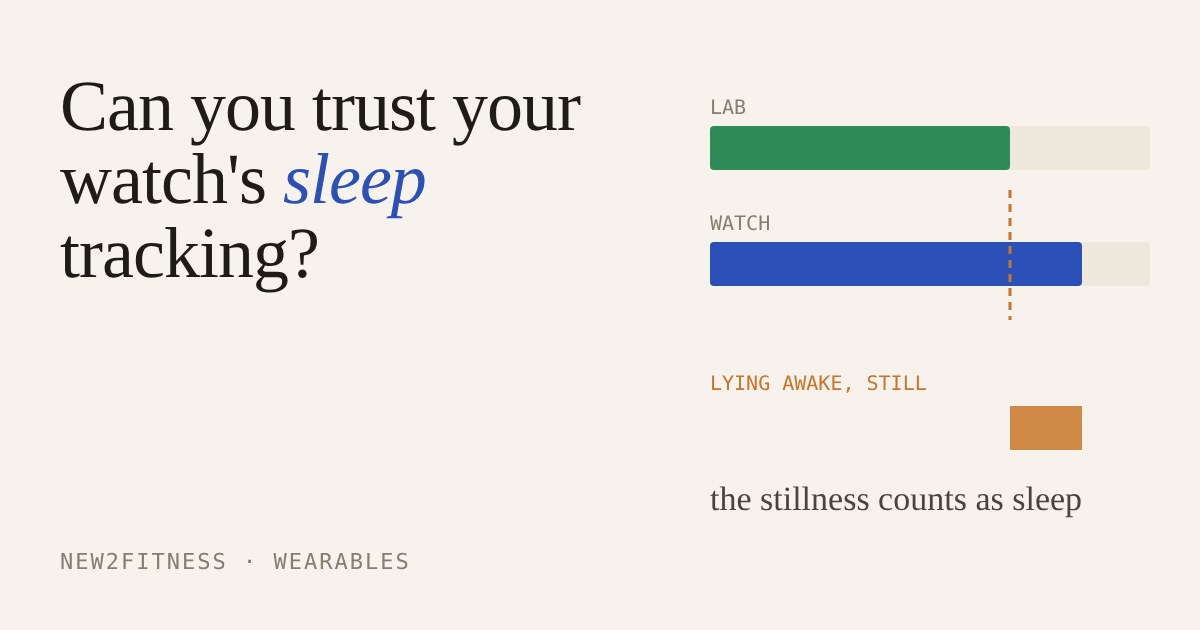
Your watch says you slept 7 hours. Did you?
Every morning your watch hands you a sleep score, a total and a coloured chart of deep, light and REM. It looks like a lab report. It is closer to an educated guess, and knowing where the guess goes wrong makes it much more useful.
What the watch actually measures
A sleep lab uses polysomnography: electrodes on the head record brain waves, plus eye movement, muscle tone and breathing. That is how sleep stages are defined. A watch has none of that. It senses how much your wrist moves and, on most models, your heart rate and its small beat-to-beat changes. An algorithm then infers "asleep" or "awake" and guesses a stage.
Stillness is the weak spot. If you lie in bed scrolling, or just awake in the dark, your wrist barely moves, and the watch can read that as sleep.
What studies found
A 2024 systematic review in JMIR mHealth and uHealth pooled studies that compared the Fitbit Charge 4, Garmin Vivosmart 4 and WHOOP with polysomnography. Averages came from only two to four small studies per device, so treat them as a rough picture.
- All three caught real sleep well: they correctly flagged about 91% to 98% of the minutes that were truly sleep.
- They were much worse at spotting wakefulness: they correctly flagged only about 30% (Garmin), 56% (WHOOP) and 61% (Fitbit) of the minutes that were truly awake.
- Total sleep time was close for Fitbit (about 6 minutes over) and WHOOP (about 1 minute under), but about 47 minutes over for the Garmin.
- Stage estimates were shakier. Average errors ran roughly 10 to 40 minutes per stage, and in different directions depending on the device.
The authors concluded that the Fitbit and WHOOP seem appropriate for estimating sleep parameters, but that all three need improvement at classifying specific sleep stages.
Why stages are the hardest part
Sleep stages are defined by brain activity. Your wrist can only hint at them: deep sleep tends to bring a slower, steadier heart rate and very little movement, while REM sleep brings a more variable heart rate with a still body. Those patterns overlap with each other and with quiet wakefulness, so the algorithm is making a statistical guess from indirect signals. Different brands also use different methods, which is why two watches worn together can disagree about the same night.
That is also why the stage chart is the least trustworthy part of the screen, even when the total is reasonable.
Try it: how much does lying awake inflate the total?
Set your time in bed and how long you lie awake. The chart shows the lab truth and what a watch with each accuracy profile would roughly report, using the review's averages for catching sleep and catching wakefulness. It is a simple model, not a prediction for your watch.
What this means for you
Use your watch for trends, not verdicts. A total that moves from 6 hours to 7 over a few weeks tells you something, because the same bias applies every night. A single night's deep-sleep number does not, because stage errors are the biggest of all.
- Judge sleep by how you feel: do you wake up reasonably rested, and are you alert in the day?
- Keep a steady bedtime and wake time. That does more than any score.
- Don't chase deep or REM minutes. Nothing here shows that more of either, as your watch counts them, means better recovery.
- If a tracker makes you anxious about sleep, stop looking at it for a while. Worry itself can make sleep worse.
This is general information, not medical advice. If you snore loudly, stop breathing at night, feel exhausted despite long nights, or struggle to sleep for weeks, talk to a doctor. A watch cannot diagnose a sleep problem.
What to buy, if anything
Nothing here needs a purchase. If your current watch or band tracks sleep, it is good enough for trends. Buying a new one for sleep stages alone will not make those numbers reliable.