Mobility · Tool · 4 min ·
How long should you hold a stretch? Build your week and see your minutes per muscle
How long should you hold a stretch? The research says the hold itself matters less than the total time a muscle spends stretched each week.
Set your hold time, repeats and days, tap the muscles you care about, and see your minutes per muscle against the five and ten minute marks from two reviews of stretching studies. Includes how hard to stretch and who should check with a doctor or physio first.
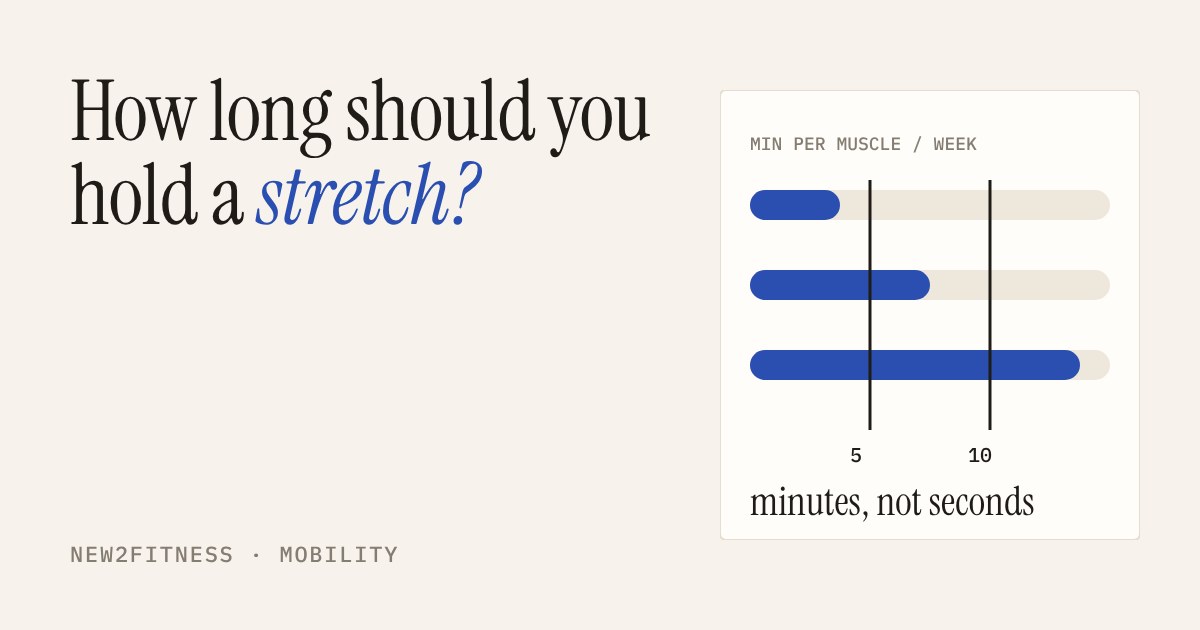
Ask ten people how long to hold a stretch and you will hear ten answers: 15 seconds, 30 seconds, "until it stops hurting", "a full minute". The research is kinder than the gym folklore. Hold time on its own matters much less than you would think. What matters is the total time a muscle spends stretched across a week.
What the studies point to
Two reviews of stretching studies in healthy adults are worth knowing. A 2018 review of 23 studies found that the total time spent stretching per week was what tracked with gains in range of motion (how far a joint moves), while the length of a single session did not. Its suggestion was static stretching on at least five days a week, for at least five minutes a week in total. A larger 2024 review found that gains in the studies levelled off at roughly ten minutes per muscle group per week, and that how many separate sessions that time was split into made no clear difference.
Two honest limits. First, most of these studies were short, in healthy adults with an average age in the twenties, so ten minutes may be a ceiling of the evidence rather than of the body. Second, the quality of the studies was mixed. Treat the numbers as a sensible starting point, not a law.
Notice what is missing: neither review found a magic hold time. Holds of 30 to 60 seconds were simply the most common in the studies. A 20-second hold done four times counts the same as one 80-second hold in this maths, so pick whatever you can stay relaxed for.
Build your own week
Set how long you hold, how many times you repeat each stretch, and how many days you stretch. Tap the muscles you want to work on. The tool adds up your minutes per muscle and shows where that lands against the five and ten minute marks.
How to use the number
If you are new to stretching, start near the lower mark. Three days a week, two holds of 30 seconds per muscle gives you three minutes. Add a repeat or a day every couple of weeks until you reach five, and see how your range feels. If it is moving, you do not need to chase ten.
Pick the muscles that limit the movements you care about: hamstrings if you struggle to reach down, calves if your heels lift in a squat, hip flexors if you sit most of the day, chest and shoulders if your arms do not go overhead. A short list done regularly beats a long list done once.
How hard to stretch
Go to a point of mild to moderate tension, the kind you can breathe through and keep relaxed. The 2024 review did not find that stretching harder gave bigger gains, so there is no reason to push into pain. Warm muscles move more easily, so after a walk or at the end of a workout is a comfortable time.
What this does and does not tell you
These numbers are about range of motion, meaning how far you can move into a stretch. They say nothing about preventing injury or improving performance, and the evidence for those is weaker. Stretching also has a limit that is partly about how your nervous system tolerates the position, so progress can feel slow and uneven. That is normal.
This is not for you if a stretch causes sharp pain, tingling or numbness, if you are recovering from an injury or surgery, or if you are pregnant or have a joint condition. In those cases check with a doctor or physiotherapist before you start, and let them set the plan.
The short version
Count minutes per muscle per week, not seconds per hold. Aim for about five, treat ten as a place where the studies stop showing extra benefit, keep it comfortable, and choose a hold time you can stay relaxed for.