Recovery · Explainer · 4 min ·
How much sleep do you need to recover from training? Set your week and see your hours
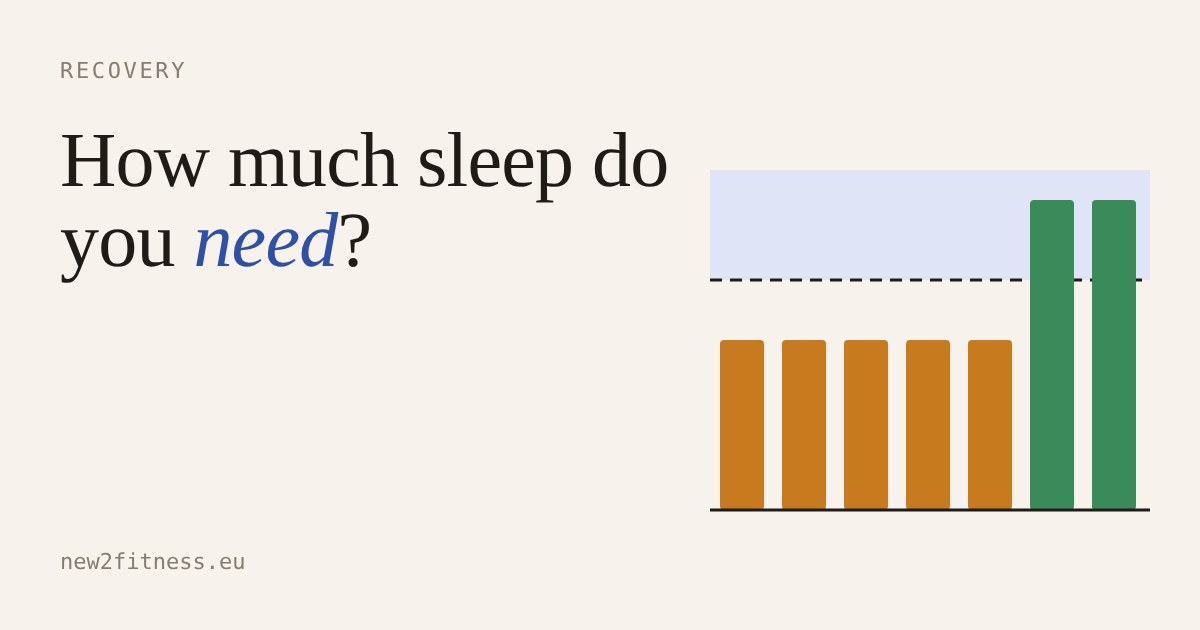
Most adults are advised to sleep at least 7 hours a night, yet it is the part of recovery people skip first. This guide explains what the research does and doesn't show about sleep and training, then lets you set your own weekday and weekend bedtimes and see how many hours you actually sleep each night against the 7-hour line.
It's general information, not medical advice.
You can plan the perfect programme and eat well, and still undo a lot of it in the hours between lights-out and the alarm. Sleep is the part of recovery that nobody sells you, which may be why it gets skipped. This guide is about how much you probably need, and how to see where your own week stands.
What the research actually says
A joint consensus statement from two sleep societies recommends that adults aged 18 to 60 regularly sleep 7 or more hours a night to support health. It also says needs vary from person to person, and that it is unclear whether sleeping more than 9 hours carries any health risk. So 7 is a floor to aim at, and many people feel best somewhere between 7 and 9.
For training, the evidence is smaller and more cautious. In one small study, 13 young adults either stayed awake for a whole night or slept normally at home. The next day, the sleepless group had higher cortisol, and their muscles tended to build protein more slowly than the rested group. It is one night, in a lab, with very few people, so treat it as a hint rather than a rule. It does fit what most coaches see: when sleep is short, training feels harder and progress feels slower.
What we can't say is that one bad night ruins a week, or that a precise number of hours builds a precise amount of muscle. Nobody has measured that.
Count the hours you actually sleep
Time in bed is not time asleep. If you go to bed at 23:30 and take 20 minutes to drift off, you start the clock at 23:50. Weekends matter too: a long lie-in on Saturday does not fully pay back a short week, and a big shift in your wake-up time can leave you groggy on Monday.
Set your usual bedtimes, wake times and time to fall asleep below. The chart shows each night of an ordinary week against the 7-hour line.
Why a short night feels worse in the gym
Muscle is only part of it. After a short night, many people find the same weights feel heavier, their focus drifts between sets, and hunger is harder to ignore. You may also be more likely to skip a session altogether, which over a whole year costs more than any single bad night does.
You will sometimes see advice to time sleep in 90-minute blocks, so you wake at the end of a cycle. The 90 minutes is a rough average: cycles vary between people and from night to night, so don't build your life around it. A steady schedule and enough total hours matter more than the exact minute of your alarm.
Naps can help on a bad night. A short one in the early afternoon is usually fine; a long one late in the day can make falling asleep that evening harder.
What nudges sleep the right way
None of these is a hack, and none of them needs gear. They are the boring things that tend to help most adults.
- A steady wake-up time. Pick one that you can hold within about an hour all week. Work back from it to a bedtime.
- Caffeine earlier in the day. It lingers for hours in the body, so a late-afternoon coffee can still be there at bedtime.
- A wind-down. Ten to twenty minutes of dim light and something calm gives your head a runway.
- Hard sessions that suit you. Some people sleep fine after an evening workout and some lie awake. Try a different time for a couple of weeks if it seems to hurt.
Who this isn't for
This is general information, not medical advice. If you regularly can't fall asleep, wake up unrefreshed after plenty of hours, snore loudly or stop breathing at night, or feel tired all day, check in with a doctor. The same goes if you are pregnant, a shift worker or a teenager: needs and advice differ, and a simple slider can't cover that.
The short version
Aim for at least 7 hours asleep on most nights, hold a steady wake-up time, and treat a short night as a reason to go easy, not to push harder. If your week looks short on the chart above, change one thing, such as lights out 30 minutes earlier, and see how training feels after two weeks.