Which dumbbells will you outgrow?
A dumbbell is the simplest piece of home gym kit there is, and the easiest to get wrong. Buy a pair that is too light and you will have outgrown it by spring. Buy a pair that is too heavy and your curls and shoulder raises will be a struggle from day one. The trick is that you do not need one weight. A beginner uses several different weights in the same week, and each of them grows at its own speed.
That is why people look at adjustable dumbbells: one set, many weights. But an adjustable set has a ceiling. Every handle holds only so many plates, so it stops at some weight per dumbbell. The question worth asking before you buy is not "how heavy can it go?" but "how long until I need it to go heavier?"
How to read the chart
Each coloured line is the dumbbell weight you would need for one lift if you keep adding load at the pace you chose. The dashed line is the heaviest dumbbell your set can make. Where a line crosses it, you have outgrown the set for that lift.
Two things usually show up. First, the lower-body lifts such as the goblet squat and the Romanian deadlift climb fastest, because your legs and back start strong and the muscles involved are big. Second, the small lifts such as the curl barely move, so a set that is too heavy for them at the start is a real problem. A biceps curl that starts at 4 kg will not jump to 6 kg on one visit. The fourth control in the figure shows why the step between weights matters: adding 2 kg to a 4 kg curl is a 50% jump, but adding the same 2 kg to a 16 kg squat is only 13%.
Fixed pairs or adjustable?
A fixed pair is one weight, made as a solid piece. It is fast to pick up, feels solid, and nothing can come loose. The price is that every new weight is another pair to buy and somewhere to store it. Fixed pairs make sense when you already know the weights you will use, or when you are short on time between sets.
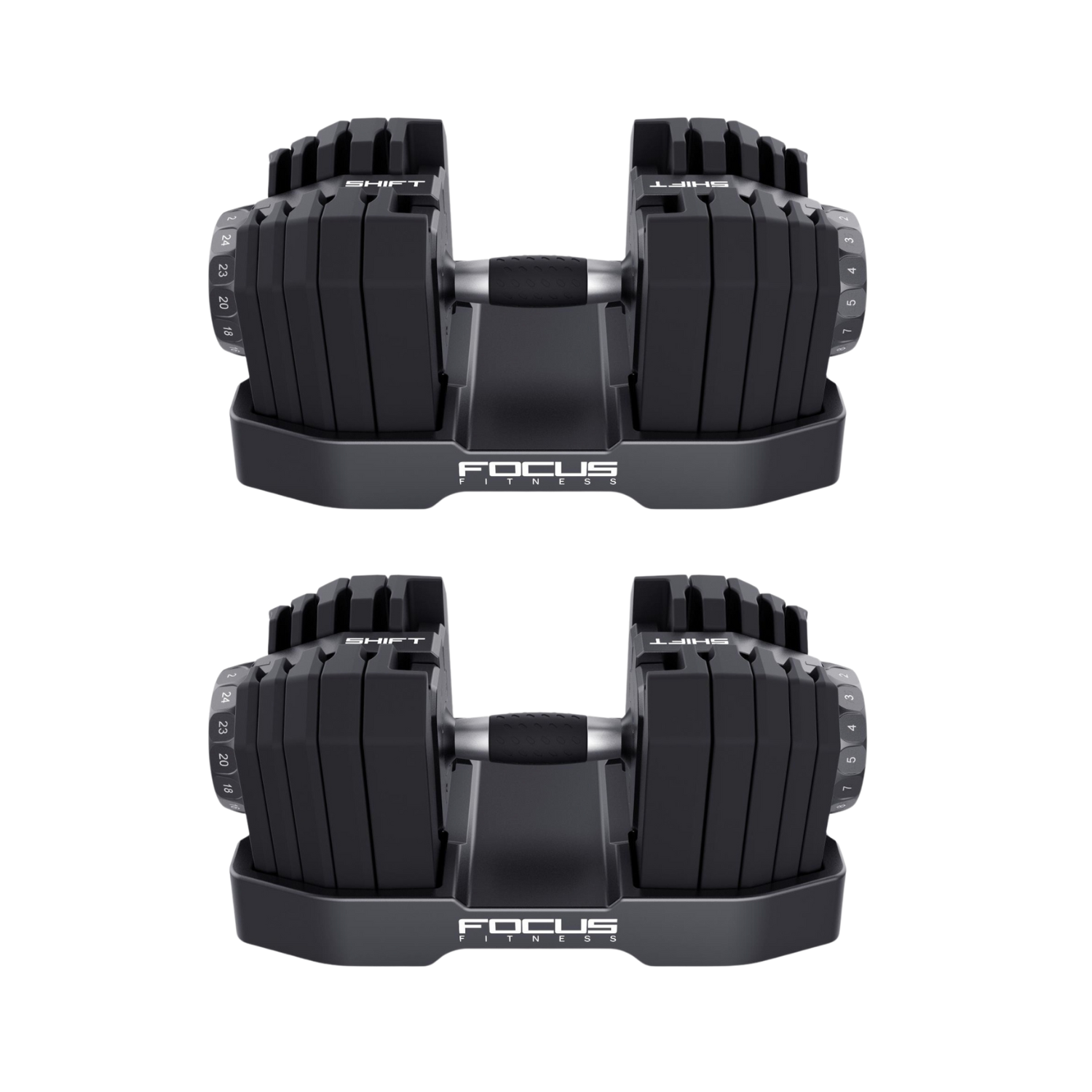
An adjustable set holds a handle plus plates, kept on by a collar or a dial. It takes up the space of one pair but gives you many weights. You pay in changeover time: threading plates on and tightening collars takes a minute, and a dial system is quicker but costs more. The other cost is the ceiling in the figure. When you pass it, you buy again.
If your lifts are light and you are tight on space, adjustable is a sensible start. If your lifts are likely to pass the limit within a year, a bigger set or fixed pairs for your heavy lifts will serve you better.
Three traps to avoid
- Total weight versus weight per dumbbell. Some listings quote the weight of the whole set, others the weight of one dumbbell. A "20 kg set" and a "2 × 20 kg set" are very different things. Check which one you are reading.
- Buying for your strongest lift. A set that only goes up in big steps is awkward for curls and raises. Think about your smallest lift as well as your biggest.
- Loose collars. On a plate-loaded set, tighten the collars before every set and look at them again if the set rattles. A plate that slides off mid-rep is an easy injury to avoid.
This guide is general information, not medical advice. Sharp or joint pain during a lift is not ordinary effort: stop, and check with a doctor or physiotherapist if it continues. The same goes if you have a heart condition, are pregnant, or are recovering from an injury.
What to look for
At the low end (around €30–50): check the maximum weight per dumbbell, not the total. Look for collars that screw down firmly and a handle you can grip without it spinning. Expect plastic or cement-filled plates, and expect to spend a minute changing weights.
In the middle (around €70–100): metal plates take up less room per kilo and feel more solid. Look for several small plate sizes so your steps stay small on the lifts that move slowly. Check that the maximum per dumbbell still gives you room to grow.
At the high end (around €250 and up): you are paying for a higher limit and quicker changes between weights. That is worth it only if you will really use the heavier loads and change weights often in a session. Check the footprint and where the dumbbells rest between sets.