Getting Started · Explainer · 3 min ·
How long until you notice results? Drag through your first 12 weeks
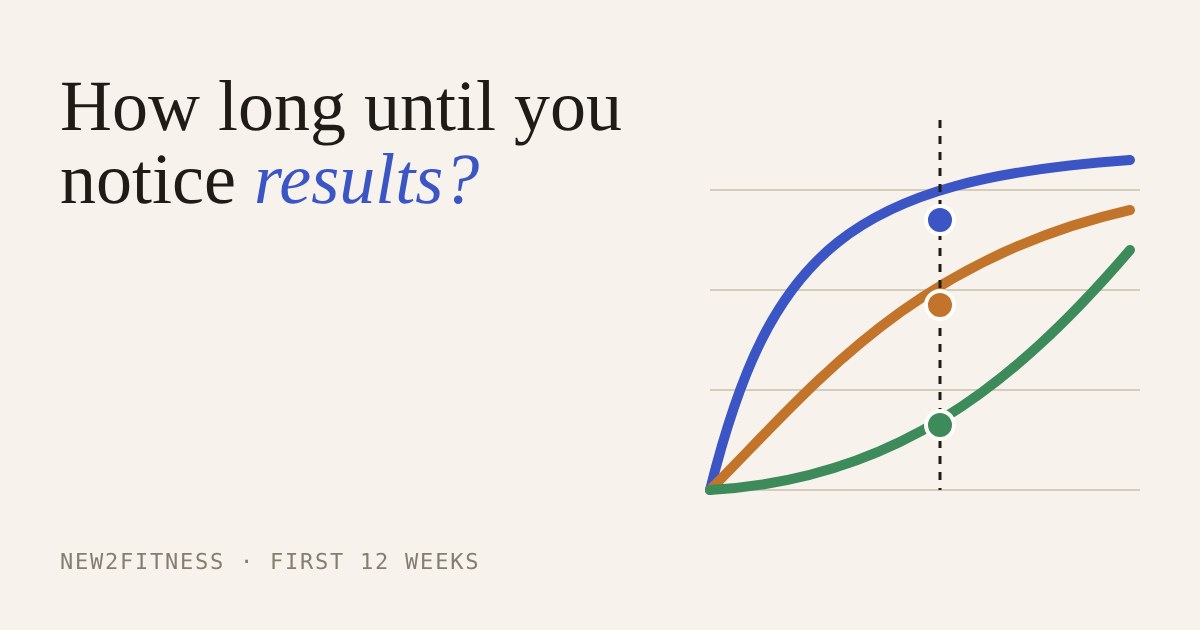
Why does nothing seem to change in the mirror for the first month? Because the first gains are skill and strength, not size. Drag through twelve weeks and see what's usually going on at each stage: how quickly you learn the lifts, how fast your numbers climb, and when muscle starts to show.
You'll also get better things to track than the mirror, and why progress slows after week six. These are typical patterns, not promises.
Why the mirror is the last to know
Almost everyone starting out asks the same thing: how long until I can tell it's working? The honest answer is that "working" shows up in a different place each fortnight. The first thing to change isn't your muscles. It's how well your brain and nerves run the muscles you already have.
In the first couple of weeks you get better at the movement itself. You recruit more of the muscle fibres you have, the right muscles fire at the right moment, and the bar stops wobbling. That's why the weights on a new lifter's log climb so fast early on, long before anything looks different. Real muscle growth starts straight away too, but it's slow and hard to see at first.
What the research shows, in plain words
In a well-known five-week study, healthy young adults trained their thighs hard three times a week. Muscle size had risen about 3.5–5% after 20 days and about 6.5–7.5% after 35 days, while strength rose around 39%. So strength ran well ahead of size. Researchers who track this closely also point out that early size measurements partly reflect swelling from the work itself, with lasting growth clearer from around the second month.
That study used tightly supervised, hard training with healthy volunteers, so don't treat the numbers as a promise. Treat the order as the useful part: skill first, strength next, visible size last.
What to track instead of the mirror
- Your log. Write down the weight and reps of each lift. Going from 3 sets of 8 to 3 sets of 10 is real progress even if nothing else moved.
- Photos every four weeks. Same place, same light, same clothes. Day-to-day, you can't see yourself change; month to month, you can.
- How everyday things feel. Stairs, carrying shopping, getting up off the floor. These improve before the shape does.
- Showing up. Training two or three times a week for twelve weeks is the result. The rest follows from it.
Why progress seems to slow down
Around weeks 6 to 8, the quick wins fade. You're no longer learning the movement from scratch, so each extra rep takes longer. This is normal and doesn't mean it stopped working; the curve flattens because the easy gains are used up. It's also the point where how hard you train, eating enough protein and sleeping start to matter more.
Who this isn't for
These are typical patterns for healthy adults in their first months of lifting, not a forecast for you. Age, sleep, food, past training and genetics all change the speed. This guide doesn't promise any change in weight or body shape. If you have an injury, pain, a heart or other medical condition, are pregnant, or have been inactive for a long time with health concerns, check with a doctor or physio before you start, and stop and get advice if something hurts in a sharp or worrying way.