Getting Started · Tool · 4 min ·
Missed some training? Slide your time off and see what you lose and how fast it comes back
Missed a few weeks of training and worried it's all gone? Mostly it isn't. Strength holds for about a month, muscle size fades more slowly still, and stamina is the first thing to slip.
Slide the weeks you've been off and see what's barely changed, what's slipping and what's clearly down, plus a rough estimate of how long it takes to get back and how to ease in. Rules of thumb, not medical advice.
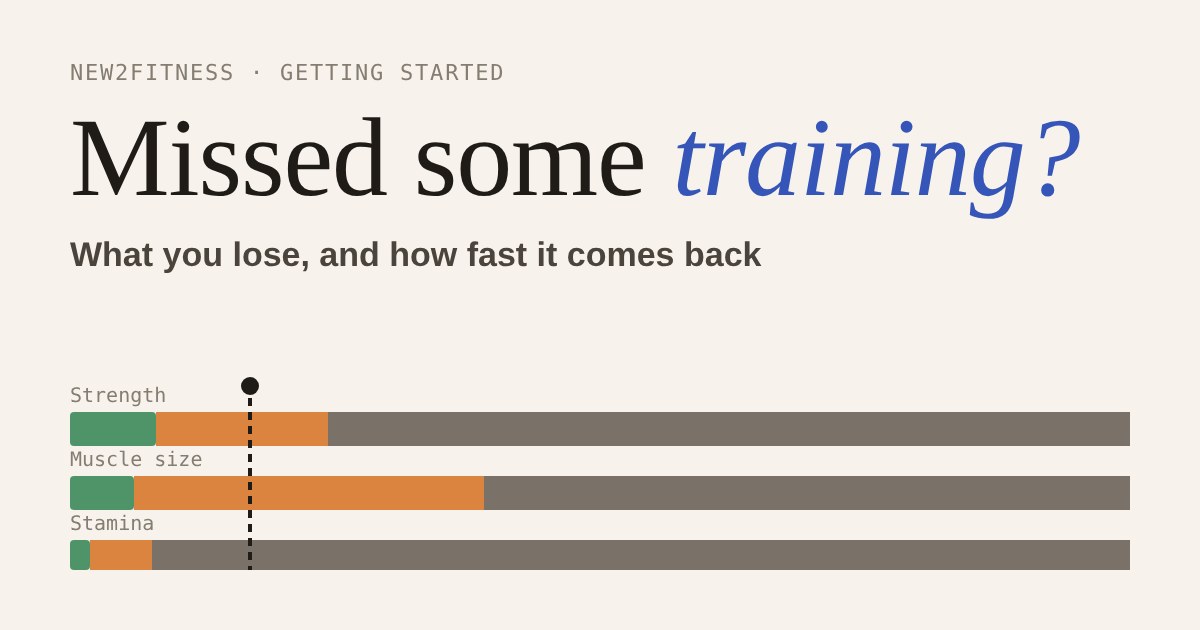
A few missed weeks cost less than it feels like
Life gets in the way: a holiday, a cold, a busy month at work. Then you stand in front of the weights and wonder whether everything you built has gone. For a break of a few weeks the honest answer is mostly no, and what you do lose comes back faster than it took to build. Different things fade at different speeds, though, so it helps to know which is which.
What the research shows, in plain words
A large review of 103 studies on stopping resistance training found that maximum strength was mostly unaffected for up to about four weeks. After that, losses sped up. Older adults (65 and over) lost strength at roughly twice the rate of younger adults, and may start slipping from around two weeks. How many reps you can do with a given weight, often called strength endurance, drops sooner and further than your one-rep best.
Muscle size is slower still. In the studies reviewed, the change within the first three weeks was too small to measure, and meaningful loss of muscle protein looks more like a matter of months. Stamina is the fastest to fade: measures of aerobic fitness drop noticeably within two to four weeks, although people who are newer to exercise tend to lose less than athletes do.
Why it comes back faster than it came
When people in these studies went back to training, they regained lost strength and size in roughly half the time they had been off, within a range of about a third to two thirds. In one study, 12 weeks off was fully regained in about 6 weeks. In another, 24 weeks off took about 12. Your body keeps the skill of the lifts, and one idea is that muscle fibres hold on to extra cell nuclei that speed regrowth. That idea is still debated, but the pattern of quick recovery is well supported.
Use the slider above to see the estimate for your own break. It is a rule of thumb from mostly trained people. A beginner who only trained for a month has less to lose and less to regain, so expect it to be quicker still.
How to ease back in
- Don't try to prove you are still strong. The first session back is for remembering the movements. Leave several reps in reserve on every set.
- Go lighter than you left off. After about a month, a common rule of thumb is to start around 20% lighter and add weight each session as it feels easy. After longer, start lighter again and rebuild over several weeks.
- Expect soreness. Muscle soreness after a break is normal and usually fades in a few sessions. Start with fewer sets than before.
- Back after a year or more? Treat it like a fresh start: simple full-body sessions, light weights and small steps up.
When you can't train, do a little
In one study of healthy adults, younger lifters kept their strength and muscle for about eight months while training at roughly one ninth of their previous volume, and older lifters needed about a third. You don't need to copy that. The useful point is that a small amount keeps a lot, so on a travel week or a busy month a short session of the main lifts beats doing nothing.
Who this isn't for
These are general patterns for healthy adults, not advice for your situation. If your break came from an injury, illness, surgery, pregnancy or a heart or other medical condition, ask a doctor or physio when and how to restart, whatever the slider says. If something hurts in a sharp or worrying way when you return, stop and get it checked.