Getting Started · Tool · 4 min ·
What should your first month of training look like? Pick your days and see four weeks
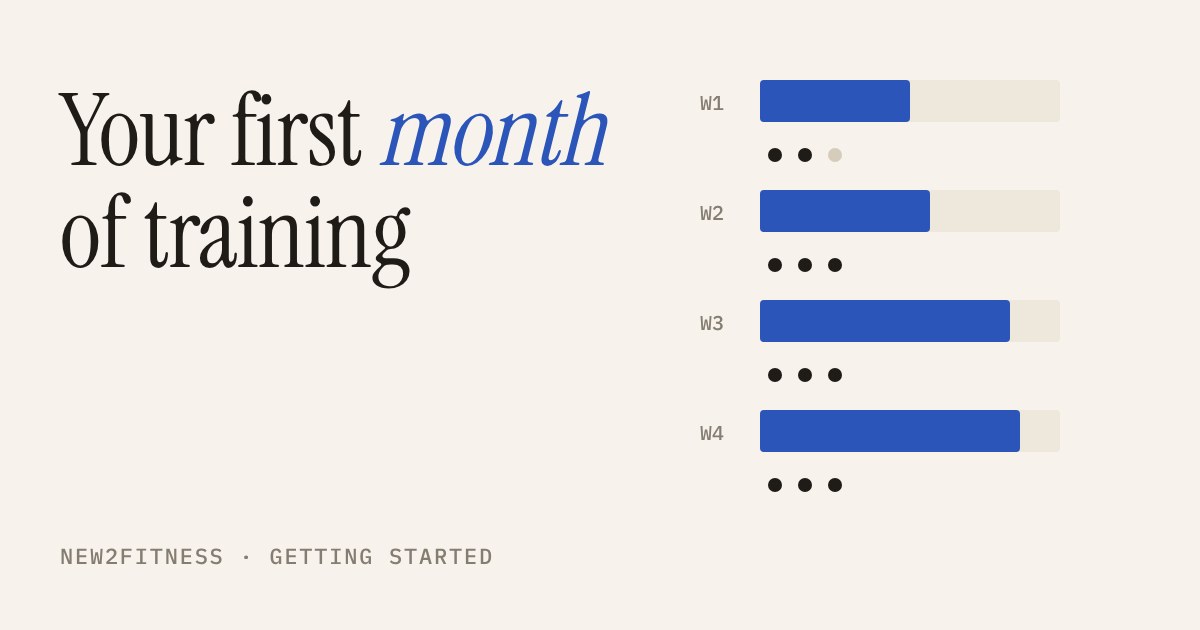
The first month of training is for learning movements, finding your limits and building a habit, not for building a physique. Pick how many days a week you can train and how many exercises per session, then tap through four weeks to see sets, reps, effort and rough session length.
It uses simple full-body sessions and gentle progression. It is a general plan for healthy adults, not medical advice.
Most beginners stall in the first month for one of two reasons: they do far too much in week one and ache for a week, or they never decide what to do and wander between machines. A month is long enough to build a habit and short enough to plan on one page. This guide gives you a simple shape for it.
What the first month is for
It is not for building a physique. It is for three smaller jobs: learning a handful of movements, finding out how much you can do and still feel fine the next day, and turning "I should go" into "it's Monday, so I go".
A lot of the strength you gain early comes from your nervous system getting better at the movements, not from bigger muscles. That is good news: you can improve quickly on light weights, and you don't need to grind. Muscle growth follows more slowly, so don't judge the month by the mirror.
The shape of the month
Use full-body sessions: every session covers a squat or leg press, a push, a pull, a hip hinge and a trunk exercise. Two or three sessions a week is plenty. For adults, the World Health Organization recommends muscle-strengthening activity on at least two days a week, so even the lowest setting below meets it.
Then you raise the load gently, one lever at a time: first learn, then add a set, then add reps, then add weight. Effort is described as reps in reserve: how many more clean reps you could have done when you stop. "4 in reserve" means it felt easy.
Week by week
Week 1: learn. Two sets of each exercise, light enough that you stop with four or more reps left. If you can't tell what that feels like yet, that is normal; err on the easy side. Focus on range of motion and a steady tempo.
Week 2: settle in. Same two sets, a little closer to the limit. If you hit the top of the rep range with good form on every set, use a slightly heavier weight next time.
Week 3: add a set. Three sets per exercise. Notice how long you are in the gym; if the session runs past an hour and you are dreading it, drop one exercise rather than skip the session.
Week 4: hold and check. Keep the three sets and repeat what you did. Holding steady is useful: you see which exercises still feel awkward, and you get a fair baseline for month two.
Picking the exercises
Choose one option from each row below and stick with it for the whole month. Changing exercises every session means you never get better at any of them.
- Squat: goblet squat with a dumbbell, or leg press.
- Push: press-ups on a raised surface, or a machine chest press.
- Pull: seated cable row, or a dumbbell row with one hand on a bench.
- Hinge: hip hinge with a light dumbbell, or a back extension machine.
- Trunk: a plank held for short, clean sets.
- Optional sixth: a shoulder press, or a calf raise.
When to adjust the plan
Some muscle soreness in the first weeks is normal, and it usually fades within a few days. If you are still very sore on training day, do the next session lighter or take an extra rest day. That is a sensible adjustment, not failure.
This is a general plan for healthy adults, not medical advice. If you have pain, an injury, a heart or blood-pressure condition, or you are pregnant, check with a doctor or physiotherapist before you start, and stop and get advice if a movement causes sharp or unusual pain.
After week four, you are ready for the next question: how to add weight over time. Keep the same exercises, keep logging, and carry on.