
Budget€12.95
Yogamat - Senz Sports TPE Mat - Blauw
A basic 6 mm mat for standing, stretching and light floor work. Fine for a first mat if you mostly stay on your feet.
6 mm thick · 180 x 60 cm · TPE
Home Gym · Guide · 3 min ·
Exercise mats come in thicknesses from about 1 mm to 15 mm or more, and the right one depends on what you do on it. Thicker is kinder to knees, elbows and spine; thinner is steadier under your feet.
Pick what you will do, slide the thickness and watch cushion and steadiness trade off. Then see which materials and sizes matter, and what to look for at each budget.
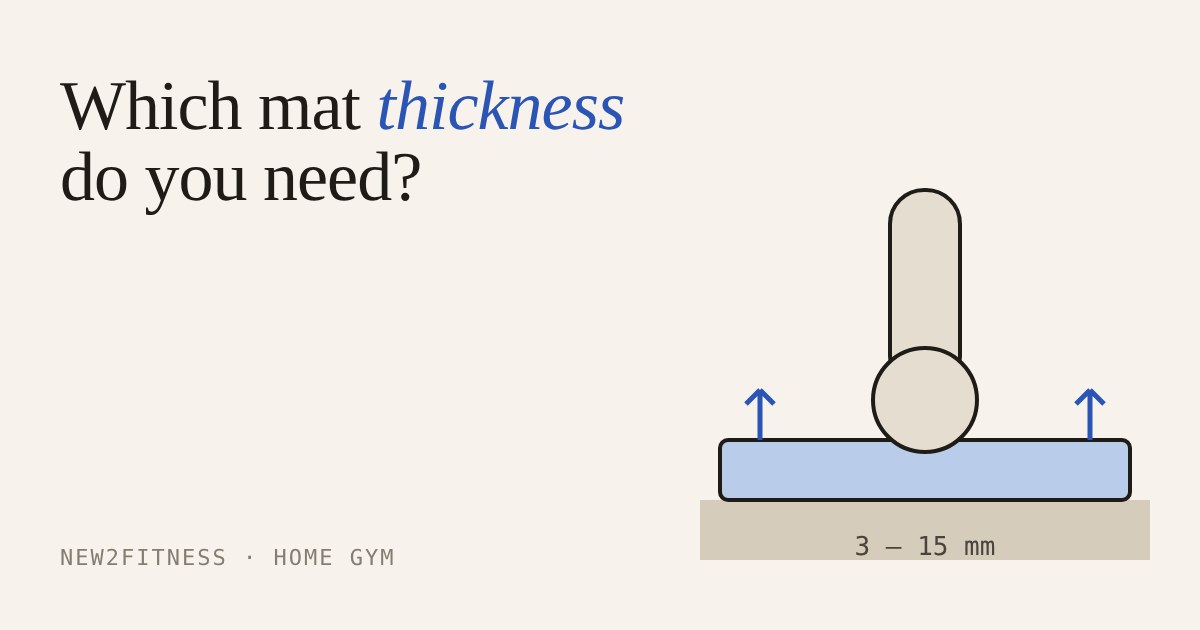
A mat looks like the simplest thing in a home gym, and it is. Still, the one number that matters, thickness, pulls in two directions: thicker is kinder to your knees and spine, thinner is steadier under your feet. The right answer depends on what you actually do on it.
Mats are sold by thickness in millimetres. Roughly: 1–3 mm is a travel mat that folds small, 4–6 mm is the standard yoga mat, and 10–15 mm is a thick floor-exercise mat. None of these is "better". Foam compresses under a hard part of your body, such as a knee, an elbow or the bones of your spine, so more foam spreads the pressure. But foam also squashes under your feet, which makes it wobble when you stand on one leg or hold a low lunge.
Try it below. Pick what you will mostly do, then slide the thickness and watch the two scores move. These are rules of thumb to build your intuition, not lab measurements.
Floor exercises such as planks, crunches and glute bridges put bony points on the ground: elbows, tailbone, spine. A mat in the 8–15 mm range saves those spots. Very thin mats on a hard floor are the usual reason people quit after a few days.
Standing work such as yoga flows, balance practice and stretching on your feet suits something thinner. At 4–6 mm your foot still feels the ground, so you can balance without the mat squashing sideways.
Kneeling work sits in between. If your knees complain on a standard mat, a folded second mat or a thicker one helps. If a knee hurts during an exercise even with padding, that is not a mat problem: stop and check with a doctor or physio.
If you do a bit of everything, a mat around 6–10 mm is a sensible start. Most beginners do not need to own two.
Under about €15: a basic mat of 6 mm or so is enough to get started. Check the length, and that the surface is not slick.
Around €15–25: this is where you find thicker foam, such as 10–15 mm, and sturdier material. It is the range to look at if you do a lot of floor work.
Above that: you are mostly paying for brand, natural materials or looks. A beginner rarely needs to spend more than this to get a mat that does the job.
Affiliate links, marked sponsored. We may earn a commission at no extra cost to you. Examples that match this guide, not tested reviews. Prices checked 13 Oct; every shop is on each product page.
A basic 6 mm mat for standing, stretching and light floor work. Fine for a first mat if you mostly stay on your feet.
6 mm thick · 180 x 60 cm · TPE
Same standard thickness in easy-to-wipe PVC, for a mix of yoga-style and floor exercises.
6 mm thick · 180 x 60 cm · PVC, printed top
Thick dense foam that spares elbows, knees and spine on planks and core work. Less steady for balance poses.
15 mm thick · 180 x 61 cm · NBR foam

