Getting Started · Tool · 3 min ·
Which workout split fits your week? Tap your days and see how often each muscle is trained
A workout split is just how you spread your training across the days you have. Tap the days you can train, pick a split, and see how many times each muscle group gets worked in a week.
Full body, upper/lower, push/pull/legs and one-muscle-per-day all behave differently, and the research suggests that when total weekly sets match, the exact split matters less than you'd think. Pick the number of days you can keep up, and let the figure show you the rest.
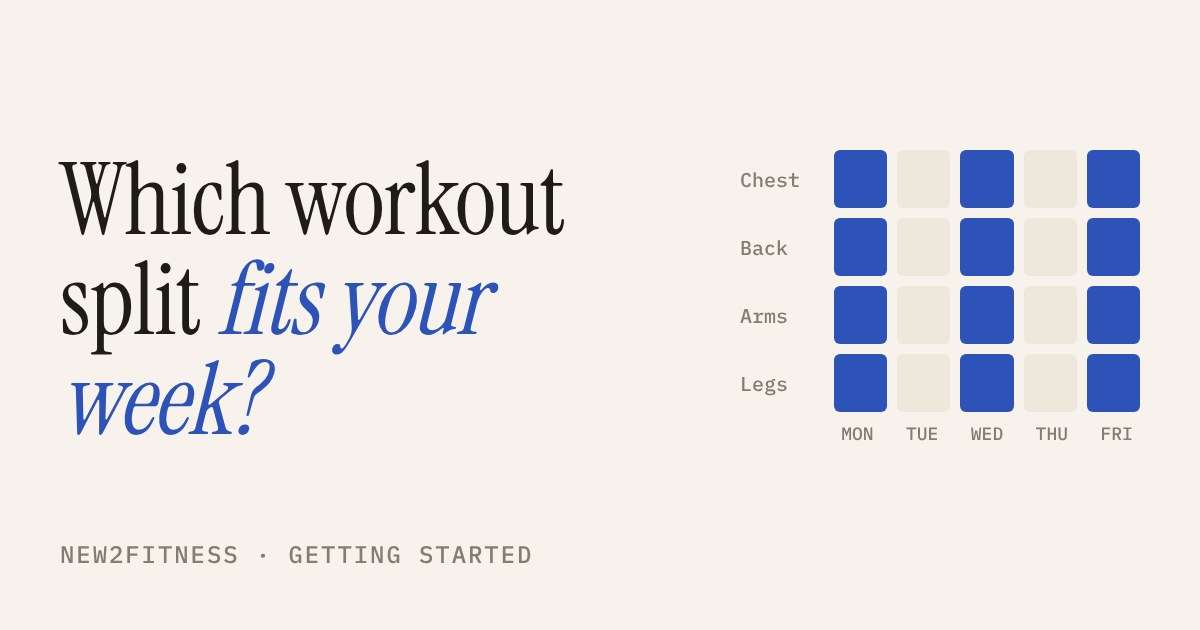
Which workout split fits your week?
A "split" is just how you divide your training across the days you have. You do everything every session, or you spread the muscles across different days. Names like "push/pull/legs" make it sound like a big decision. For a beginner it mostly comes down to one question: how many days can you realistically train, week after week?
Tap the days below, pick a split, and see how often each muscle group gets trained.
What the research says
The usual advice is to train each muscle at least twice a week. It's sensible, but the evidence for it is softer than gym folklore suggests. A review of the research by Schoenfeld, Grgic and Krieger concluded that when the total number of weekly sets is the same, how many days you spread them over has little notable effect on muscle gain.
So frequency is mostly a tool for fitting your sets into your life. Training a muscle twice or three times a week lets you split its weekly work into smaller chunks, so each session stays shorter and you stay fresher for the later sets. Training it once a week means doing all of that muscle's sets in a single visit, which gets long and tiring quickly.
Picking a split by days per week
This is a starting point, not a rule. Play with the figure above and you'll see the same pattern.
- 2–3 days: full body. Every session covers the whole body, so every muscle is trained two or three times a week. With three days, a day off between sessions (for example Monday, Wednesday, Friday) gives you time to recover.
- 4 days: upper / lower. Two upper sessions and two lower sessions, so every muscle gets two hits. This is the neatest fit for four days.
- 5–6 days: push / pull / legs, or upper / lower plus extra. Push/pull/legs over six days trains everything twice. Over five days the pattern drifts from week to week, so some muscles get two sessions one week and one the next.
- One muscle group per day: try it in the figure. Each muscle is trained once a week, which means long sessions for that muscle and a long gap before the next one. It's popular, but it's rarely the easiest way to start.
How to choose
Pick the number of days you can keep up for months, not the number that looks impressive. Three consistent days will beat six days you abandon after a month. If your week changes, a full-body split is forgiving: missing a session doesn't leave a muscle untouched for a week.
If you're returning after a break, start with fewer days than you think you need and add one later. And if you have pain, an injury, a heart or other health condition, or you're pregnant, check with a doctor or physio before choosing a plan; the figure above doesn't know about any of that.
What to do next
Start with the number of days you could still manage in your busiest week. Use full body for two or three days, upper/lower for four. Stay with that for a couple of months and judge it by whether you kept showing up, not by whether it looks clever on paper.