Nutrition · Tool · 4 min ·
How much fat do you need? Set your calories and see where protein, fat and carbs fit
Fat gets ignored or feared in training advice, yet your body needs some of it. How much fits alongside the protein and carbs you need?
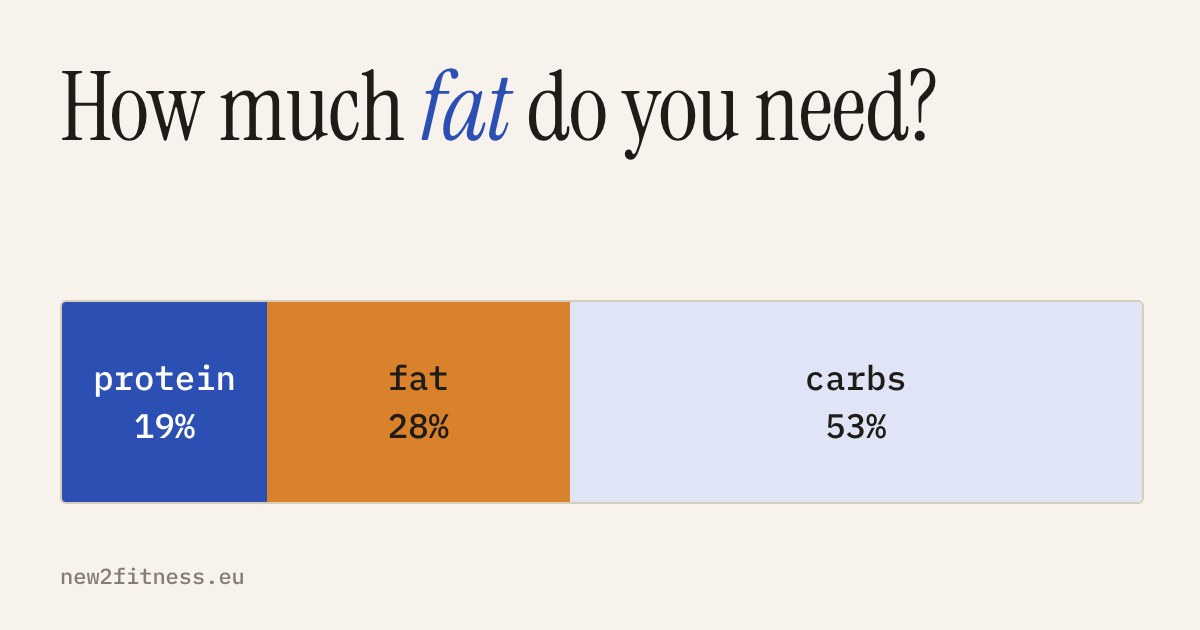
Enter your weight and calories, set protein per kg, then drag the fat share and watch grams of protein, fat and carbs change live. The usual adult range is 20–35% of energy from fat, and carbs fill the rest. Rough planning numbers in kg, with who it isn't for.
Fat is not the enemy, and it is not the main event
Most training advice talks about protein and carbs. Fat gets left out, or treated as something to cut. But fat does real jobs: your body uses it to absorb vitamins A, D, E and K, it is a building material for cell membranes and hormones, and it supplies two fatty acids, omega-3 and omega-6, that you can only get from food.
So the useful question is not "how little fat can I eat?" It is "how much fat leaves room for the protein and carbs my training needs?" The tool below answers that with your own numbers.
Where the numbers come from
Three ideas give you a sensible split, and none of them needs a spreadsheet.
- Calories per gram. Protein and carbohydrate each give about 4 kcal per gram. Fat gives about 9 kcal per gram, which is why a little fat adds up fast.
- Protein first. People who lift regularly tend to do well at around 1.6 g of protein per kg of body weight a day. That is a target for the whole day, not for one meal.
- Fat in a range. European and US health bodies both suggest that adults get about 20 to 35 percent of their energy from fat. Below that range it gets hard to cover the fats you need; above it, there is less room for carbs.
Carbs are what is left. That is not because carbs matter least. It is because protein and fat have clear targets and carbs flex to fill the rest of your calories, which is also how your harder sessions get fuelled.
Reading your result
Try the 20 percent and 35 percent buttons with the same calories. At the starting numbers (70 kg, 2,400 kcal), fat rises by about 40 g while carbs fall by about 90 g. That is the trade-off in one picture: fat has 9 kcal per gram and carbs have 4, so every gram of fat takes the calorie room of a little over two grams of carbs.
A worked example: at 70 kg and 1.6 g per kg, protein is about 112 g, or roughly 450 kcal. At 28 percent fat, 2,400 kcal gives about 75 g of fat. The remaining calories, around 1,280 kcal, become about 320 g of carbs. Change any one number and the others re-balance.
For most beginners, somewhere in the middle of the range is a calm place to start. Heavy fat cutting is not needed for training, and neither is a high-fat plan. If you train hard and often, leaning to the lower half of the range leaves more room for carbs. If you train lightly, a little more fat is fine.
What fat looks like on a plate
Grams of fat are hard to picture, so here are rough examples. Labels differ, so check yours.
| Food | Fat, roughly |
|---|---|
| 1 tablespoon of olive or rapeseed oil | about 14 g |
| A small handful of almonds (30 g) | about 15 g |
| 1 egg | about 5 g |
| Half an avocado | about 10–15 g |
The kind of fat matters too. Health bodies suggest limiting saturated and trans fats and favouring unsaturated ones, such as oils, nuts, seeds and fish. Fish also brings omega-3; about 250 mg a day of long-chain omega-3 is a commonly cited level for adults, which a portion or two of oily fish a week roughly covers.
Who this is not for
This is a planning aid for healthy adults. It is not for anyone under 18, pregnant or breastfeeding, or managing a condition such as diabetes, heart, kidney or liver disease, or with a history of disordered eating. For those, check with a doctor or registered dietitian first. If you are eating much less than your body needs, adding fat or protein targets on top is not the answer.
What to look for
- Start from protein. Set about 1.6 g per kg and see what is left.
- Keep fat inside the range. 20–35 percent of calories is a sensible, flexible window.
- Let carbs fill the rest. More hard training usually means you want more of them.
- Food first. Get fat from foods you enjoy before you reach for any supplement.