Strength · Explainer · 4 min ·
Do you have to go all the way down? Slide your range and see which part of the muscle you train
Do you have to take every rep all the way down and all the way up? Full range of motion is a safe default, but the research gap between full and partial reps is small. Early studies hint that the stretched part of a rep may matter most for muscle growth.
Drag the sliders to choose where each curl starts and stops, and see which part of the muscle's length you train, what you skip, and what the evidence says about each version.
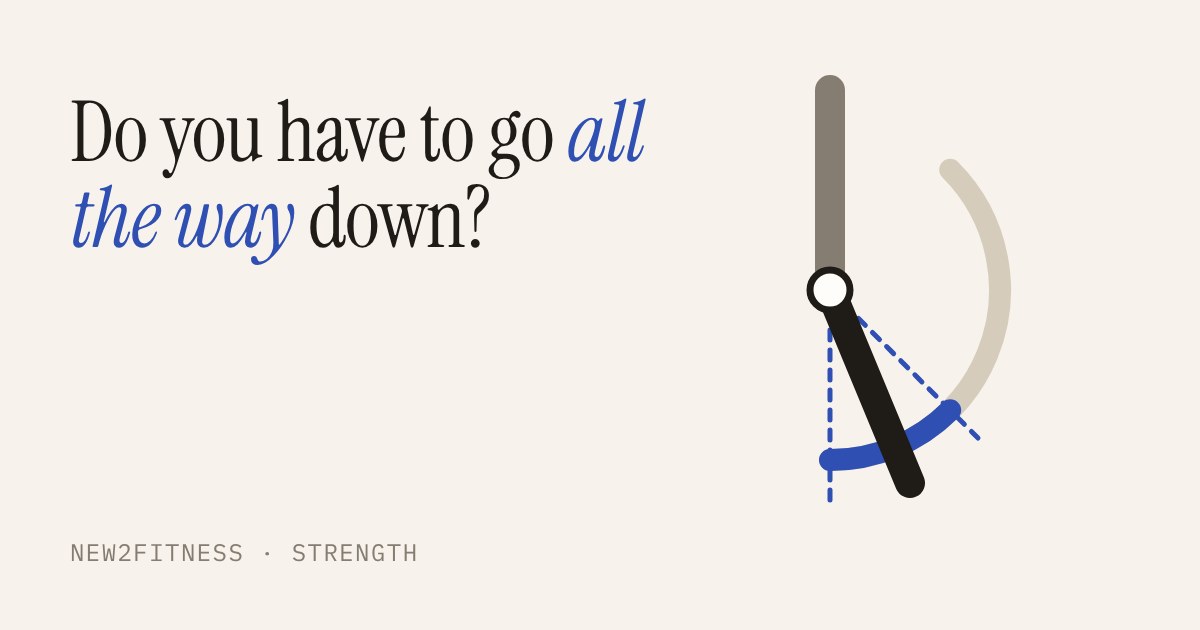
You have probably heard two opposite rules. One says every rep must go the full distance, down to the bottom and up to the top. The other says half reps are fine, or even better. Which one should a beginner follow?
Short version: full range is a safe default, but it is not magic. The research gap between full and partial reps is small, and the part of the range that matters most may be the stretched part, not the squeezed part. Drag the sliders below to see what each choice trains.
What "range of motion" means
Range of motion is the distance a joint travels during a rep. In a curl it is how far your elbow bends, from a straight arm to a fully bent one. In a squat it is how deep you go. Full range means the whole distance your body comfortably allows. It does not mean forcing a depth that hurts, and it looks a little different on every body.
A partial rep stops somewhere before the end. You can skip the bottom (the muscle is stretched), the top (the muscle is squeezed short) or both ends and only move through the middle.
What the research says
A 2023 systematic review and meta-analysis pooled studies that compared full and partial range of motion. On average, full range came out slightly ahead, but the difference was between trivial and small. In plain words: if you picked either one, you would grow and get stronger either way, and the full-range group was only a touch ahead.
The same analysis hinted at something more interesting. When it looked only at partial reps done in the stretched position, those looked as good as full reps for muscle growth, and possibly better. The uncertainty around that result was wide, though. It could also mean no difference at all, so treat it as a lead and not a rule.
One small study fits that picture. In an 8-week trial, 19 untrained women trained one arm with preacher curls through the first part of the range (the stretched part) and the other arm through the last part (the squeezed part). The stretched-range arm grew more at one measured site near the elbow, and its full-range strength rose more. Across both measured sites the growth difference was not significant, and it is one short study in one group, so it proves little by itself.
Why the stretched end might matter
The idea is that a muscle working hard while it is long gets an extra growth signal. Nobody has fully pinned down why, and it may differ from one muscle to the next. What you can take from it is practical: the bottom of a rep is not the part to cut short. A rep that stops well above the stretch is skipping the section that research most often finds useful.
There is also a plain reason to be careful with partials. Because you can usually lift more with a shorter range, it is easy to load the bar for ego and then only do the easy middle of the movement.
What to do with this
- Default to full range. Go as far as you can with control, in a range that feels fine for your joints. For a squat, that is the depth you can hit without your form falling apart, not a number someone told you.
- Control the bottom. Don't bounce out of the stretch. A pause of a second or so at the stretched position is a simple way to feel it.
- Use partials on purpose. A bit of variety, a plateau, or a joint that is cranky at one end are fair reasons. Doing them to lift more weight is not.
- Judge by effort, not by depth alone. A hard set that ends close to failure matters more than a few extra degrees.
Who this isn't for
If a joint hurts at one end of a movement, or you are coming back from an injury, the right range for you is whatever a doctor or physio says it is. This is a general guide and not medical advice. Pain that goes with a certain depth is a reason to ask, not to push through.