Strength · Explainer · 4 min ·
Should you hold your breath when you lift? Scrub a rep and see when to breathe and brace
Should you hold your breath when you lift? It depends on the set. This guide explains bracing in plain words: breathe in low, tighten your whole trunk, and keep it firm while you move the weight.
Scrub through one rep of a squat, deadlift, bench press or row, on a light set and a heavy one, and watch the air in your lungs and the tightness of your trunk change. You'll see when a short breath-hold helps, why it should last only for the hard part of the rep, and who should check with a doctor first.
You've probably heard two opposite rules: "never hold your breath" and "take a big breath and lock your core." Both are half right. What helps most is knowing which kind of set you're doing, because a warm-up set and a heavy set ask different things from your breathing.
What "bracing" actually means
Bracing is making your whole trunk firm at once, so your spine stays put while your arms and legs move the weight. You do it in two steps. First, breathe in low, so your belly and the sides of your lower ribs widen, rather than lifting your shoulders. Second, tighten the muscles all the way around your middle, the way you would if someone were about to give you a gentle poke in the stomach.
That is different from sucking your belly in. In one small lab study of eight healthy young men, bracing gave a more stable lower back than pulling the belly in. It was a small study, so treat it as a useful hint, not a law. In practice, most coaches teach bracing because it is simple to feel and easy to repeat.
Scrub a rep and watch the breath
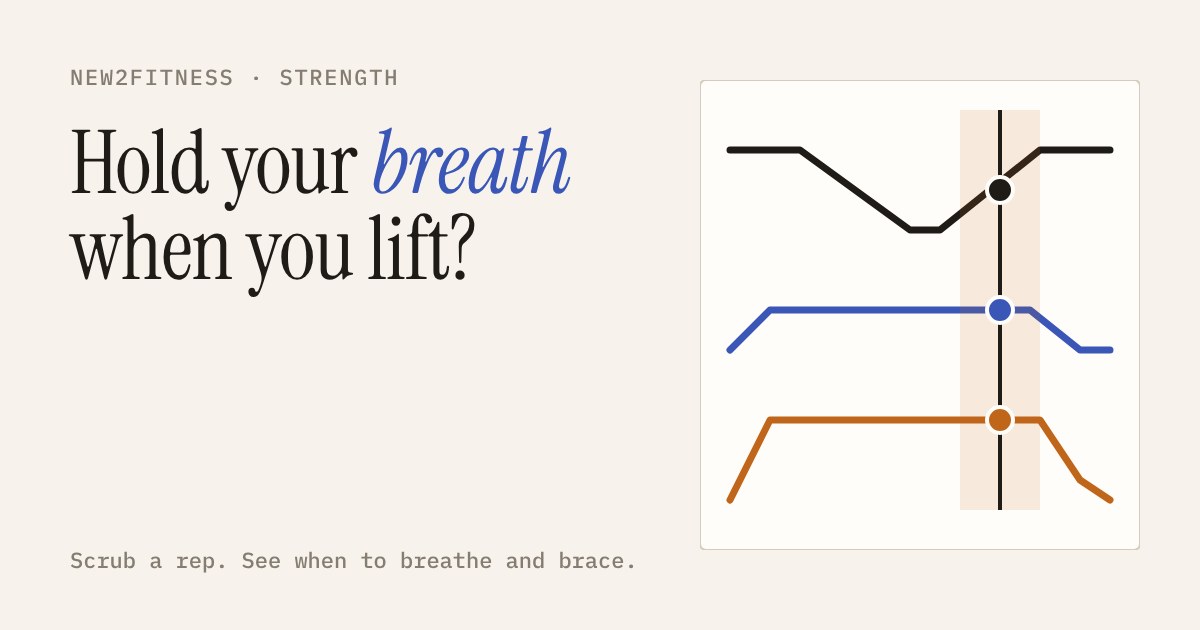
Pick a lift and a kind of set, then drag the slider through one rep. The three lines show where the weight is, how much air you hold, and how tight your trunk is.
How to feel it before you add weight
Stand up and put your hands on your sides, just above your hips, thumbs behind you. Breathe in so your hands are pushed outward, not just your chest forward. Now tighten as if you were about to cough, and keep breathing in small sips. That firm, wide feeling is the brace. Practise it with an empty bar or your bodyweight until you can find it without thinking.
Three mistakes show up again and again. Lifting your shoulders to breathe in, which fills your upper chest but leaves your middle soft. Sucking your belly in, which feels tight but is not the same as bracing. And bracing once, then losing it halfway through the set. If the brace slips on your last reps, the weight is probably heavier than your technique can handle today, so drop it a little next time.
Do you have to hold your breath?
No. On light and moderate sets, just breathe: out as you work against the weight, in as you return. Holding your breath only earns its place when the load is close to your limit, because the air you hold, plus a tight trunk, makes your middle stiffer. Even then, the hold is short. You breathe in, brace, get through the hardest part, and breathe out.
It isn't free. Holding your breath while you strain raises your blood pressure for those few seconds. A systematic review of studies on this found the pressure inside the belly was highest in heavy squats (over 200 mmHg) and lowest in the bench press (about 79 mmHg), with deadlifts and leg presses in between. The authors suggested that people new to lifting hold off on very heavy squats and deadlifts until they have adapted. That is one more reason a beginner doesn't need to rush the weight up.
A simple rule for your first months
- Most sets: breathe steadily, out on the effort. Keep a light, firm trunk.
- Heavy sets: breathe in low, brace, lift, and let the air out once you are past the hardest part. Then reset with a fresh breath for each rep. Never hold across a whole set.
- Rows and similar lifts: your trunk holds your position the whole time, but your breathing can keep its rhythm.
- Dizzy, a headache, or chest pain: put the weight down safely and stop for the day.
Who this isn't for
This is general information, not medical advice. If you have high blood pressure, a heart condition, a hernia, are pregnant, have had recent surgery, or have back pain, check with your doctor or physio before you do heavy lifts or hold your breath. Common advice for people in those groups is to breathe out through the effort rather than hold. Ask which pattern suits you.
If you're unsure, start light. Learning to brace with a weight you could lift ten times is a better way to practise than learning it under a weight you can barely move.