Cardio · Explainer · 4 min ·
How easy is easy cardio? Slide your effort and use the talk test to find zone 2
Zone 2 is the easy cardio pace you hear about everywhere, but nobody tells beginners what it feels like. Slide the effort from 1 to 10 and see what you can say out loud, how your breathing changes, and a rough heart-rate range for your age.
The talk test is a free, built-in meter. If you can speak in full sentences, you are almost certainly in easy territory. We also cover why heart-rate numbers are only a second opinion, and how much of a week should be easy.
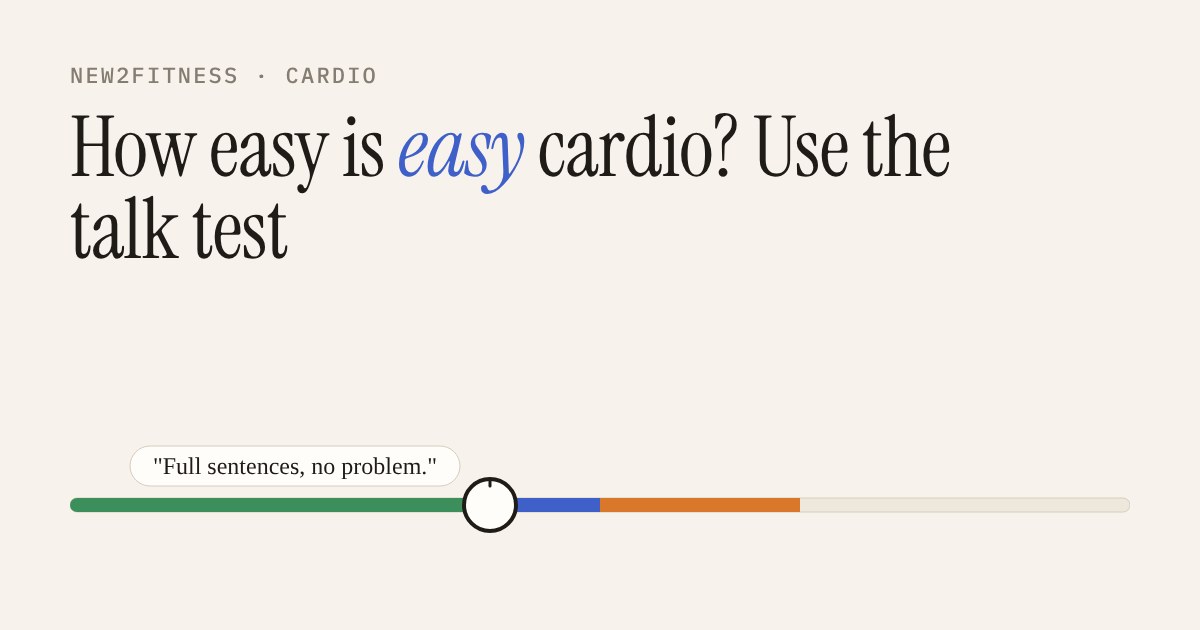
You will hear that most of your cardio should feel "easy", and that this is called zone 2. The idea is simple. The hard part is knowing what easy actually means when you are new, because many beginners go too fast on their gentle days and too slowly on nothing at all. The good news is that you already own a free, built-in meter: your ability to talk.
What "zone 2" means
Heart-rate zones are slices of effort, usually numbered 1 to 5 from very light to all-out. Zone 2 is the easy-but-not-trivial slice: a pace you could keep up for a long time, breathing steadily, finishing the session feeling like you could have done more. Different sources draw the exact edges differently, so treat the number as a label for a feeling rather than a precise line.
Behind the label is a physiological landmark called the first ventilatory threshold. Below it, your breathing rises in step with your effort. Just above it, breathing starts to climb faster than the effort does, and talking gets harder. Easy training lives just under that point.
Why the talk test works
In a small study of 28 healthy volunteers, people who could still talk comfortably during an exercise test were at or below their ventilatory threshold, while those who clearly could not were above it. That is a small sample, so it is not a guarantee for every person, but it matches what coaches see: if you can speak in full sentences, you are almost certainly in easy territory.
The test is simple. While moving, say a sentence out loud, such as what you had for breakfast. If you can say it in one go without gasping, you pass. If you need to break it up, you are on the edge. If you can only manage a word or two, you are well above it.
What to do with this
Pick an activity you can do steadily, such as brisk walking, jogging, cycling or swimming. Start the session slowly and check in with the talk test a few minutes in. If you cannot speak a full sentence, slow down, even if that means walking. This is normal for many new runners: the pace that feels easy can be slower than you expected, and it will speed up over the weeks as your fitness builds.
Heart rate is a helpful second opinion, not the boss. It drifts up with heat, poor sleep, caffeine, hills and stress, and the age-based maximum is only an average. If your watch says one thing and your breathing says another, believe your breathing.
How much of your week should be easy?
Studies of elite endurance athletes found that roughly four in five of their sessions were easy, with a smaller share of hard work on top. That is an observation of what very experienced athletes do, not a rule written for beginners. But it points at something useful for newcomers too: easy sessions let you train more often and recover well enough to show up again.
A simple starting shape is two or three easy sessions a week, and, once those feel comfortable, at most one session with some harder efforts. If you are new to exercise, begin with the easy ones only.
Who this is not for
The talk test is a guide for healthy adults. If you have a heart condition, take medication that affects your heart rate, are pregnant, or get chest pain, unusual breathlessness or dizziness during exercise, check with your doctor before setting intensity targets, and stop and seek medical advice if symptoms appear.