Recovery · Tool · 4 min ·
How many rest days do you need each week? Plan your lifting week and see the gaps
Do you have to train every day to see results? No. The training is the signal, and your body adapts while you rest. The WHO suggests strength work on two or more days a week, and research on frequency found about twice a week per muscle group works well.
Tap the days you would lift, choose a full-body or upper/lower split, and see how often each half of your body is worked and how much rest it gets between sessions. General information for healthy adults, not medical advice.
"Do I have to train every day to see results?" No. For a beginner the opposite is closer to the truth: the work you do in the gym is only the signal, and your body does the building while you rest. The real question is how many rest days a week you need, and the answer depends on how you arrange your sessions.
Why rest days are part of the plan
A hard session gives your muscles a reason to adapt. The adapting happens afterwards, while you eat, sleep and do very little. Studies that measured muscle building after weight training found it stays raised for roughly a day or two, a bit longer in people new to lifting. That is why a common beginner pattern leaves at least one day between sessions that work the same muscles.
It is also why more is not automatically better. If you train the same muscles again before you have recovered, you start the session tired, lift less and enjoy it less. For a first-year lifter, three well-spaced sessions usually beat six rushed ones.
What the guidelines and research say
The World Health Organization suggests adults do muscle-strengthening activity on two or more days a week, on top of their aerobic activity. A 2016 meta-analysis of studies on training frequency found that working each muscle group about twice a week gave better muscle growth than once a week when the total amount of work was matched. Nothing in that research says you must train a muscle three, four or five times.
So a sensible starting range is two to three strength sessions a week, which leaves four or five days with no lifting. Those are not wasted days: a walk, an easy bike ride or a stretch on a rest day is fine. "Rest" here means no hard session.
Plan your week and see the gaps
Tap the days you would lift, pick how you split your sessions, and see how many times each half of your body gets worked and how much rest it gets in between. The week wraps around, so Sunday sits next to Monday.
Three weeks that work
Two days (Mon, Thu): two full-body sessions. Simple, and every muscle is hit twice with plenty of rest. Good if your week is busy.
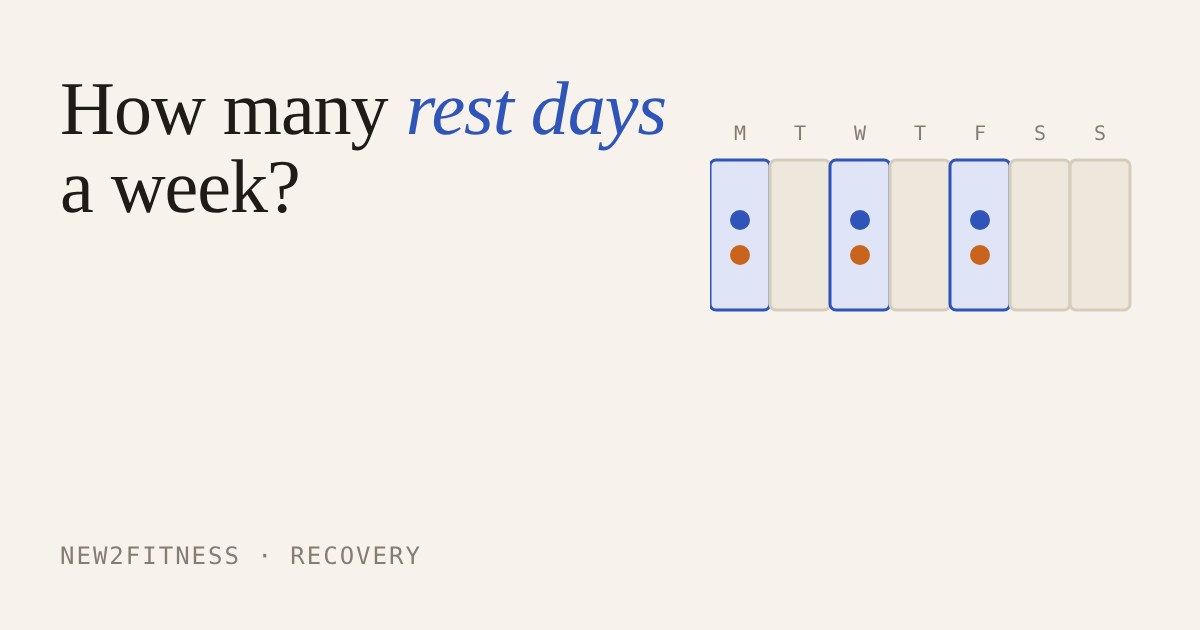
Three days (Mon, Wed, Fri): three full-body sessions with a rest day between each, then a two-day weekend break. The classic beginner layout.
Four days (Mon, Tue, Thu, Fri): upper on Monday and Thursday, lower on Tuesday and Friday. Each half of your body trains twice, and the days it rests are the days the other half works. Try the planner above with that setup.
How do you know you need more rest?
Some soreness after a new session is normal and fades in a few days. Signs that you are asking too much include weights that feel heavier than last week for several sessions in a row, sleep that gets worse, a mood that is flatter than usual or no wish to train at all. In that case take an extra rest day or make the next session lighter. If you have pain that is sharp, lasts for days or comes with swelling, or you have a medical condition, check with a doctor or physiotherapist before you carry on.
What to do on a rest day
Move gently if you like: a walk, an easy bike ride, some light stretching. Eat enough protein and sleep as well as you can. You do not need to "earn" a rest day, and taking one is not skipping a workout. It is the part of the workout where the change actually happens.
This guide is general information for healthy adults, not medical advice.