Wearables · Explainer · 4 min ·
Is the VO2 max on your watch accurate? Slide the error and see what the trend still tells you
Your watch gives you a VO2 max number, but it is a guess from your heart rate and pace, not a lab measurement. Two small studies of the Apple Watch found typical errors of around 13 to 16 percent, and the watch tended to read low.
Slide the controls to see how a wrong number can still show a real trend, and how to use it without being fooled.
What your watch's VO2 max number actually is
VO2 max is the most oxygen your body can use per minute, divided by your body weight, so it is written in millilitres per kilo per minute (mL/kg/min). It is a common way to describe aerobic fitness. In a lab it is measured by breathing into a mask while a test gets harder until you can't continue.
Your watch doesn't do that. It estimates the number from things it can see: your heart rate and how fast you were moving, usually during an outdoor walk or run. A faster pace at a lower heart rate points to a higher fitness. That is a sensible idea, and it is also a guess built on assumptions about how your heart rate behaves.
How far off can it be?
Two small studies on the Apple Watch, each testing around 20 to 30 adults against a lab test, give a rough idea. One found the watch read about 4.5 mL/kg/min too low on average, with a typical error of about 16%. The other found about 6 mL/kg/min too low and a typical error of about 13%. Both are small samples, and other brands use different methods, so treat these as a warning sign rather than a verdict on every watch.
Two details matter more than the averages. First, the error was not the same for everyone: in the first study the watch read high for the least fit people and low for the fittest. Second, the error between individuals was wide. Some people were within a point or two, others were off by ten or more.
So a watch that says 42 could reasonably mean a real value anywhere from the mid-30s to the high 40s. That is the gap between "average" and "good" on most fitness charts.
Try it: a wrong number can still show a real trend
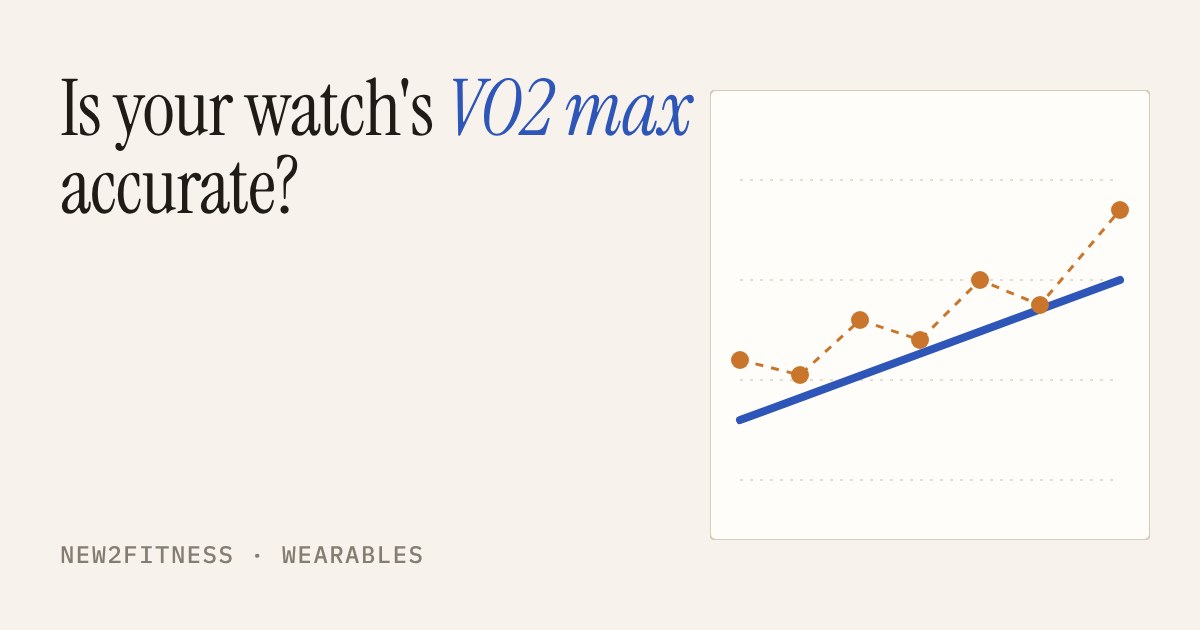
If a watch is consistently off by the same amount, the single number is wrong but the direction over time can still be right. That is the useful question for a beginner: is it going up as I train? Set up a pretend person below. Change how fit they really are, how much they improve over twelve weeks, how far off the watch is, and how much its readings wobble from week to week.
How to use the number without being fooled by it
Treat the figure as a rough label, not a measurement. Compare it with your own past readings from the same watch, in similar conditions, rather than with your friend's watch or a chart. If your number rises over two or three months while your runs or walks get easier, that agrees with what you are feeling. If it dips for a week, that is within the wobble.
A few things can plausibly push the estimate around without your fitness changing: heat, a hilly route, poor sleep, caffeine, a strap worn too loose so the heart rate is read badly, and a wrong maximum heart rate or weight in your profile. Check your profile details first, because your weight goes straight into the maths.
Don't use it to decide how hard to train, and don't treat a low number as a verdict on your health. If you are worried about your fitness, a breathlessness that feels out of proportion, chest pain or dizziness, talk to a doctor. A watch can't tell you anything about that.
Who this is not for
The chart above is a teaching toy. It doesn't apply if you have a heart condition, take medication that changes your heart rate, or are pregnant: heart-rate based estimates are less reliable in those cases, and your doctor is the right person to ask what intensity is safe.
What to buy, if anything
Nothing, for this one. If you already have a watch that gives a VO2 max, use it as a trend line. If you are choosing a watch, a VO2 max estimate is a nice extra rather than a reason to spend more; look at how well it tracks heart rate and whether you will actually wear it.