Mobility · Explainer · 5 min ·
Can you get your arms overhead? Move the sliders and see where it comes from
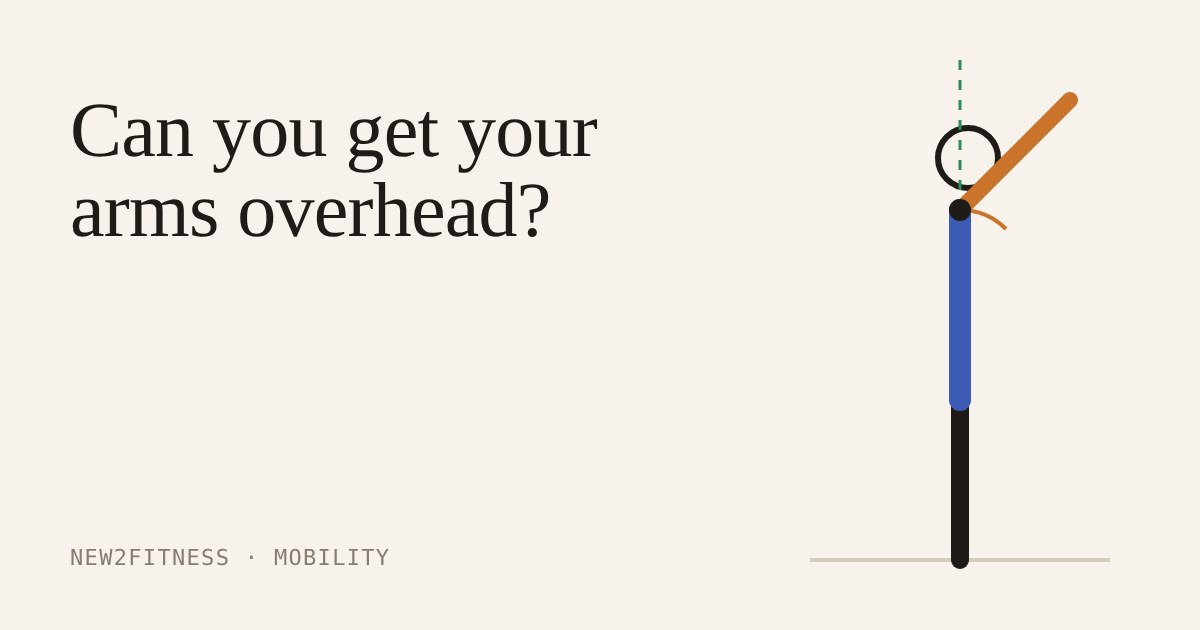
Raising your arm overhead is three movements at once: the upper arm turns in its socket, the shoulder blade rotates upward, and the upper back straightens a little.
Move the sliders on a simple side-view model to see how each part adds up to a full reach, and how arching the lower back can make a stuck shoulder look fine. Then try a quick wall check and learn what gentle practice helps, and when to see a doctor or physio.
Raising your arm is a team effort
Lift your arm straight up beside your ear and it feels like one movement. It is really three things happening at once: the ball of your upper arm turns in its socket, your shoulder blade glides and tilts upward across your ribs, and your upper back straightens a little. Add them up and many healthy adults end with the arm pointing roughly 170–180° from where it hung, which is straight overhead.
Physiotherapy textbooks describe the shoulder joint and the shoulder blade sharing the job at roughly two to one after the first few degrees, so for every 2° the arm turns in the socket, the blade rotates about 1°. Exact numbers vary from person to person, so treat the figures below as a cartoon model, not a measurement of you.
Where a stuck overhead reach usually hides
If your arm will not go all the way up, the shoulder joint itself is only one suspect. A rounded, stiff upper back can stop the ribcage from tilting back, and a shoulder blade that does not turn upward can run out of room. Short, tight muscles around the chest and the sides of the ribcage can limit both. Try the "Stiff upper back" example above and notice that a small shortfall in each part adds up to an arm that stops well before straight up.
Many people hide the gap without noticing. They arch the lower back, ribs flaring forward, and the arm appears to reach the ceiling. The "Arching to cheat" example shows it: the arm points up, yet the shoulder only got most of the way there. In a lift such as an overhead press, that arch moves the load onto your lower back instead of your shoulders.
A quick wall check you can do
Stand with your back, head and bottom against a wall and your feet a short step away, ribs gently pulled down so your lower back is not arching far off the wall. Slowly raise both arms forward and up, thumbs pointing back, and see how far they get before the lower back leaves the wall or your elbows bend. This is a rough check for your own interest, not a test with a pass mark. Both sides can differ, and that is common.
What helps, gently
Two habits tend to be useful over a few weeks. First, practise raising the arm with the ribs down: stand tall, keep the lower back flat, lift slowly and stop where the movement is smooth. Second, give the upper back some attention with easy extension work, such as lying over a rolled towel placed across the mid-back, or reaching overhead while breathing out and letting the ribs drop. Short, comfortable sessions most days beat one hard stretch a week.
- Use the pain rule. A stretching or pulling feeling is fine. Sharp pain, a pinch at the top of the shoulder, tingling or weakness is a reason to stop.
- Get checked when it matters. If you have shoulder pain, a past dislocation or injury, numbness, or you are pregnant or recovering from surgery, talk to a doctor or physiotherapist before working on it.
- The model is not a diagnosis. It cannot tell you what is limiting you, and it is not meant for anyone with a shoulder condition.
Why it matters in the gym
Overhead positions show up more often than most beginners expect: a shoulder press, a pull-up or lat pulldown, a kettlebell snatch, reaching a high shelf. If the shoulder, shoulder blade and upper back share the movement well, the load stays where you want it. If one part is stuck, another part pays for it, and for pressing that is usually the lower back or the front of the shoulder. That is why a smooth, ribs-down reach is a better thing to aim for than a dramatic one.
It also explains why strength and mobility are not opposites. Lifting through a comfortable range with control, such as light overhead presses or hangs, is a perfectly good way to build range over time, because the muscles learn to own the new position. Start with a weight you could lift for many more reps than you do, and let the range come first.
Small signs to notice
You do not need to measure anything to learn from your own body. Watch a side-on video of yourself raising an arm, or ask a friend. Notice whether the ribs flare out, whether the head pokes forward, or whether the shoulder hikes up toward the ear before the arm is even halfway. Each is a clue about which part of the team is sitting out, and each can usually be improved with slow practice rather than force.
Do you need a full overhead reach?
If you want to press weights overhead, hang from a bar or paint a ceiling, a comfortable arm position near your ear is useful. If you cannot get there yet, you can still train: landmine presses, incline presses and other variations let you load the shoulders while you work on the movement. Progress comes from small, regular practice and not from forcing a position.