Mobility · Explainer · 4 min ·
Do you need to get up every 30 minutes? Plan your workday and see your longest sit
Stand up every 30 minutes: it sounds like a law, but it comes from a few studies with real limits. A lab trial found 2-minute walks every 20 minutes lowered blood sugar after a meal, and a large tracker study linked shorter sitting stretches with lower risk, but no one has found the perfect interval.
Set your workday length, break interval, break length and one meeting you can't leave, and see your longest unbroken sit. Not medical advice.
You have probably seen the advice: stand up every 30 minutes. It is repeated so often that it sounds like a law of nature. It is not. It is a sensible rule of thumb built on a handful of studies, and it helps to know what those studies actually showed, because that tells you how strict you need to be.
What the research does and doesn't say
A well-known lab trial from Australia (Dunstan and colleagues, 2012) had 19 overweight or obese adults aged 45 to 65 sit for several hours after a sugary, fatty drink. On one day they sat without a break. On other days they stood up for 2 minutes of walking every 20 minutes, at a light or a moderate pace. Both walking days produced clearly smaller blood sugar and insulin rises afterwards: roughly a quarter lower for glucose and a bit under a quarter lower for insulin.
A much larger study (Diaz and colleagues, 2017) followed nearly 8,000 US adults aged 45 and over who wore activity trackers for a week, then tracked deaths until 2015. People whose inactive time came in shorter stretches had the lowest risk, and the authors suggested breaking up sitting at least every 30 minutes. That is where the 30-minute rule comes from.
Now the limits. The lab trial was one day, in a small group, measuring blood markers rather than how people feel or live. The big study is an association: the trackers could not tell sitting from standing still, and it cannot show that breaks cause the lower risk. A later review of seven short trials found that walking breaks lowered glucose and insulin more than standing breaks did, but it could not say whether one schedule beat another. And the World Health Organization's 2020 guidelines say simply to limit sedentary time and replace it with movement of any intensity; they give no number for breaks.
So the honest summary is: breaking up long sits looks worthwhile, walking looks better than just standing, and nobody can tell you the perfect interval. Every 30 minutes or so is the usual rule of thumb; if that is not realistic for your job, every 45 to 60 minutes is still better than never.
Plan your workday
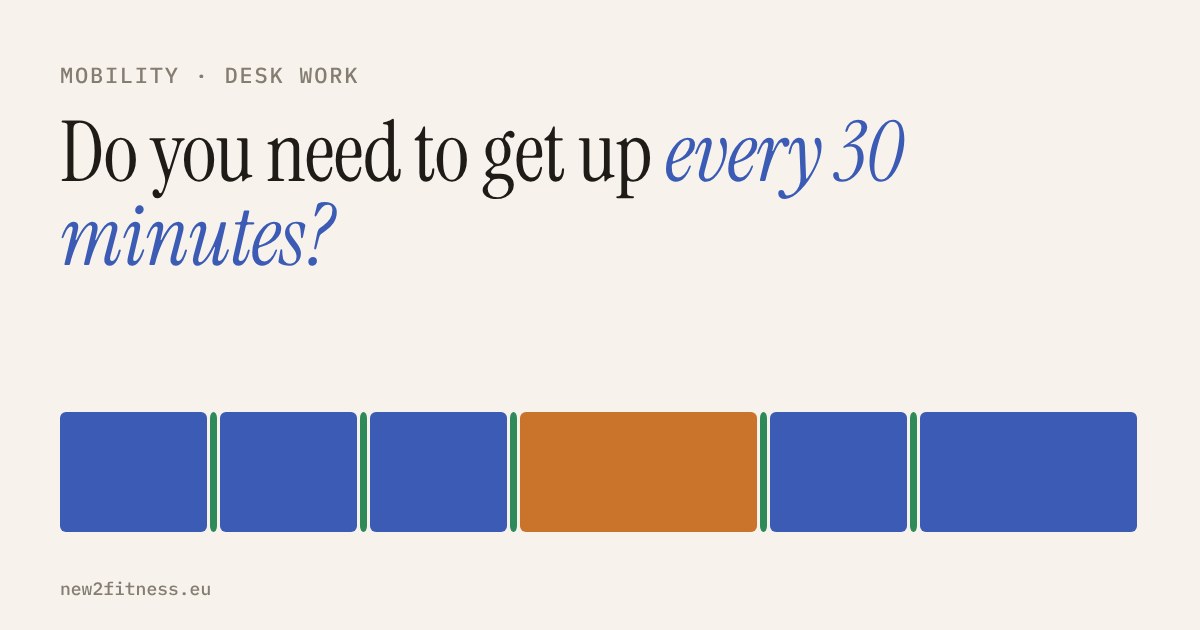
Set your day below. The bar shows every stretch of sitting; blue is a stretch of 30 minutes or less, amber is longer. The meeting slider adds one block you cannot leave, because real days have those.
What to do in a break
The trials used walking, so walking is the safest bet: to the kitchen, up a flight of stairs, around the block if you can. Light walking was enough in the lab trial; it did not have to be brisk. If you cannot walk, standing and moving still counts as a break from sitting, though in the review it did less for blood sugar than walking did.
Breaks are not a replacement for training. The World Health Organization still recommends 150 to 300 minutes of moderate activity a week plus muscle-strengthening on at least two days, and says people who sit a lot can offset some of the harm by doing more than that. Think of breaks as the thing that fills the rest of your waking day.
Making it stick
- Tie it to something you already do. Refill your water each time you finish an email batch, or stand for every phone call.
- Use a timer you cannot ignore. A phone alarm or a watch reminder every 30 to 45 minutes beats good intentions.
- Do not chase perfection. The research does not say 31 minutes is harmful and 29 is safe. A day with a few long sits and a few walks is still far better than one without.
- Take the pain seriously. If sitting makes your back, hip or neck hurt, or movement brings on pain, dizziness or breathlessness, see a doctor or physio rather than working through it.
Not medical advice. This guide is for general fitness and does not replace a professional's view of your own health.